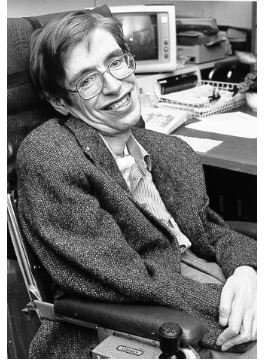
Stephen Hawking, Lucasian Professor of Mathematics, is famous for a number of scientific theories and commercial publications. His most famous book, “A Brief History of Time,” brought the concept of black holes and the Big Bang to the general public.
Stephen W. Hawking is a theoretical physicist based at the University of Cambridge. He holds the coveted Lucasian Professor of Mathematics chair at the university. Hawking is also a Fellow of Gonville and Caius College and holds the research chair at Waterloo’s Perimeter Institute for Theoretical Physics.
His research has been distinguished in the fields of cosmology and quantum gravity, with a strong focus on black holes . In terms of popular culture, he has written a number of works and produced a television series, Stephen Hawking’s Universe.
Facts About Stephen W. Hawking
Birth: January 8, 1942
Birth Place: Oxford, England
Religion: Agnostic
Field: Applied Mathematics, Theoretical Physics
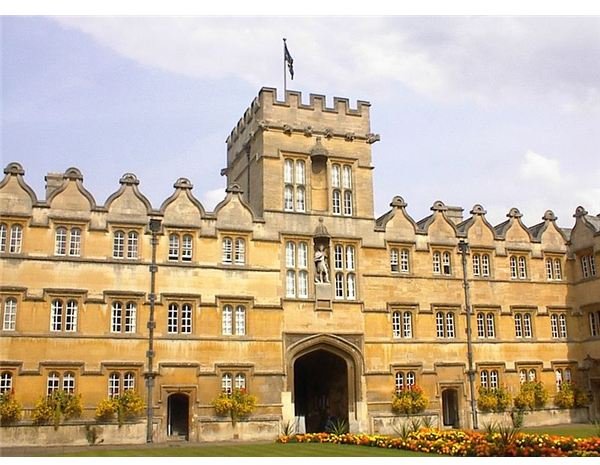
Schooling: University of Oxford, University of Cambridge
Key Achievements: Black Holes, Theoretical Cosmology, Quantum Gravity
Notable Honors: Eddington Medal (1975), Hughes Medal of the Royal Society (1976), Albert Einstein Medal (1979), Order of the British Empire (1982), Gold Medal of the Royal Astronomical Society (1985), Member of the Pontifical Academy of Sciences (1986), Wolf Prize in Physics (1988), Prince of Asturias Award (1989), Companion of Honour (1989), Julius Edgar Lilienfeld Prize of the American Physical Society (1999), Michelson Morley Award of Case Western Reserve University (2003), Copley Medal of the Royal Society (2006), 12 Honorary Degrees, Member of the U.S. National Academy of Sciences. Cosmos Award from the Planetary Society (2010)
Notable Achievements in the Field of Astronomy and Physics
-
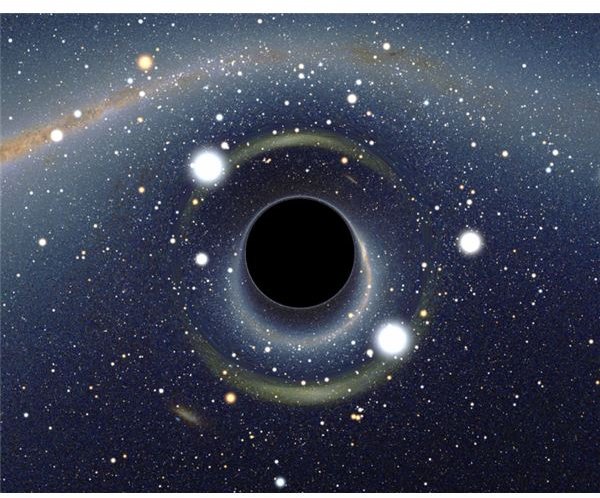
In 1970, Hawking was able to show that black holes give off radiation.
Advertisement -
Working with Roger Penrose, Hawking was able to create a number of new mathematical concepts to study Einstein ’s theory of general relativity in relation to cosmology.
-
Postulating that the Big Bang began the universe and Black Holes would ultimately be the end, Hawking and Penrose determined that the theory of General Relativity and Quantum Theory needed to be combined.
Advertisement -
In 1983, he worked with James Hartle on the “No Boundary Proposal”. This stated that both time and space have no boundaries, therefore the laws of science exist everywhere.
-
His greatest work, A Brief History of Time was published in 1988. The book stayed on the best-seller list for 237 weeks and sold nine million copies. It has also been translated into 33 languages.
Advertisement
Amazing Facts
In July 2004, Hawking lost a long-time bet with Kip Thorne from CalTech. Originally, Hawking postulated that no information can cross the event horizon of a black hole. However, at the 17th International Conference on General Relativity and Gravitation in Dublin, Ireland, he announced that he believed black holes will eventually transmit information about the matter that is swallowed.
In preparation for his 2009 sub-orbital spaceflight on Virgin Galactic’s SpaceShipOne, Hawking flew on the Zero Gravity Corporation’s “Vomit Comet” on April 26, 2007. This made Hawking the first quadriplegic to float in zero gravity.
Stephen Hawking has also been canonized in two popular science fiction programs, Star Trek: The Next Generation and Red Dwarf as well as a guest appearance on Late Night with Conan O’Brien.
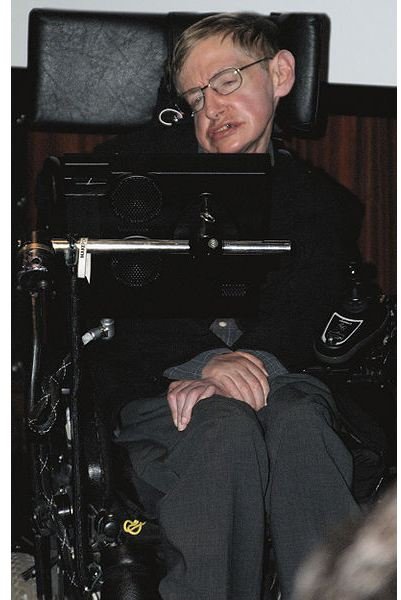
With all of his professional success, perhaps Stephen Hawking’s greatest achievement is his overcoming extensive medical problems. While in his last year of college, he began to lose motor control of his body. In 1963, he was diagnosed with amyotrophic lateral sclerosis, also known as Lou Gehrig’s Disease. Hawking’s condition continued to deteriorate until he was confined to a wheelchair.
While at the Geneva CERN particle accelerator in 1985, Hawking was again afflicted with another illness. He fell ill with pneumonia and was placed on life support. After being flown to Cambridge, he was sent to Addenbrooke’s Hospital, which performed a tracheotomy. This save his life, however left him without a voice. This is how he was forced to use the famous computer system which gives him an electronic voice.
On April 20, 2009, Hawking was hospitalized for a chest infection. He was again admitted to Addenbrooke’s Hospital and made a full recovery. This event, combined with the rigors of aging, prompted Hawking to make a decision to step down as the Lucasian Professor of Mathematics at the University of Cambridge.
Additional Resources
Reference
Professor Stephen Hawking, https://www.hawking.org.uk/
Image Credits
Stephen Hawking. (Supplied by NASA; Public Domain; https://upload.wikimedia.org/wikipedia/commons/e/eb/Stephen _Hawking.StarChild.jpg)
University of Oxford. (Supplied by Manvyi at Wikimedia Commons; Public Domain; https://upload.wikimedia.org/wikipedia/commons/2/2c/University _College_Oxford.jpg)
Black Hole. (Supplied by Alainr at Wikimedia Commons; Creative Commons Attribution ShareAlike 2.5 License; https://upload.wikimedia.org/wikipedia/commons/5/5e/BH _LMC.png)
Stephen Hawking in France. (Supplied by Qz10 at Wikimedia Commons; Public Domain; https://upload.wikimedia.org/wikipedia/commons/3/31/Stephen _Hawking_050506.jpg)
This post is part of the series: Famous Astronomers
There are a number of famous astronomers from history. People ask “what is Neil Degrasse Tyson doing today?” or “when did Galileo discover Jupiter?” While becoming an astronomer can be a challenge, the accomplishments of Edmund Halley and the IQ of Stephen Hawking are important.