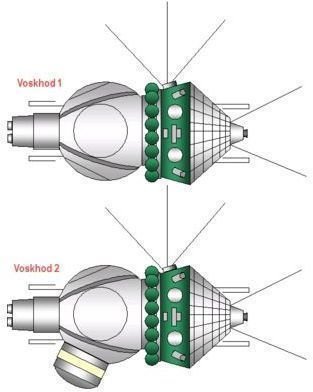
The program “Voskhod” was intended to test and study the aspects of crew interaction in flight and the possibility of spacewalk. Both were achieved in mid-1960. In addition, many scientific and technical experiments were carried out – mainly medical and biological research. Read more below.
Replacing Vostok
The second phase of Soviet space program is called “Voskhod” – sunrise. After several successful launches of “Vostok” spacecrafts, it was time to move forward in the quest of exploring space. “Voskhod” was the name of a new spacecraft series designed for flights on a circumterraneous orbit. Those spacecraft resembled the “Vostok” space vehicles in many ways, but were designed to carry multiple cosmonauts (Russian term for astronaut).
Spacecraft design
To achieve that and place three cosmonauts in the same volume that previously contained only one person, developers had omitted the ejection seat, which application in the “Vostok” enabled the cosmonaut to leave the ship at certain point during the landing and landed with a parachute.
Besides that, to save place, cosmonauts were intended to be without space suits during the flight. Also, as the crew had to land inside the spacecraft, a new decent module was designed – it included a breaking system that would fire a solid-fueled rocket once the spacecraft neared the ground to make the landing softer and smoother.
Voskhod Spacecrafts
Voskhod 1 crew selection
In spite of the fact that this flight was considered much more dangerous than previous ones, many people were anxious to be included in the crew. Korolev decided he wanted Constantin Feokistov, the designer of the landing module, to be included in the crew – however, the nomination was approved only after severe discussion. The crew of 3 also included commander Vladimir Komarov and doctor Boris Egorov.
Voskhod 2 - first EVA
The Voskhod-2 mission was even more spectacular. Launched on March 18th, 1965, the ship carried only 2 astronauts – Commander Pavel Belyaev and a pilot Alexei Leonov. During the second orbit of Earth, Leonov performed the first ever EVA – Extra Vehicular Activity, becoming the first person to walk in space. Leonov was in outer space for over 10 minutes (12 minutes and 9 seconds), with two TV cameras transmitting his every move to Earth. Even though this was a great achievement, the flight had many problems. On his return to the vehicle, Leonov space suit had expanded and did not allow his re-entry to the vehicle. He had to lower the pressure inside the suit to fit through the hatch. Also, the automatically programmed landing did not work, and the craft was landed on manual controls – missing the intended landing point by several kilometers. For over 50 hours the astronauts remained inside the landed spacecraft, waiting for the rescue teams.
Voskhod Spacecraft
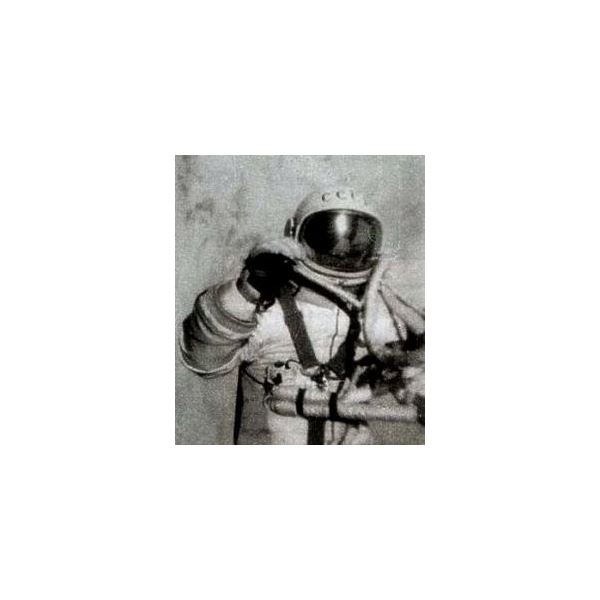
Leonov Spacewalk
Those failures, among other discovered problems, lead to canceling the next planned Voskhod manned flight, which was intended to last over 15 days. Instead, an experimental flight of another Voskhod – which was assigned the name of Cosmos-110 – was launched, carrying 2 dogs onboard. The flight lasted for 22 days.
Meanwhile, a new Soyuz space program was on its way – which would provide greater achievements to Soviet Space exploration. This will be described in the next article.
References:
Content:
Multiple Wikipedia articles (russian, english)
https://www.buran.ru/htm/gud%2018.htm
https://space.kursknet.ru/cosmos/russian/machines/vkh2.sht
Images:
https://ru.wikipedia.org/wiki/%D0%A4%D0%B0%D0%B9%D0%BB:Voskhod _1_and_2.png
https://ru.wikipedia.org/wiki/%D0%A4%D0%B0%D0%B9%D0%BB:Leonovwalk.jpg
This post is part of the series: Soviet/Russian Space Program - a Review
This series reviews the development and advances of space technology and programs by the former Soviet Union and Russia.