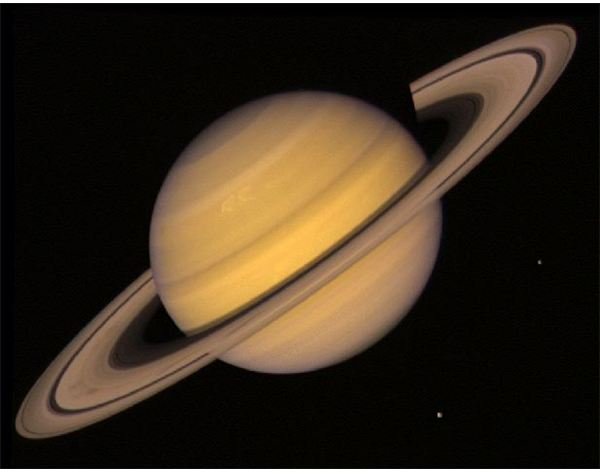
Learn amazing facts about Saturn, the second-largest planet in the solar system. See incredible images of this beautiful planet and its rings.
The Facts
-
Position in the solar system: 6th planet from the sun
-
Closest distance to the sun: Perihelion is 1.353 x 10⁹ km (840,000,000 miles)
Advertisement -
Furthest distance from the sun: Aphelion is 1.515 x 10⁹ km (941,000,000 miles)
-
Minimum distance to Earth: 1.2 x 10⁹ km (745,000,000 miles)
Advertisement -
Saturnian day: 10.656 hours
-
Saturnian year: 29.46 Earth years
Advertisement -
Axis tilt: 26.73°
-
Orbital Inclination to ecliptic: 2.485°
Advertisement -
Orbital Eccentricity: .0565
-
Diameter (equatorial): 129,536 km (74,853 miles), about 9.4 times the diameter of Earth
Advertisement
-
Mass: 568 x 1024 kg (625 x 1021 tons), about 95 times the mass of Earth
-
Gravity: 1.065 times Earth’s gravity at 1 bar pressure
Advertisement -
Escape velocity: 35.5 km/s, about 3.2 times the escape velocity of Earth
-
Temperature: At 1 bar pressure, 134 K (-139° C or -218° F)
Advertisement -
Mean surface pressure: »1000 bar
-
Atmospheric composition: Mostly hydrogen (96.3%) and helium (3.25%) with trace amounts of methane, ammonia, “heavy hydrogen” (hydrogen deuteride), and ethane
Advertisement -
Number of moons: 60
-
Ringed system? Yes
Advertisement -
Magnetic field? Yes
Images
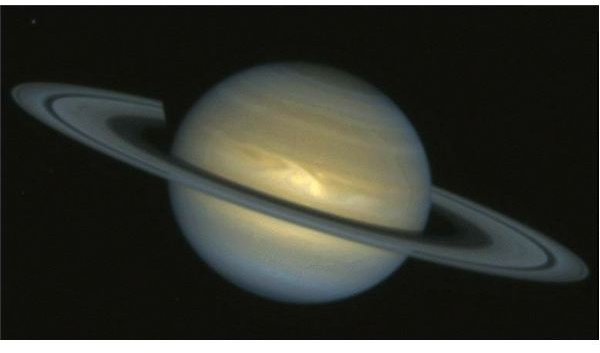
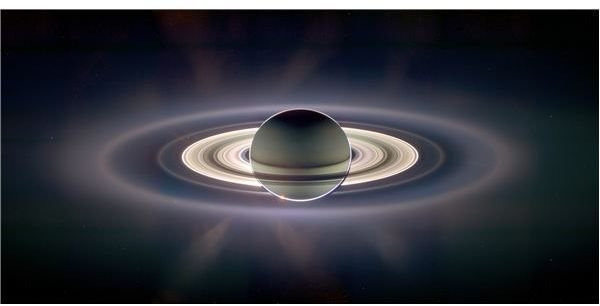
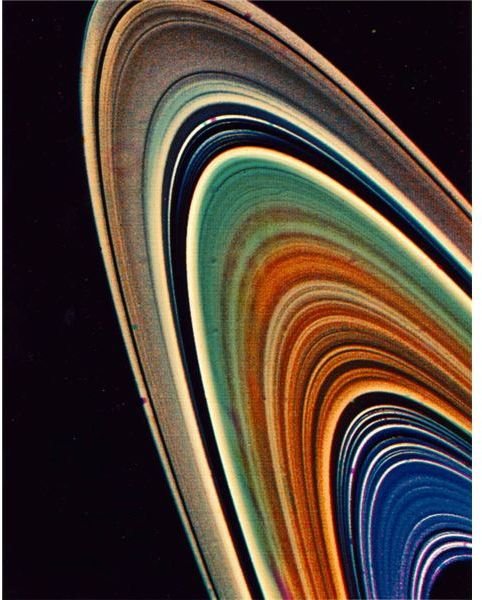

Left to right:
Saturn Storm — 1994 Hubble Space Telescope view of a storm on Saturn’s surface. The white clouds are made of ammonia ice crystals.
Saturn Rings with Eclipse — 2006 Cassini image (brightness enhanced) in which Saturn eclipses the sun, making its rings very prominent.
Saturn’s Rings (False Color) — 1981 Voyager 2 image.
Amazing Facts About Saturn
Saturn is most famous for its rings, lettered A through F, but not in order. The outermost ring, Ring E, is 966,000 km (600,000 miles) in diameter, about eight times the planet’s diameter. The innermost ring, Ring D, has an interior diameter of 133,800 km (83,000 miles), only about 10% greater than the planet’s diameter.
Saturn also has amazing moons. Only Jupiter has more natural satellites. Saturn’s moon, Titan , is bigger than the planet Mercury and is the only moon in the solar system with a dense atmosphere. Titan is the only solar system object other than Earth that has liquid on its surface, with lakes probably made of hydrocarbons. Some astrobiologists speculate that microorganisms may live there.
Who discovered Saturn? As one of the five planets visible from Earth with the naked eye, Saturn has been known since antiquity. It was named after the Roman god, Saturnus, father of Jupiter.
Saturn and its moons have been the target of five different NASA missions: Pioneer 11, Voyagers 1 and 2, Huygens (a mission to the moon Titan), and most recently, Cassini.
Credits
NASA’s Saturn Fact Sheet (https://nssdc.gsfc.nasa.gov/planetary/factsheet/saturnfact.html )
NASA’s Saturnian Rings Fact Sheet (https://nssdc.gsfc.nasa.gov/planetary/factsheet/satringfact.html )
Photos:
Saturn (top) — True-color 1981 photo from Voyager 2. The moons Rhea and Dione are visible. https://nssdc.gsfc.nasa.gov/image/planetary/saturn/saturn.jpg
Saturn’s Rings with Eclipse — https://photojournal.jpl.nasa.gov/figures/PIA08329 _fig2.jpg
Saturn’s Rings (False Color) — https://nssdc.gsfc.nasa.gov/image/planetary/saturn/saturn _rings_false.jpg
Saturn Storm — https://nssdc.gsfc.nasa.gov/image/planetary/saturn/hst _saturn_storm.jpg


