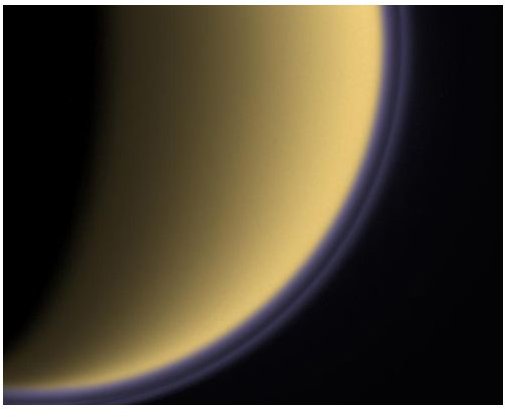
What do you know about Saturn’s aptly named moon Titan? For a planetary satellite, Titan has many unique features, including its large size (it’s the second largest moon in the solar system) a thick and frigid atmosphere, and lakes of methane and ethane.
The Facts
- Year discovered: 1655
-
Discovered by: Christiaan Huygen
-
Position among Saturn’s moons : 20th satellite from the planet
Advertisement -
Size among Saturn’s moons: Largest
-
Average distance to Saturn: 1,221,830 km, 759,210 miles
Advertisement -
Rotation: synchronous with Saturn (10hr 39.36m 21.6s)
-
Orbital period: 15days 22hr 41m 24.3s (15.94542068 Earth days)
Advertisement -
Orbital Inclination to Saturn’s equator: 0.33 degrees
-
Eccentricity: 0.029192
Advertisement -
Diameter (equatorial): 5,150 km, 3,200 miles
-
Mass: 1.3455x10^23 kg, 2.9663x10^23 lbs
Advertisement
-
Mean Density: 1,880 kg/m3, 117.36 lbs/ft3
-
Gravity: .14 (Earth = 1)
Advertisement -
Escape Velocity: 2.639 km/s, 1.64 miles/s
-
Surface temperature (average): -179C, -290F
Advertisement -
Surface pressure: 1.467 bars, 1.448 atm
-
Atmospheric composition: 98.4% nitrogen, 1.6% methane
Advertisement -
Albedo: 0.22
Above left: A colorized image taken by Cassini shows the purplish atmospheric haze encircling Titan. Image credit: NASA/JPL/Space Science Institute, https://solarsystem.nasa.gov/multimedia/display.cfm?IM _ID=2783
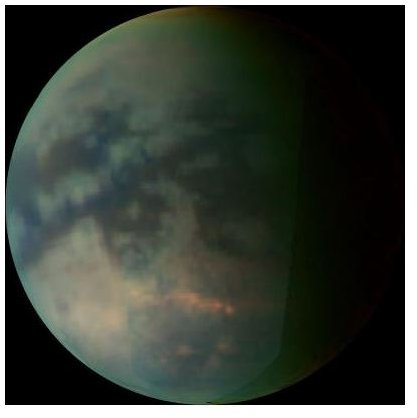
Right: Titan’s methane cloud cover. Image credit: NASA/JPL/University of Arizona, https://www.eurekalert.org/multimedia/pub/5390.php?from=102316
More Interesting Facts About Titan
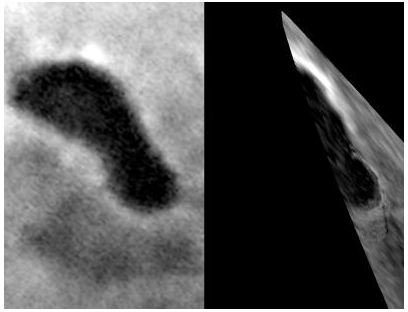
1) Swimming in hydrocarbons. Titan joins Earth as the only other body in our solar system known to have liquid lakes on the surface. NASA’s Cassini orbiter confirmed that status when it observed Ontario Lacus, a 150-mile long hydrocarbon lake in Titan’s south polar region. This project is overseen by Carolyn Porco .
2) Tod****ay’s forecast: chance of methane drizzles in the west. Astronomers at the University of California, Berkeley, used near-infrared imaging to detect methane raining from the constant cloud cover over Titan’s major continent, Xanadu. “The stratiform clouds we see are like cirrus clouds on Earth,” said research astronomer Mate Adamkovics. “One difference is that the methane droplets are predicted to be at least millimeter-sized on Titan, as opposed to micron-sized in terrestrial clouds – a thousand times smaller. Since the clouds have about the same moisture content as Earth’s clouds, this means the droplets on Titan are much more spread out and have a lower density in the atmosphere, which makes the clouds ‘subvisible’ and thus
hard to detect.”
3) So similar, yet so different. Titan’s thick atmosphere and climate features make for a planetary body that resembles Earth – especially early Earth – in many ways, though at much colder temperatures. “One of the things that attracts me about Titan is that it has a lot of the same circulation features as Earth, but done with completely different substances that work at different temperatures,” said Ray Pierrehumbert, a professor in geophysical sciences at the University of Chicago. “The ironic thing on Titan is that although it’s much colder than Earth, it actually acts like a super-hot Earth rather than a snowball Earth, because at Titan temperatures, methane is more volatile than water vapor is at Earth temperatures.”
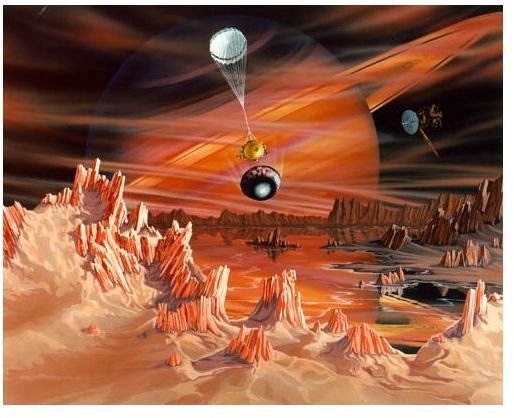
Above left: Artist Craig Attebery’s depiction of the Huygens probe approaching Titan’s surface, with Saturn looming in the background. Image credit: Craig Attebery, NASA, https://solarsystem.nasa.gov/multimedia/display.cfm?IM _ID=3963
Right: Images of Titan’s hydrocarbon lake, Ontario Lacus. Image credits: NASA/JPL/Space Science Institute (left), NASA/JPL/University of Arizona (right), https://www.eurekalert.org/multimedia/pub/9295.php?from=118974
References
Nasa, https://solarsystem.nasa.gov/planets/profile.cfm?Object=Sat _Titan&Display=Facts&System=Metric
Nasa, https://nssdc.gsfc.nasa.gov/planetary/factsheet/saturniansatfact.html
daviddarling.info, https://www.daviddarling.info/encyclopedia/T/Titan.html
uanews.org, https://uanews.org/node/20615
Berkeley, https://www.berkeley.edu/news/media/releases/2007/10/11 _titan.shtml
eurekalert, https://www.eurekalert.org/pub _releases/2007-10/uoc-tic100207.php