Many gardeners and farmers ask themselves, “what factors affect plant transpiration?” If you have been asking yourself this question, read on to learn the answer.
Transpiration is the process in which water evaporates from plants. It occurs during photosynthesis when the leaves’ stomata are open for carbon dioxide and oxygen to pass through. This process is essential and it is the driving force that pulls water from the roots to bring materials up from the roots so that biosynthesis can occur within the leaf, to supply photosynthesis, and to cool the leaf. So, what factors affect plant transpiration?
Light
When plants are in the dark they will transpire more slowly than they would in the light where they transpire more rapidly. This primarily occurs because the opening of the stomata is stimulated by light and because light warms the leaf which leads to quicker transpiration.
Temperature
Higher temperatures result in plants transpiring faster. This is because water evaporates faster as temperature increases. For example, a leaf can transpire, at 30 degrees Celsius, three times faster than it would at 20 degrees Celsius.
Relative Humidity
As the difference in a substances concentration in the two regions increases, the rate of that substances diffusion will increase. When the air that surrounds a plant is dry, the water diffusing out of a leaf will occur more rapidly.
Air Movement and Wind
When no breeze is present, the air that surrounds a leaf becomes increasingly humid, resulting in and reduction in how quickly it transpires. When there is a breeze, humid air is replaced by drier air because the breeze carries the humid air away.
Soil Water and Soil-Moisture Availability
If water loss occurs and this loss of water is not replaced by water in the soil, a plant will not longer be able to transpire quickly. When a plant’s roots absorption of water fails to keep up with how quickly transpiration is occurring, the stomata closes and turgor loss occurs. When this happens, the rate of transpiration is immediately reduced, as is photosynthesis. The plant will begin to wilt if the turgor loss affects the remaining leaf and stem.
Type of Plant
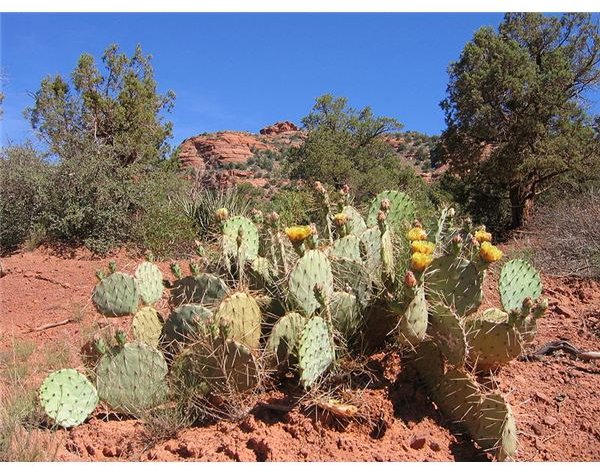
The type of plant plays a large role in how quickly plants transpire water. This is because different plants will transpire water more quickly than others, or at different rates. Some plants that grow in arid regions, and regions prone to drought , such as succulents and cacti, transpire less water than other plants so they conserve water. However, a large oak tree transpires a lot of water and on average will transpire approximately 40,000 gallons of water per year.
Transpiration can lead to a plant losing a high volume of water. This is why it is important to know what factors affect transpiration so that they can be identified and prevented. How much water a plant transpires varies greatly over time and geographically.
Resources
The Encyclopedia of Earth. (2007). Transpiration. Retrieved on February 7, 2010 from the Encyclopedia of Earth: https://www.eoearth.org/article/Transpiration
Image Credits
Cacti: Derek Kaczmarczyk – Wikimedia Commons
This post is part of the series: Intracellular Plant Transpiration
Find a thorough understanding of intracellular plant transpiration and how plant transpiration works.