The Crab Nebula is one of the most recognizable objects in the night sky. It sits in the constellation Taurus, and is a tiny smudge of light a fraction of the apparent size of the full Moon. A thousand years ago, it amazed astronomers as one of the brightest objects in the sky.
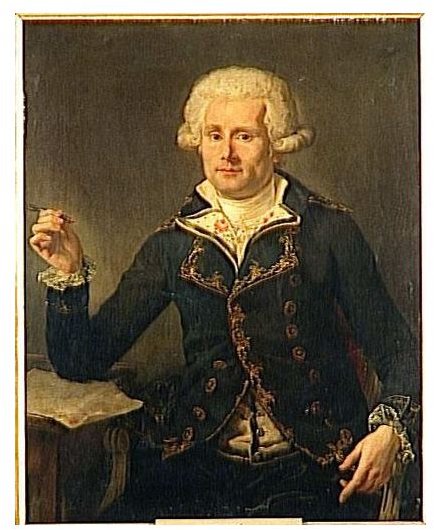
In 1771 a French astronomer named Charles Messier set out to create a catalog of objects in the night sky that were not stars. Until very recently, telescopes were not powerful enough to resolve stars as anything other than points of light while things like comets or nebulae would appear as tiny smudges of light. Charlie’s specialty was finding comets. Over days or even weeks he would point his telescope at some smudge and make painstaking observations of its movement. If it moved, it was a comet and it it didn’t move it was a nebula. This list of “Messier objects” was the largest catalog of non-star objects ever created to that time. The very first little smudge on that list, M1, is what we’re here to talk about. Let’s learn some Crab Nebula info.
What is the Crab Nebula?
In Messier’s time, astronomers didn’t know exactly what M1 was. All they could really tell what that it looks like a blurry star. The Crab Nebula is a big cloud of hydrogen gas that measures, as viewed from Earth, 4 arcminutes in diameter. To compare, the full Moon is 30 arcminutes across. 7,500 years ago the Crab Nebula was a red supergiant, thousands of times brighter than our sun. When the iron core of that star
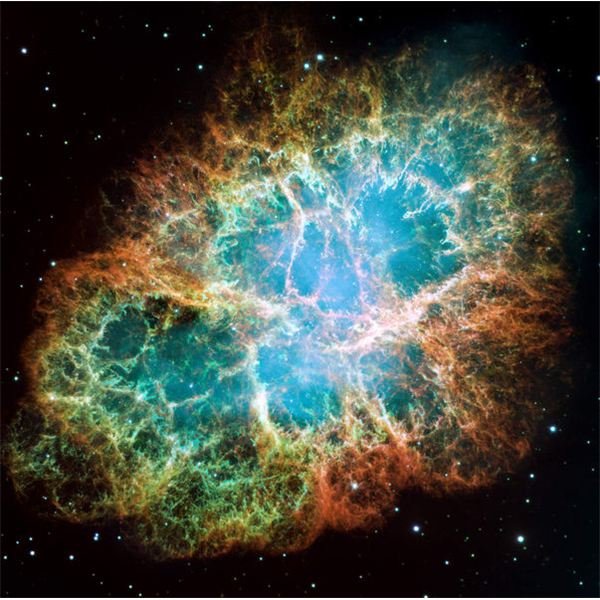
reached 1.4 solar masses, the force of gravity forced it to suddenly collapse into a 12-mile wide neutron star . The outer layers of gas began falling inward, rushing towards the center of gravity. As the gas fell it picked up speed, reaching about a fourth the speed of light. When that gas smashed into the neutron star, it could not compress anymore. Other than a black hole, nothing can be more dense than a neutron star. The falling gas was reflected backwards, making a huge explosion: a supernova. The star’s outer layers were blown off, leaving a planetary nebula with a neutron star floating silently at its center.
In 1054 the light from this supernova reached the Earth. Ancient astronomers in China and the Middle East watched as a star suddenly became as bright as the full moon. For 25 days it was actually bright enough to be able to see during the day. When modern astronomers found accounts of this strange star, they pointed their telescopes where these ancient scrolls said to look and found the Crab Nebula.
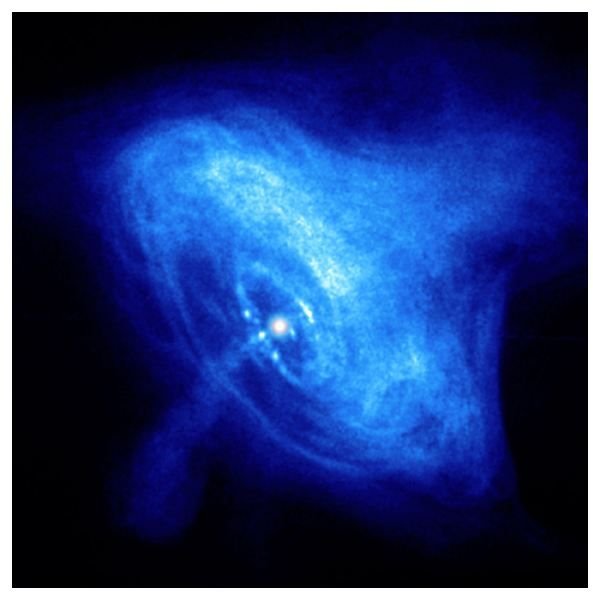
The neutron star left in the nebula’s center emits light across all wavelengths of light. Because of the shape of the star’s magnetic field, it only emits this light from its magnetic poles. When a neutron star’s magnetic poles and rotational poles do not align, it creates a type of lighthouse effect. From the Earth’s perspective, we see a flash of light 2 times for every revolution. This type of pulsating star is called a pulsar . The flashes of light from pulsars are extremely regular, and used to be the most acurate way of telling time before more complicated methods were invented using radioactive decay. The Crab Pulsar is an interesting case in that it is one of the rare pulsars that emits visible light and is also one of the brightest sources of gamma rays in the sky. It has a diameter of 25 kilometers and rotates 30 times every second.
Crab Nebula Info
Distance: 6,500 light years
Apparent Magnitude: + 8.5
Absolute Magnitude: - 3.1
Constellation: Taurus
Composition: helium, hydrogen, carbon, oxygen, nitrogen, iron, neon, sulfur
Temperature: 11,000 - 18,000 K
Diameter: 11 light years
Sources
https://adsabs.harvard.edu/abs/1997AJ....113..354F
https://hubblesite.org/newscenter/archive/releases/2002/24/text/
https://chandra.harvard.edu/photo/2006/crab/
https://adsabs.harvard.edu/abs/1999PASP..111..871C
Credits
Messier Picture https://www.astroalcoy.org/messier/messier2.jpg
Nebula Picture https://www.lib.fit.edu/pubs/librarydisplays/colors/603px-Crab _Nebula.jpg
Pulsar Picture https://lithops.as.arizona.edu/~jill/EPO/Posters/Supernova/0052 _xray_widefield.jpg