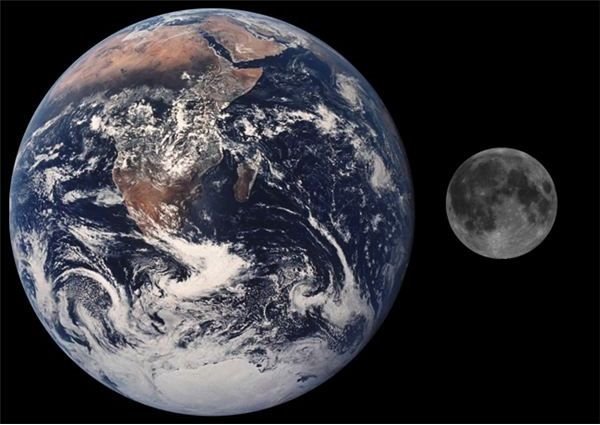
The oceanic tides the Earth experiences due to the Moon’s gravitational effect are beneficial for aquatic and terrestrial life, not to mention surfers. Those benefits come at a price, however, as the Moon is slowly moving away from the Earth as a result. Find out why in this article!
There’s no such thing as free energy…
Some ancient peoples considered the heavens perfection in motion, a sign of divine handiwork. They might not have been so certain, had they known what the relentless laws of physics are wreaking upon the Earth-Moon system as time moves ever onward.
It is the gravitational attraction between the Earth and the Moon, or, more specifically, between the Moon and the Earth’s oceans, that pulls those same oceans along in the Moon’s wake. To put an approximate number on it, the volume of Earth’s oceans is approximately 1.33 billion cubic kilometers, while the mass of water is one kilogram per liter; that works out to about 1.33 quadrillion kilograms; while this is nowhere near the mass of the Earth or Moon, it is still more than enough to throw a monkey wrench into the works. (Note: Tidal action does not affect the whole of the oceans, by any stretch, but these numbers give some feeling for the sense of scale involved.)
That complication is caused by the fact that, unlike in most physics classes, real masses are far from point masses. The distortion in the Earth’s shape caused by these tides exerts a force on the moon. A slight force, to be sure, but tangible nonetheless. At the same time, this mass also slows the Earth’s rotation. From here, conservation of angular momentum takes over, and, since the Earth’s angular momentum is decreasing (in other words, our days are getting longer ), the Moon’s angular momentum has to increase. As a result, the Moon is moving away at a velocity of 3.8 centimeters a year, a figure that we know courtesy of reflectors placed on the Moon during Project Apollo.
Lest you start making plans to hold a farewell party, though, it will be quite some time before the Moon succeeds in making its breakaway from the Earth- long before then but still a few billion years down the road, the Sun will have run out of hydrogen fuel and switch to burning helium, resulting in an increase in its size sufficient to dramatically increase the temperature here on Earth and cause the oceans to boil off, rendering the discussion moot unless technology someday provides a way to refuel the Sun.
Images
Credits
Image by NASA