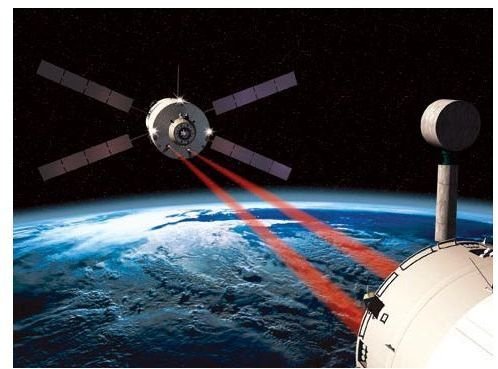
The Automated Transfer Vehicle is a fully automatic system for delivering supplies, experimental apparatus, and personal effects to the astronauts on-board the ISS. The maiden voyage of an ATV, the Jules Verne, took place in 2008, and a follow-up with the ATV, Johannes Kepler is scheduled for 2009.
First Mission
The Automated Transfer Vehicle (ATV) is an unmanned service and logistics vehicle used to resupply the International Space Station (ISS) with water, mail, food, compressed air, and experimental equipment. The ATV that was named Jules Verne, after the famous 19th century French author, successfully docked with the ISS on 3 April 2008. The vehicle carried spare parts for the European Columbus laboratory, personal items for the ISS crew, and a special 19th century edition of the Jules Verne classic De la Terre à la Lune (From the Earth to the Moon).
Before and After
Before any of that could happen, the launch and early operations phase (LEOP) put the ATV into low Earth orbit on an Ariane 5 launcher , which was one of the riskiest parts of the mission. Success was defined as the deployment of its solar array panels that generate the power used to control the spacecraft. The ATV has batteries, but they only last for a limited amount of time. The solar arrays have to work, or else the ATV cannot bring its orbit into line with that of the ISS. Fortunately, everything went swimmingly with Jules Verne.
After undocking on 5 September 2008, it made what is called a “destructive re-entry” into Earth’s atmosphere over an uninhabited part of the Pacific Ocean on the 29th of September, 2008.
Other Tasks
Resupply is not the ATV’s only function. It also refuels the space station by transferring propellant to the Zarya module, the Russian Functional Cargo Block, which was the first component launched for the International Space Station , in November 1998. The ATV is also equipped to reboost the ISS into its proper orbit, a regular maintenance chore that keeps the ISS from falling out of orbit due to atmospheric drag.
Multinational Effort
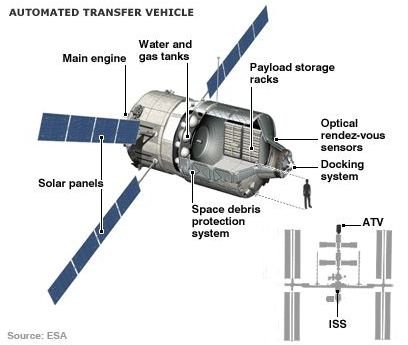
The ATV is closely monitored by a human staff back on Earth, but the docking is completely automatic, and the craft is designed to autonomously handle any emergency without damaging the ISS or putting the ISS crew in danger. While it is docked, it provides extra room for the crew, 22 cubic meters worth, approximately the size of a London double-decker bus. ESA has managed the project via remarkable cooperation between different space agencies and companies: France’s EADS Launch Vehicles is the primary contractor for the ATV, with Aerospatiale’s Les Mureaux responsible for the overall management and vehicle engineering and testing. Germany’s Daimler Chrysler Aerospace is in charge of the production of the propulsion and reboost system. Alenia Spazio of Italy developed the cargo carrier, and Matra Marconi Space of France developed the avionics equipment and rendez-vous software. Oerlikon Contraves of Switzerland had the responsibility of designing the spacecraft structure subsystem, while Alcatel Bell Telephone of Belgium was responsible for electric ground support equipment.
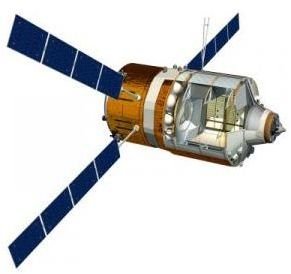
The Johannes Kepler ATV
The next ATV, named Johannes Kepler after the German astronomer and mathematician, was delivered to the EADS Astrium in Bremen, Germany on the 10th of September 2009. It is scheduled for a November 2010 launch.
The Integrated Cargo Carrier (ICC) was built in Turin, Italy and was transported to Germany on a Beluga aircraft. Once in Germany, it was transferred to the Integration Hall, where it will be integrated with the two main ATV modules: the Equipped Avionics Bay (EAB) and the Equipped Propulsion Bay (EPB) for final testing. The avionics are undergoing thermal testing at the ESA Large Space Simulator in Noordwijk, Netherlands.
While the Jules Verne performed flawlessly, there were some lessons learned from its post-flight analysis that will be put in place so that the Johannes Kepler ATV is even better.
References:
https://www.spaceandtech.com/spacedata/platforms/atv_sum.shtml
https://www.nasa.gov/mission_pages/station/structure/elements/fgb.html
https://www.scienceinschool.org/print/473
https://www.space.com/missionlaunches/080403-atv-iss-docking-wrap.html
https://www.spacetoday.org/SpcStns/ATV/ATV.html
https://www.gpsworld.com/files/gpsworld/nodes/2008/1471/JulesVerne.jpg