What are comets? Where do they come from and how often do they visit? Read the answers to these questions and more in this article all about comets.
The Facts
1. Description: Balls of rock particles and ice that follow long orbits around the sun; sometimes called “dirty snowballs” or “icy mudballs”
2. Parts: Nucleus, coma, hydrogen cloud, dust tail, ion tail
- Nucleus: relatively solid block of ice and rock particles, 1 to 10 km in diameter
- Coma: water vapor and other gases released from the nucleus via sublimation
- Hydrogen cloud: millions of km in diameter; surrounds the comet
- Dust tail: made of tiny particles of the nucleus; up to 10 million km long
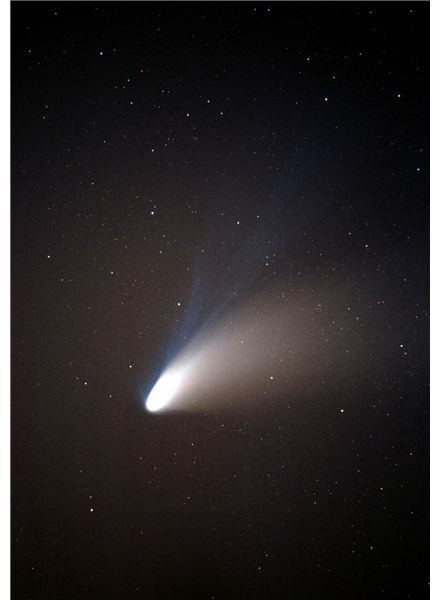
- Ion tail: made of charged particles that interact with solar wind; hundreds of millions of km long; due to solar wind, always points away from the sun
3. Origin: Remnants from the formation of the solar system about 4.6 billion years ago
4. Types: Short-period (periodic) comets have predictable orbits of under 200 years; long-period comets, with orbits over 200 years, visit the sun so rarely that the periods of many have not been accurately determined
5. Composition: The “dirt” is composed of minerals such as silicates and metals. The “ice” is composed various compounds of the lighter elements carbon, hydrogen, oxygen, and nitrogen, including water, ammonia, methane, carbon monoxide, and sometimes organic compounds such as ether
6. Location: Most of the time, comets are beyond the orbit of Neptune. Short period comets range out to the Kuiper Belt, 4.5 to 7.5 billion km (30-50 AU) from the Sun. Long-period comets range to the Oort Cloud, four orders of magnitude farther than the Kuiper Belt at 100,000 AU.
7. Orbital Paths: Most are extremely eccentric, with one end of the ellipsis near the sun and the other far beyond the planetary orbits. Some long-period comets may not follow an elliptical orbit at all, but rather make a single pass around the sun during their lifetimes, on either a parabolic or hyperbolic path
8. Orbital Periods: Range from under five years (some periodic comets) to thousands of years (long-period comets), even up to an estimated 30 million years
9. Number of known comets: 441 short-period comets; 3091 long-period comets
Famous Comets
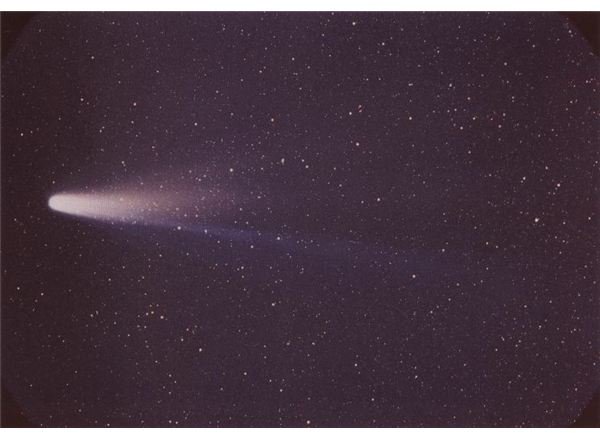
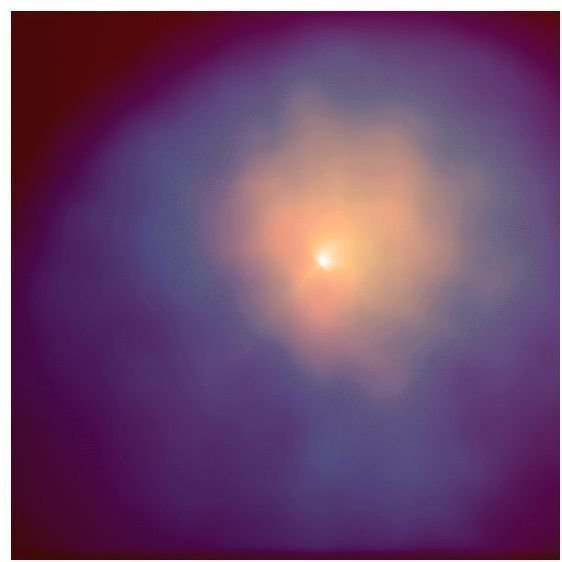
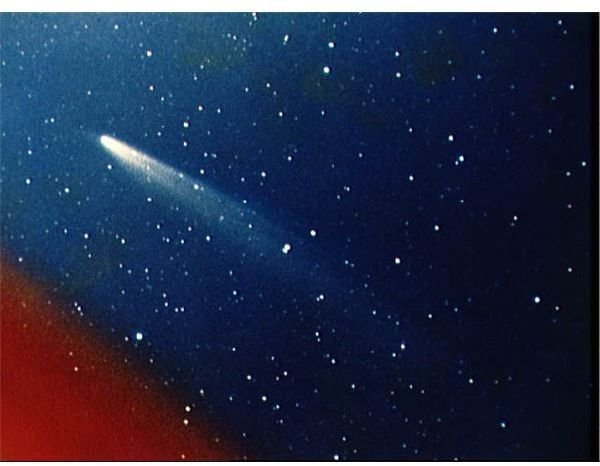
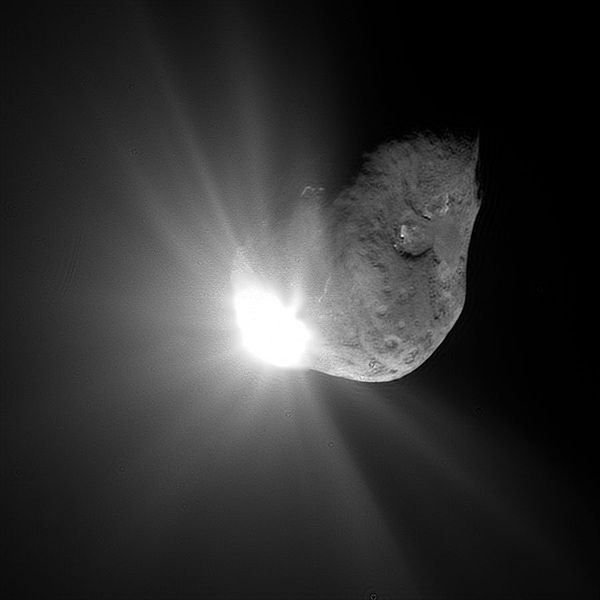
Above, from left to right and top to bottom:
Hale-Bopp: Long-period comet with an irregular orbit, with most recent perihelion in 1997. Previous perihelion was about 4200 years ago; next perihelion will be in about 2370 years. The extreme difference in orbital period is due to gravitational effects of the comet’s approach to Jupiter in April 1996. Hale-Bopp is associated with the “Heaven’s Gate” cult, whose members committed mass suicide.
Halley’s Comet : The most famous comet with a period of 76.1 years; last visit was in 1986
Hyakutake: Bright comet that came within 0.1 AU of earth in 1996. Very long period comet with orbital period estimated around 40,000 years. Image from the Hubble Space Telescope.
Kohoutek: Long period comet observed by Skylab astronauts in 1973 and 1974. This photograph dates to January 1974.
Tempel 1: Visited by the Deep Impact probe, which launched a projectile into the nucleus and recorded extensive data and images. Image is of the probe impacting the nucleus.
References
“Comets ” (nineplanets.org)
Johnston, Wm. Robert. “Known populations of solar system objects .”
Additional comet data from NASA
Image Credits
Hale-Bopp: image licensed under GFDL from https://en.wikipedia.org/wiki/Image:Comet _Hale-Bopp.jpg
Halley’s comet: National Space Science Data Center, NASA
Hyakutake: Hubble space telescope image (NASA)
Kohoutek: University of Arizona for NASA-JSC
Tempel 1 Deep Impact probe: NASA