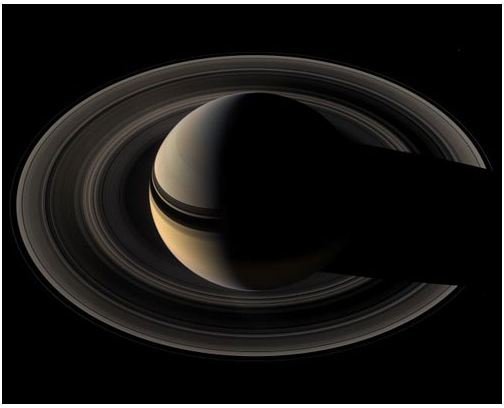
Saturn is not the only ringed planet in the solar system – Jupiter, Uranus and Neptune also have rings – but it does by far display the most fascinating and complex system of rings anywhere in our planetary neighborhood.
The Facts
**
1) Year discovered: 1610
2) Discovered by: Galileo Galilei (though he couldn’t identify them as rings)
3) Year idenfitied as rings: 1655
4) Identified as rings by: Christiaan Huygens
5) First extensively photographed by: Pioneer 11 (1979) took the first low-resolution photos, but the planet was much more extensively photographed by Voyager 1 (1980) and Voyager 2 (1981).
6) Distance of rings from Saturn’s center: 66,000 to 480,000 km (that’s 41,010 to 298,258 miles)
7) Thickness: No more than 1000 km or 621 feet
8) Size of particles in rings: anywhere from 1 cm to several meters, with some larger objects and “moonlets”
9) Composition of particles in rings: Make up of mainly water ice with trace amounts of silicate materials.
10) Estimated total mass of rings: Possibly more than three times that of Saturn’s moon Mimas (which is 3.75 x 10^19 kg or 8.27 x 10^19 lbs)
11) Types of rings: The main rings (A, B and C), the dusty rings (D, E and G), F Ring
12) How rings were named: In the order of discovery (i.e., “A” was discovered first)
13) Innermost ring: D Ring (67,000 to 74,500 km, or 41,632 to 46,292 miles, from Saturn’s center)
14) Outermost ring: E Ring (180,000 to 480,000 km, or 111,847 to 298,258 miles, from Saturn’s center)
15) Leading theory for ring formation: Breakup of a moon (either through tidal forces or meteor impact), leftover remnants from the early solar system
16) Likely source of material in E Ring: Microscopic, cryovolcanic material from the moon Enceladus
17) Age of rings: Uncertain (theories range from 100 million years to 4 billion years old, though recent data from Cassini-Huygens indicate the older age is more likely)
18) Other ring features: “Braided” rings, ringlets, spokes (radial features)
19) Likely cause of spokes: Saturn’s magnetic field
20) Largest gap in rings: Cassini Division (4,700 km, or 2,920 miles, wide)
21) Likely causes of gaps in rings: Gravitational pull of “shepherd” moons, resonance effects between ring particles and moons
Above left: A natural-color mosaic image of Saturn’s rings, taken by Cassini. (Image credit: NASA/JPL/Space Science Institute, https://solarsystem.nasa.gov/multimedia/display.cfm?IM _ID=5723)
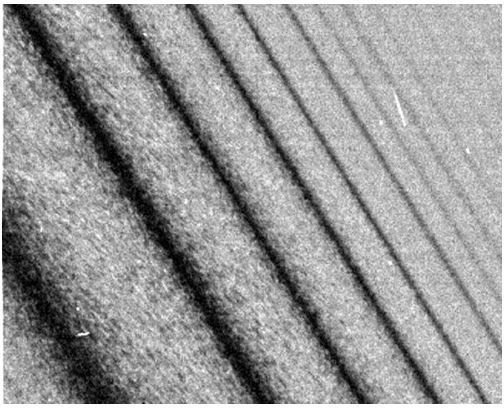
Right: A closeup of Saturn’s A Ring. (Image credit: NASA/JPL/Space Science Institute, https://solarsystem.nasa.gov/multimedia/display.cfm?IM _ID=2724)
More Amazing Facts About Saturn’s Rings
1) The rings have their own atmosphere. Flying close by the rings, Cassini-Huygens observed enhanced levels of oxygen gas in the ring system. Researchers believe water from the rings is broken up into its components, hydrogen and oxygen; the hydrogen dissipates while the oxygen stays.
2) Saturn’s A Ring acts like a giant sponge. In addition to feeding material into the E Ring, cryovolcanoes on the moon Enceladus are also spewing out gases that become plasma that’s sucked into the A Ring.
3) What a disappearing act. As Saturn circles the sun (once every 29.5 years), the angle at which we view its rings changes. Twice during each circuit, the rings are edge-on as viewed from Earth, making them all but disappear. These ring plane crossings vexed Galileo (“Has Saturn swallowed his children?” he asked during a ring plane crossing in 1612), but they’re a great time for astronomers to study Saturn for new moons and other features without the glare from the rings.
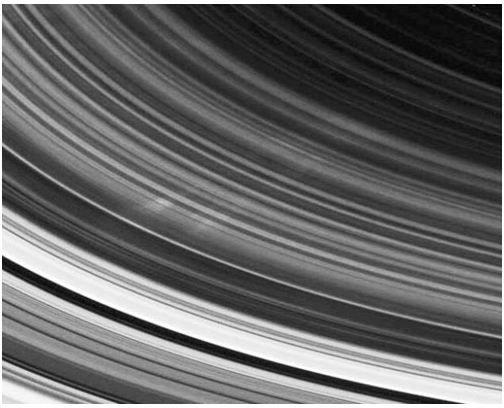
Above left: Cassini’s image of radial spokes in Saturn’s B Ring. (Image credit: NASA/JPL/Space Science Institute, https://solarsystem.nasa.gov/multimedia/display.cfm?IM _ID=4083)
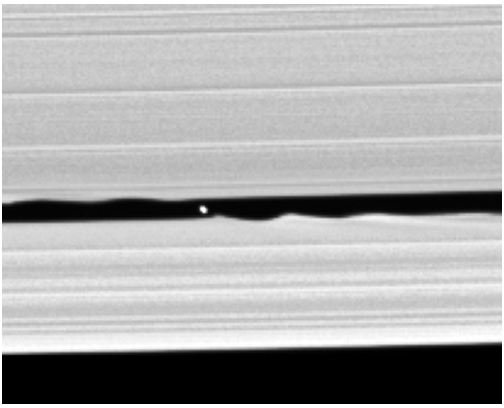
Right: Cassini helps find a new moon, the seven-km-wide S/2005 S1, in the Keeler gap of Saturn’s rings. (Image credit: NASA/JPL/Space Science Institute, https://solarsystem.nasa.gov/multimedia/display.cfm?IM _ID=3863
Credits
https://www2.jpl.nasa.gov/saturn/faq.html
https://solarsystem.nasa.gov/planets/profile.cfm?Object=Saturn&Display=Rings
https://www.astronomynow.com/080924saturnsringsolderandbigger.html
https://en.wikipedia.org/wiki/Rings _of_Saturn
https://pds-rings.seti.org/saturn/
https://www.daviddarling.info/encyclopedia/S/Saturn _rings.html