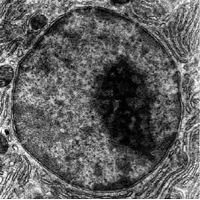
The cell nucleus is a highly specialized organelle that is often called the cell’s ‘brain’. It’s an amazing structure that controls and coordinates cellular activities including metabolism and protein synthesis. And it houses an organism’s genetic material.
How Large is the Cell Nucleus?
Under a light microscope the cell nucleus looks like a black dot and its size varies depending on the species and stage of the cell’s life cycle. It is usually the largest organelle in the cell and can contain up to about 2 metres of DNA which has to be tightly coiled and packed so that it can fit in. The average diameter of the nucleus in mammalian cells is 6 micrometers.
Who Discovered the Cell Nucleus?
Although the ‘father of microbiology’ Antonie Philips van Leeuwenhoek (1632-1723) is believed to have observed the nucleus in fish blood cells, it was the Scottish botanist Robert Brown who is credited with its discovery. In 1831 he presented his findings in a paper to the Linnaean Society. He had observed opaque spots in plant tissue and realised they were a key component of cells. He coined the term nucleus which is still in use today.
Where is the Nucleus Located in the Cell?
Only eukaryotic cells possess a nucleus and there is usually only one per cell. However, the cells of slime molds can contain millions of nuclei.
Conventionally, people think that the nucleus is in the centre of the cell, and that can be the case, but it is not always in this position. Nuclei tend not to be near the edge of a cell as this can be a precarious place for them to be.
Is DNA Restricted to the Nucleus of a Cell?
Nuclear DNA is restricted to the nucleus, bound up in 46 chromosomes. However, there is another source of DNA in the cell, and it’s the mitochondria , the cellular power packs. Each organelle contains a DNA sequence of 16,569 base pairs that encodes 37 genes.
What is the Nucleus Made up of?
The nucleus is made up of several key structures and these include: -
Chromatin - combination of DNA, RNA and proteins that make up the chromosomes
Nuclear envelope - double membrane structure that encloses the nucleus
Nucleolus - where ribosomes are made
Nucleosomes - short lengths of DNA coiled around histone proteins
Histone proteins - serve as spindles for DNA to coil around
Chromsomes and DNA - the nucleus contains most of the cell’s genetic material.