DNA is the key to you and me. The genetic information is locked up inside one of the longest molecules in nature. It is a twisted double helical structure which we will unravel a little to find out how it is put together.
Hydrogen Bonds Maintain DNA Stability
Hydrogen bonds are amongst the several factors that keep DNA together. They occur between the base pairs (the four rungs of the DNA ladder) - adenine, guanine, cytosine, and thymine. And though individually each hydrogen bond is weak, the fact that there are so many hydrogen bonds within a DNA molecule make it an extremely powerful force that keeps DNA together.
DNA is More Stable than RNA
That DNA is more stable than RNA is due to several biochemical factors including:
- -OH group on the second carbon chain of RNA make it less stable than DNA .
- The RNA molecule has larger grooves than DNA, and these provide potential docking spaces for damaging enzymes.
DNA forms Loops
The DNA molecule can actually form loops . They are created by the binding of proteins and protein complexes to different DNA regions. When the proteins interact with each other loops form. DNA loops plays pivotal roles in many cellular processes such as transcription , gene expression, and replication .
DNA Strands are Antiparallel
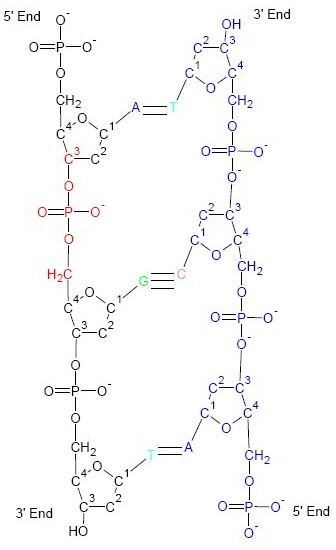
The sugar phosphate backbones of the DNA molecule run in opposite directions . Each strand has two ends; let’s take one of those.
At one end there is a 5’-OH group, where a free phosphate group is attached. And at the opposite end is a 3’-OH group, which is where a free hydroxyl group is attached.
The DNA molecule is structured in such a way that there can never be two 5’ (so called “five prime”) or two 3’ (“three prime”) at the same end of the molecule. So the two strands of the molecule are upside down in relation to each other.
So, imagine the DNA molecule as a ladder, and if you look at the supports separating the rungs. The top of one of those supports will be 5’ and the top of the other will be 3’. Then scoot your eyes down to the bottom of the structure and you’ll see that the strand with a 5’ top has a 3’ bottom, and the strand with a 3’ top has a 5’ bottom.
DNA Structure Discovery
Before Crick and Watson’s landmark paper on the structure of DNA, many scientists such as Linus Pauling thought that the hereditary information was inside proteins, and so they spent their time studying proteins and not DNA. However, the methods that Pauling employed to determine the structure of proteins were adopted by Crick and Watson in their search for the structure of DNA.