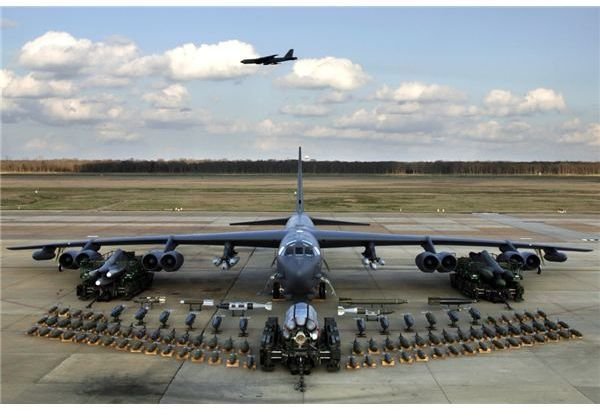
In the year 1952, on the day April 15th, an enormous aircraft with a wingspan area of 4000 square feet was taken into flight by a test pilot named Tex Johnson. The world was now to learn about the B52 bomber airplane!
Introduction - The Requirements
This historic B52 bomber airplane basically originated in June 1946 when Air Material Command called for bids for a new strategic bomber. The concept of the proposed airplane was partly that it would be capable of carrying out missions, without being dependent upon any advanced and intermediate bases, controlled by other countries.
In addition, it was required to possess a five thousand mile combat radius area and have the ability to cruise at a speed of four hundred and fifty miles per hour. It was further specified that an operational height of forty thousand feet had to be attained. The armament specifications included at least five turret gunners and 20mm cannons. The bomb load was designated to ten thousand pounds.
The Design - B-47 Improved
Boeing and their engineers took up the challenge and by the utilization of technical advancement, introduced twenty degrees angled swept-back wings. Turbo-prop engines, as used on the B47, were replaced with comparable jet engines, with the additional benefit added of in-flight refuelling. This was a particular feature about the B52 bomber airplane, which was a relatively new concept at the time. The original plan for the airplane was rejected, with the demand for a higher speed capacity. This was duly adhered to by the addition of two engines and changing the wing sweep to a thirty degree angle.
Two Prototypes
The United States Air Force gave authorization for two proto-types to be built: the XB-52 and the YB-52. Boeing had responded in

dramatic fashion - from their original creations, evolved a giant of the skies, with sloped-back wings, massive eight engine power and a capacity to carry up to about 70,000 pounds of weaponry. The YB-52 was completed in November 1952. Information and knowledge of this lethal airplane was protected, as it could have been a military disaster if certain foreign powers learned about the B-52 bomber airplane.
Big Ugly Fat Fellow
The aircrews developed their own feelings about the B52 bomber airplane and naturally found an affectionate nickname for it - “Big Ugly Fat Fellow" or “BUFF” for short! During 1954, the first B52 bomber airplanes were delivered to Strategic Air Command, but the engineers at Boeing were working to further improve the airplane. Future models saw upgraded electronic and radar systems and the traditional silver color, started to appear in camouflaged patterns. Weaponry and flying abilities were also updated, to compete and excel in the ever changing conflict scenarios.
The Missions
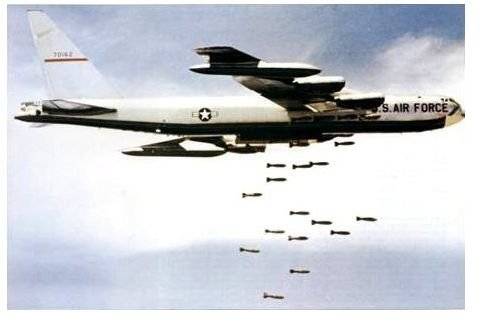
Vietnam in 1965 first saw the B52 used in warfare . During December 1972, in an attempt to enforce negotiations with the North Vietnamese, the B52 bombers were used and this proved successful, although several of the airplanes were lost by enemy action.
The year 1991 saw the conclusion of the Cold War and whilst the B52 remained in service, Strategic Air Command was disbanded. Having been transferred in 1992 to the Air Combat Command, the B52 served during the Gulf War and delivered forty percent of all weaponry dropped on Iraq by the United States and its allies. The airplane was again involved in action during 2001 in Afghanistan against terrorist activities.
Summary
When reference is made about the B52 bomber airplane by various people, it may be by one or more of its three popular “nicknames”. Apart from the one given by the aircrews, there was “Whispering Death”, so called by the North Vietnamese Army, due to high altitude from which the bombs were released, thereby giving no warning of their imminent impact. “Rolling Thunder”, originates from the sound made by a multitude of bombs dropped from B52s, within a relatively small area of operations known as “carpet bombing”.
References and Image Credits
https://www.centennialofflight.gov/essay/Air _Power/B52/AP37.htm
https://www.boeing.com/defense-space/military/b52-strat/b52 _50th/index.html
https://www.guardian.co.uk/flash/0,5860,586467,00.html
https://www.af.mil/information/factsheets/factsheet.asp?id=83
https://inventors.about.com/od/militaryhistoryinventions/ss/Bomber.htm
Image Credits:
https://www.ufosirius.com/b-52/
https://www.psywarrior.com/24thPsyopDet.html
https://www.parabolicarc.com/2009/04/22/boeing-q1-earnings-tank/


