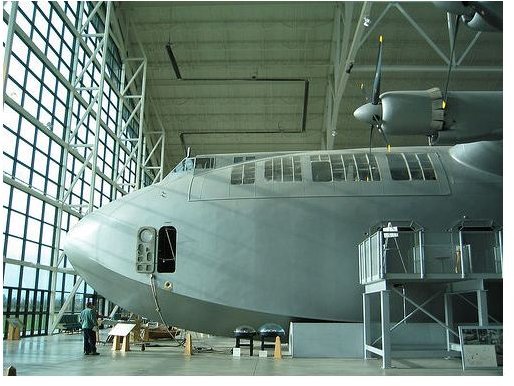
The largest aircraft ever built, the Spruce Goose airplane, was built by Howard Hughes during and just after WWII. It sealed its place in history with a one-time flight.
Spruce Goose Background
The Spruce Goose airplane is the largest aircraft ever built and it is almost entirely made of wood. The airplane is fascinating due to its place in history, its designer and how it came to fly. In the early days of World War II the U.S. was looking for a way to transport large numbers of troops and supplies to the war fronts. Transport ships were being built as fast as the shipyards could produce them and the enemy was sinking them even faster.
Industrialist Henry J. Kaiser proposed a fleet of flying boats and teamed up with Howard Hughes to design and build three prototype aircraft. The Spruce Goose became linked to Hughes as he and his team designed and eventually built the first prototype. Hughes ended up putting millions of dollars of his own money in the project and was the only person ever to fly the Spruce Goose airplane.
Features of the Spruce Goose Airplane
The Hughes Flying Boat H-4 aircraft was built from wood due to the shortage of aluminum during WWII. The government contract stipulated that the flying boat not be manufactured from materials critical to the war effort. Howard Hughes licensed a process from the Fairchild Aircraft company to produce laminated wood parts for the aircraft. The Hughes team had to overcome a wide range of engineering problems to build the Spruce Goose.
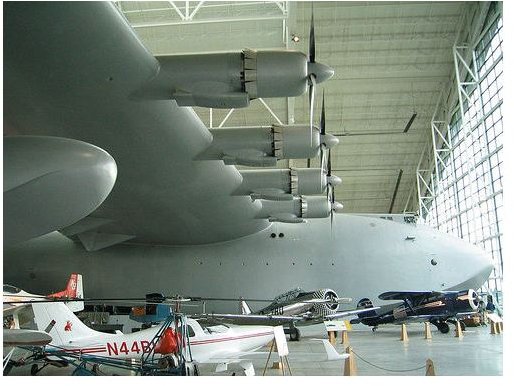
The Spruce Goose airplane has a wingspan of 320 feet, which is over 100 feet wider than the winds of a Boeing 747. The H-4 was designed to transport two railroad box cars or up to 750 troops. The flying boat was powered by eight 3,000 horsepower engines spinning 17 ft. diameter propellers. The Spruce Goose weighs about 300,000 pounds.
Although the Spruce Goose is manufactured from laminated wood, it is not spruce but primarily birch. The laminated wood used to build the airplane is considered by many engineering experts to be lighter and stronger than aluminum.
The Spruce Goose Flies!
After the war ended, Howard Hughes continued working on the H-4 project and eventually completed one aircraft, now known as the Spruce Goose, in 1947. Mr. Hughes received permission to do water taxi tests off Long Beach. On November 2, 1947 the airplane was taken out for the water taxi tests with Hughes at the controls. The first two test runs had the flying boat moving smoothly up to 35 and 90 miles per hour. On the third test run Hughes dropped some flaps and the airplane took off! The Spruce Goose flew for about a mile at an altitude of 70 feet.
No attempt was ever made to fly the airplane again. Howard Hughes kept the airplane in flying condition at a cost of $1 million per year until his death in 1976. The U.S. Navy considered testing the airplane in 1977 for data on long low altitude over water flights, but nothing ever came of it.
Visit the Spruce Goose
The historic Spruce Goose airplane is now the featured display aircraft at the Evergreen Aviation and Space Museum in McMinnville, Oregon.
Spruce Goose Photos
Resources
Evergreen Aviation and Space Museum