For decades, climatologists have raised global concern regarding widespread effects of global warming. One question worthy of consideration is: Are tsunamis a product of global warming? This is because the oceans release methane gas that, if warmed, might cause underwater avalanches!
Tsunami Evolution
A tsunami is one or more cataclysmic wave(s) produced through seismic activity on the ocean floor. Tsunamis often follow earthquakes, but other events such as volcanic eruptions and landslides are capable of creating the sudden seismic impact required to produce a tsunami.
Underwater seismic events produce waves that spread in all directions. This is similar to the way ripples are produced when a boy tosses a rock onto the surface of a pond. Tsunamis frequently attain speeds up to 500 miles per hour. As they approach shore, these tsunami waves are redirected by the elevated slope of the seafloor. Worse, their amplitude (height and power) increases! They travel inland and destroy everything that stands in their path.
Curiously, just before they come ashore, in the event of a tsunami, involved coastal waters may recede a considerable distance from shore. This may be the only warning a tsunami is imminent!
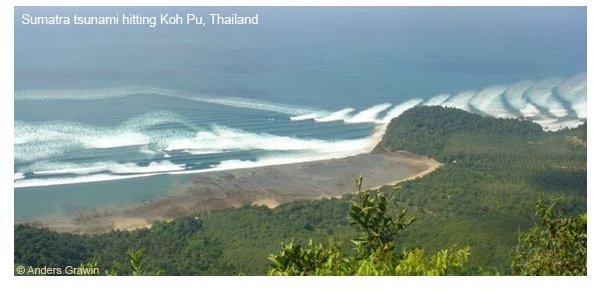
Sumatra Tsunami, Koh Pu, Thailand
Image Credit: NOAA Center for Tsunami Research
How Underwater Methane Could Initiate a Tsunami
At great depths, the oceans’ waters are quite cold. They are sufficiently cold to produce a hydrate (technically, a clathrate) of the natural gas, methane, called methane hydrate. If global warming occurred to a sufficient degree, the hydrate could be decomposed to water and simple methane gas. Especially unfortunately, the USGS says, “A likely mechanism for initiation of landsliding involves a breakdown of hydrates at the base of the hydrate layer. The effect would be a change from a semi-cemented zone to one that is gas-charged and has little strength, thus facilitating sliding.” This is of genuine concern. Deposits of methane clathrate are believed to be immense. Even though the methane does not explode, disappearance of the solid hydrate could cause a tsunami. In addition, the USGS estimates that, as a greenhouse gas, methane is ten times worse than carbon dioxide. The gas released by the decomposed clathrate would become part of a “vicious circle.” The gas from the decomposed clathrate would increase the atmosphere’s temperature which would warm the oceans which would decompose yet more of the clathrate, and so on.
References and Resources
Wood’s Hole Oceanographic Institution: When Seafloor Meets the Ocean, the Chemistry is Amazing
Science and Technology Review: “Methane Hydrate - a Surprising Compound ”
USGS Fact Sheet:Gas (Methane) Hydrates
More from Bright Hub: “Life and Climate Biomes ,” by Krima Olive Molina