Learn about the North American banana spider, a large but gentle spider. Learn how they look, where they live, what they eat, and more so you can share these banana spider fun facts with others.
Description
Banana Spider (also known as the golden silk spider)
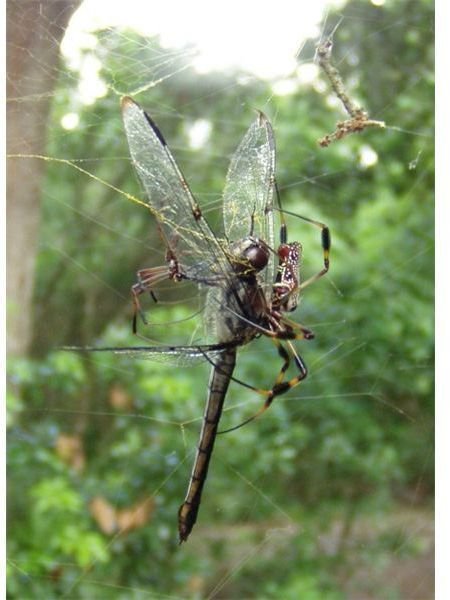
One fun fact about the banana spider is the striking difference between the female and male, known as sexual dimorphism (meaning they do not appear to be the same species). The female is considerably larger than the male. She is the largest non-tarantula spider in North America. Her body is elongated, about 1-3 inches in length, and her leg span can reach over 5 inches. The male banana spider, on the other hand, has a slender body, averaging about a 1/2 inch in length. The female is colorful with yellow spots, thus giving the name “banana spider” and the male is dark brown and rather inconspicuous.
Click on image to enlarge.
Banana Spider Web
The name “golden silk spider” came about because of the color of its silk. The yellow spider silk of sunlit webs shine brightly like gold and is beneficial by attracting bees. In the shade, the yellow blends in with the foliage in the background, acting as camouflage.
A banana spider’s web has a roundish “orb” shaped center. It is among the strongest of any spider silk and is said to surpass the strength of Kevlar, a fiber used in bulletproof vests.
Habitat
Banana spiders can be found in Florida to the Carolinas and in other warm and humid regions. They prefer sunny areas and tend to build their webs across a walkway or trail, spanning several feet. The spider web is normally at eye-level or higher, putting it in a perfect path for catching flying insects.
Diet
The diet of a banana spider consists of small to medium sized insects, including flies, mosquitoes, bees, stink bugs, grasshoppers, locusts, moths, dragonflies, and butterflies .
Behavior
Another fun fact is, despite being scary looking, the banana spider is non-aggressive. They are shy and will only bite if held or pinched. A banana spider does posses venom similar to the black widow spider but it is far less potent, making the bite quite harmless to humans. Normally, a small welt will appear and pass within 24 hours but a severe allergic reaction is possible in some individuals.
Banana spiders are good to have around to help control pesky insects like mosquitoes. However, if you prefer not having them around your home, you can tear down the spider web with a stick or broom and the banana spider will move on to another location further away.
Scientific Classification
Kingdom: Animalia
Phylum: Arthropoda
Class: Arachnida
Order: Araneae
Suborder: Araneomorphae
Family: Nephilidae
Genus: Nephila
Photo Credit
Image by Diana (author)