There are many possible renewable methods of generating electricity, but sea water is seldom considered a serious option. Here we’ll witness through an experimental set up how this simple method of producing free electricity can be one of the most efficient ones.
Electricity from Sea Tides
It’s ironic isn’t it? We constantly speak and debate about the energy crisis, exhausting fossil fuels, and rising electric bills, but simply fail to notice the vast amount of naturally available energy that’s scattered everywhere around us, waiting just to be picked up.
When it comes to renewable energy sources, normally we think of either solar power or wind power. How can we just forget about sea water (tides), which in fact covers the maximum portion of this globe and perhaps has the most constructive forces of all? If properly tamed and utilized for generating electricity, this raw force can surely produce enough electricity to eliminate the power crisis once and for all.
We all are familiar with the constant tidal waves generated by the sea. This vertical motion of the water can be simply used as a pump to alternately pull and push an enclosed air column inside a hollow tube or pipe. The generated air pressure can be used to rotate a turbine of a motor and generate electricity.
The simple experimental model presented here will convincingly prove the great potential of this method of generating electricity from sea water.
Let’s do it.
Building the Experimental Model
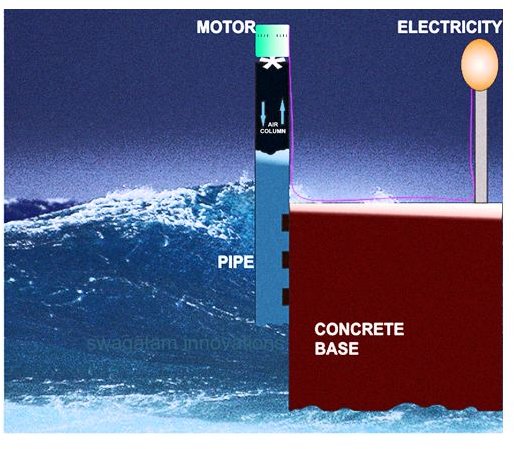
We know that the surface of the sea is very turbulent, generating constant inflation and depression over its surface level. If we take a cross-section of this movement, we find that the amount and the rate of displacement of the level is quite significant. If a hollow cylindrical pipe (open at its ends) is fixed such that 1/4 of its part is vertically immersed inside sea water, we can simply visualize the intense vertical push-pull motion of the water and the resultant release and suction of the air column inside the tube. Yes! If a motor/turbine assembly is fixed at the top opening of the tube, the above push-pull of the enclosed air can be very effectively used to rotate the turbine and generate electricity.
If you have access to a solid structure or construction somewhere deep in the sea (about 50 meters from the shore) you can well try out this simple experiment of generating electricity from sea water (definitely after taking permission from the relevant authorized bodies). The procedure is as follows:
As shown in the adjoining diagram, fix a hollow pipe (as per the specifications provided) suitably using clamps and bolts over the available structure, such that 30% its total length is immersed in the sea water. Now, if keep your palm over the top open outlet of the pipe, you will immediately be able to experience the strong to and fro gushes of air.
Take the procured motor/turbine assembly and secure it firmly over the top opening of the pipe as shown in the diagram.
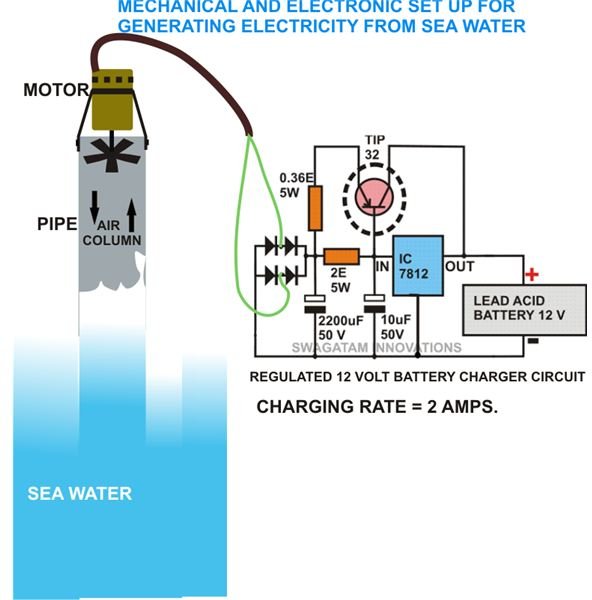
The action can be immediately witnessed as the turbine starts rotating in a reverse-forward motion, responding perfectly to the produced air thrusts. But, the above rotation, though powerful, is quite haphazard and not in one direction, and cannot generate a stable voltage. The output will alternately change its polarity, so it becomes difficult to optimize.
As usual, electronics is never out of ideas. A simple bridge rectifier can solve the problem. Regardless of the input voltage polarity, a bridge rectifier will always produce a direct current with constant polarity at its output. And, by adding a capacitor and a voltage regulator to it, we can further enhance the voltage quality so that it may be directly connected to a battery for charging.
The present set up incorporates the above idea to receive a clean and a continuous power output.
Thus, the whole explained procedure of generating electricity from sea water becomes pretty straight forward. The power generated from such an installation is powerful, permanent, and totally free of cost and maintenance. Imagine, if a government initiative is taken to construct many such units along the entire sea shore, I bet we can completely eliminate the issue of power crisis.