A detailed article helping you to understand what Kinetic Energy Recovery System (KERS) is and how it is used in F1 to recovery some part of the energy that is lost.
Kinetic Energy Recovery System, KERS
Introduction:
KERS stands for Kinetic Energy Recovery System. In short, what it does is to convert a part of the energy lost in braking and recovering it at a later point of time. Thus the KERS works under the law of conservation of Energy.
Parts of a KERS unit:
The various parts of KERS are
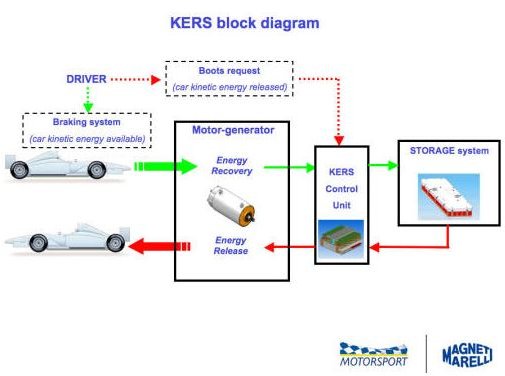
1. Braking system: This is the part from where the energy to be stored is collected,
2. Generator/Motor unit (GMU): This is used in the Electronic KERS where either the generator or motor will take over depending on whether the battery is being charged or discharged.
3. Flywheel: This is used in Mechanical KERS. It is used to store and release mechanical energy.
3. KERS control unit: This unit is provided apart from the control unit provided by Microsoft. This unit controls the signals and the levels on how much energy should be transferred from one part of vehicle to another, meaning the storing of energy and releasing of energy. It also performs an array of other operations.
4. Storage system: It is either the flywheel or battery, depending on which type of KERS is used.
Working Diagram for KERS
Two Types of KERS
They are:
1. Mechanical KERS
2. Electric KERS
How Mechanical KERS work:
This type of KERS gets mechanical energy and stores mechanical energy. This includes a flywheel that spins at around 64,000 rpm and collects energy from the brakes. Later when required, the wheels are coupled to the flywheel, thus giving additional acceleration to the car.
How Electric KERS work:
In this type of KERS the mechanical energy is stored as electrical energy and then later it is converted from electrical energy to mechanical energy. There is a generator/motor unit (GMU) which stores and releases the energy. When the car is braked, the transmission drives the generators which store the energy in super capacitor batteries. Later when required, the battery drives the electric motor which transmits energy to the wheels.
Disadvantages of KERS technology
Electronic KERS, as they store charge in the battery and as they charge and discharge very quickly, get hot very quickly. There is also a risk of the user or any other individual getting a shock when KERS is activated. So the driver is protected by well insulated dress and the other individuals get to see a warning light that says when the KERS is on or not.
The drawback with Mechanical KERS is that the flywheel will be spinning at high rate and there is a danger of the flywheel affecting the driver if it disintegrates and is not properly shielded.
Image credit
The credit for the image in this article goes to:
https://www.racecar-engineering.com/articles/f1/316137/the-basics-of-f1-kers.html