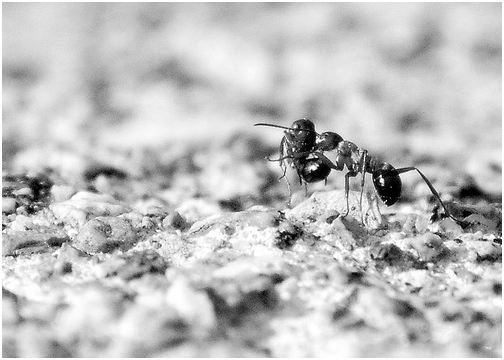
Ants are a common household problem, especially as the weather warms up. Next time you find yourself reaching for the bug spray, consider trying a more natural way to get rid of ants. This guide will provide tips and recipes for green ways to control an ant invasion.
As pesky as ants can be, it is important to realize that ants are beneficial insects that act as Mother Nature’s recyclers. They are able to feed on and consequently recycle matter from other insects, plants and animals, and they can even help to aerate the soil in our gardens. As helpful as these little recyclers can be, most people are not interested in sharing their homes with them. So what is a natural way to get rid of ants? This article will explore several non-toxic, chemical free options to rid your home of unwanted ants.
Limit the Ant’s Access to the Home
Ants are natural born scavengers and as such, they will take the opportunity to scavenge wherever and whenever the opportunity presents itself. Problems arise when ants find the opportunity to scavenge inside the home. The first line of defense against an invasion of ants is to block their points of entry. Careful observation will allow homeowners to identify where a trail of ants is entering the home and act quickly to deter them.
Traditional sealant techniques such as caulking around gaps in window frames, or cracks in a foundation will help to limit the access ants and other insects will have to the interior of a home. One helpful technique to determine the point of entry for ants is to leave a sweet offering such as a piece of candy on the kitchen counter or floor overnight. The ants should form a trail to the candy, making it easy to backtrack and find out exactly where the ants are entering the home.
Use Household Spices and Powders to Deter Ants
Once the points of entry have been effectively blocked or limited, it is time to address the ants that have managed to make it inside of the 
Talcum powder has been shown to be a safe and effective deterrent to ants. Sprinkling just a light dusting of talcum powder on windowsills, floorboards, or even pantry shelves can dissuade ants. Many people find that an ant will not walk across a surface that has been treated with traditional talcum powder, however, baby powder made from cornstarch will not have the same effect.
Another common way to deter ants is to use spices such as cinnamon, cayenne or black pepper. These spices can be left in a small trail along windowsills, cabinets or floorboards, or even sprinkled directly on a gathering of ants. The strong smell will cause the current ants to retreat and prevent future ants from invading.
Fresh Mint and Bay Leaves Are Natural Ant Repellents

All-Natural Ant Spray Recipes
When an ant infestation is already underway, it is sometimes necessary to take a more aggressive route. A natural way to get rid of ants is by spraying them with a solution made from vinegar or soap. The following recipes for all-natural ant sprays are non-toxic and when used as directed, will not harm people or pets.
Vinegar Based Ant Spray
Ingredients:
- 1 cup white or apple cider vinegar
- ½ cup water
- Small spray bottle
Directions:
- Add the vinegar and the water to the spray bottle and shake to combine.
- Spray the solution directly onto the trail or swarm of ants and allow the area to dry.
- Wipe the treated area clean and reapply as necessary.
Detergent Based Ant Spray
Ingredients:
- 1 cup liquid Ivory Soap
- 1 cup water
- Small spray bottle
Directions:
- Add the liquid soap and the water to the spray bottle and shake gently to combine.
- Spray the solution directly onto the trail or swarm of ants and allow the area to dry.
- Wipe the treated area clean and reapply as necessary.
Summary
As one of the most common household pests, ants can be troublesome if they are not quickly controlled. The natural ant control methods discussed in this article should help to eliminate an ant invasion in a manner that is safe for the whole family. Click here for more tips on green ways to control household pests such as fleas.
Sources
https://www.thefrugallife.com/ants.html
https://www.manataka.org/page1949.html
https://eartheasy.com/live _natpest_control.htm
Photo credit: “Ant” by Olivier Bareau https://www.flickr.com/photos/kowax09/2440472941/
Photo credit: “Cinnamon Sticks” by photo8 https://commons.wikimedia.org/wiki/File:Cinnamon-other.jpg
Photo credit: “Mint Leaves” by Kham Tran https://commons.wikimedia.org/wiki/File:Mint-leaves-2007.jpg