Helping students retain the information they learn is an important aspect of teaching. Instructors can accomplish this goal by taking advantage of the way the brain works and structuring their courses to reinforce ideas that are taught. By focusing on concept relationships, students can retain more.
Introduction
Reinforcing online learning can be done effectively and reliably if instructors keep in mind the way the brain stores information. The brain relies on networks of billions of connections to fashion new memories and to recall ideas. Using this concept, instructors can reinforce online learning by figuratively building bridges from existing knowledge to new concepts.
Bridges to New Concepts
The process of reinforcing online learning via bridge building can take a number of different forms. Instructors can use course discussions, written assignments, activities, and more to help students retain information. Bridge development techniques are intended to attach a new concept to some existing understanding that can be drawn upon at a future time.
When instructors reinforce online learning using these figurative bridges, they help students store and recall the information quickly and reliably. Instructors can have students retain the information in their classes by rotem but when it comes time to apply the information, it may be difficult to access in a dynamic way because it is so compartmentalized in the mind. As instructors we should focus on neural networks and fashion connections using classical teaching techniques applied in a way that reinforces the learning that takes place.
Phase I: Identify the Knowledge Gap
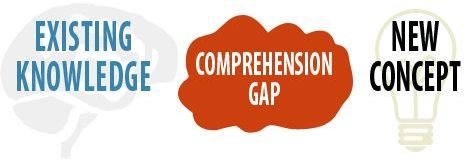
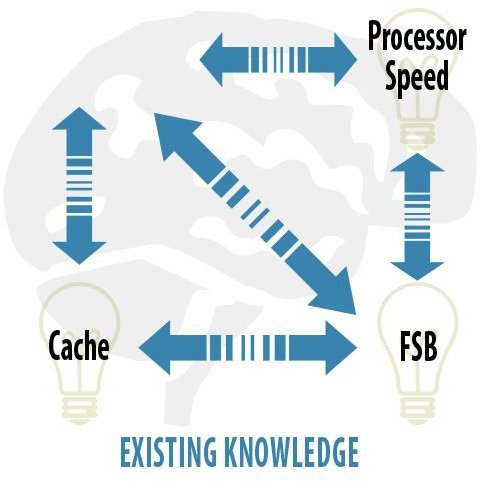
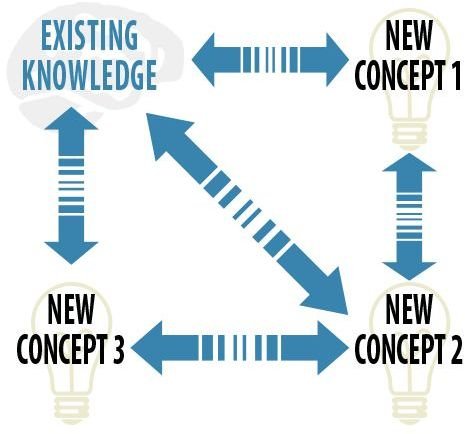
Identifying the existing knowledge and the gap between a new concept is the first phase of the process. For the sake of this example, I am going to use computer processor architecture. What I want to help establish is the ability of my students to understand three concepts related to processor architecture: speed, FSB, and cache. I want my students to be able to recall these concepts and use them in determining the capability of a processor. A gap exists between the existing knowledge of computers and the concepts related to computer architecture as illustrated in Image 1.
Phase II: Implement a Traditional Learning Tool
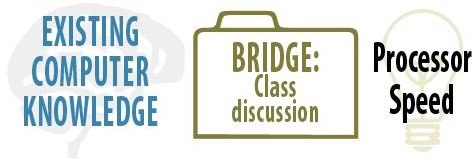
I employ an activity related to promote understanding of the first concept: speed. Since my students already know what a computer is, I employ a learning tactic designed to address some information contained in the text combined with some historical information. Specifically, I ask my students to discuss the impact that increased speeds have had on computing since 1997. Using this exercise to reinforce the concept of computing speed rather than simply stating that processors have speeds upwards of 3 GHz today helps to build a bridge between existing computer knowledge and processor speed.
Phase III: Reinforcing New Concepts By Branching from Other New Concepts
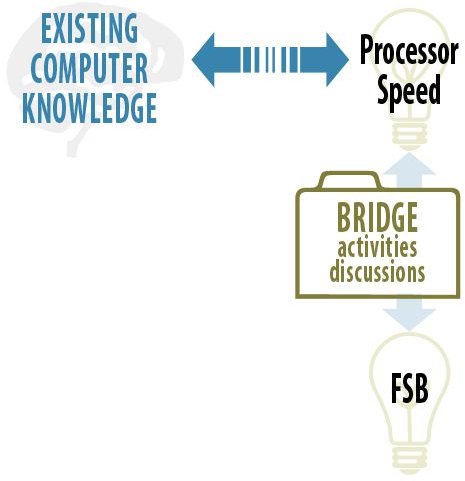
In order to continue to reinforce the new idea, I create the next bridge from the first new concept I introduced, which was processor speed. In Image 3 you can see that in order to more effectively reinforce the online learning concept I create an activity wherein I have students write a paper to explain how the FSB size can function as a bottleneck for input and output of the processor. This activity requires the student to revisit the first concept while exploring the second concept as shown in Image 3.
Review
These steps are used to branch out further and further from the existing knowledge until the bridges become permanent pathways. The newly established pathways increase the scope of the student’s existing knowledge as in Image 4. This enables students to add further concepts to their understanding and the process repeats itself. As long as instructors remember the way the brain stores information, they will be more effective in reinforcing online learning.
Comprehension Gap