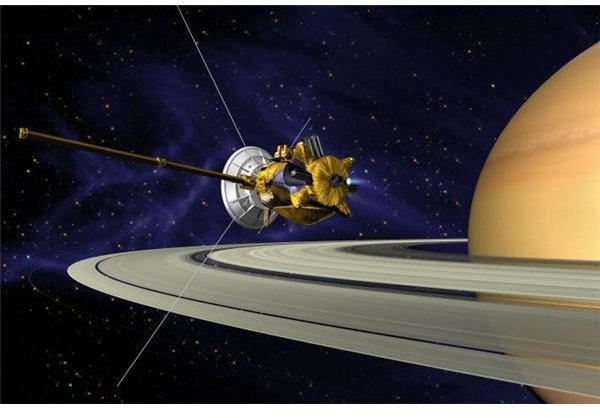
Cassini first began its study of the Saturnian system back in June of 2004 and continued exploring the system until June 2008. Cassini has recently had its mission extended. For more information, read on.
Facts About the Cassini Saturn Mission:
Since achieving orbit about Saturn in June of 2004, the Cassini Saturn mission received an extension to continue looking for answers to the many new questions that developed after its arrival to Saturn’s system of rings and moons. It is overseen by Carolyn Porco .
Facts about the Cassini Saturn Mission:
Official Name: For the first four years, its official name was the Cassini Saturn Mission, but now, due to its extension, it has been named the Cassini Equinox Mission.
Active Observation of the Saturnian System: The mission first began on June 30, 2004 and continued through June 30, 2008. It has now been approved to continue through September 2010 to help answer the many newly developed questions about Saturn’s equinox, which occurs in August of 2009.
Cassini Partners: This is a joint effort between NASA, the ESA, and the Italian space agency, ASI, with the entire project being managed by NASA’s Jet Propulsion Laboratories.
Launch Date: October 15, 1997
Launch Vehicle: Titan IVB/Centaur
Weight of Cassini: 5,712 kilograms (12,593 pounds)
Distance traveled to orbit Saturn: 3.5 billion Km/2.2 billion miles
Saturn’s average distance from Earth: 1.43 billion Km/ 890 million miles
At Cassini’s arrival, the one way speed of light time from Saturn to Earth: 84 min.
During orbital tour, the one way speed of light time from Saturn to Earth: 67-85 min.
Venus flyby: Apr. 26, 1998 (234km) & June 24, 1999 (600km)
Earth flyby: Aug. 18, 1999 (1171 km)
Jupiter flyby: Dec. 30, 2000 (10 million km)
Arrival date in Saturn: June 30, 2004
Huygens Probe size: 2.7 meters (8.9 feet) in diameter, Weight: 320 kilograms (705 pounds)
Huygens Prober release date: December 24, 2004
Huygens Probe Landed on Titan: January 14, 2005
Amazing Facts
- Huygens probe sucessfully landed on Titan and sent back information on large methane lakes and hydrocarbon sand dunes and the possibility of a sub-surface liquid water-ammonia ocean.
- Cassini has indicated that there may be rings around Saturn’s moon, Rhea.
- Cassini has discovered “ice-volcanoes” on Enceladus, whose plums are rich in hydrocarbons, which may indicate a subsurface ocean - a prime location for extraterrestrial life.
- Thirty-three states in the United States worked on the Cassini Saturn Mission.
- The cost for the Cassini Saturn Mission came to $1.422 billion for the pre-launch development, $710 million for the mission operations, $54 million for tracking, $422 million for the launch vehicle, $500 million for the ESA, and $160 million for the ASI, totaling approximately $3.27 billion, with the U.S. contributing $2.6 billion and the European partners’ contributing $660 million to the mission.
- Over 5,000 people worked on some area of this mission.
Resources
Article:
Image:
https://www.irf.se/press/pics/60030main_cassini-concept-b.jpg