There are more moons orbiting Saturn than any other known planets. Since the early days of astronomy, researchers have located these moons and given them unique names based on mythological gods. Unlike most other celestial systems, the moons of the planet Saturn have a number of unique features.
How Many Moons Does Saturn Have?
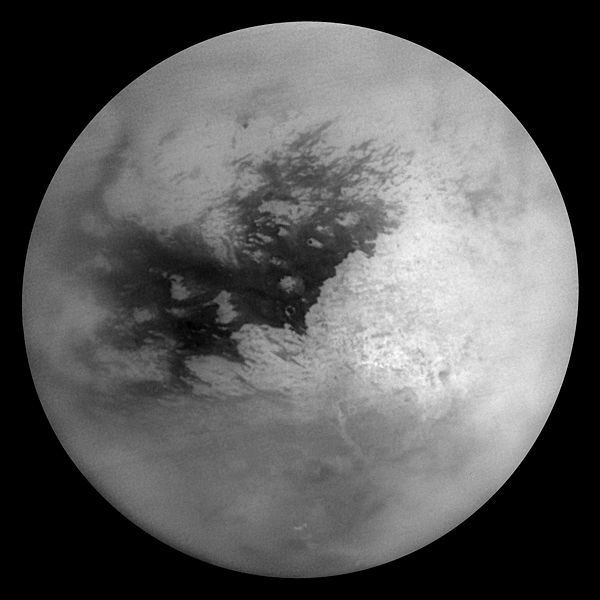
As of 2010, 62 individual moons of the planet Saturn have been identified to maintain orbits, although only 53 have been named. The smallest of these moons is merely 0.6 miles (50 km) across, while the largest, Titan , is almost half the size of the Earth. Only 24 of the satellites maintain regular orbits, while the remainder have irregular paths. It is believed that many of the moons were captured from debris of larger
bodies that collided earlier in the life of the solar system.
There is much debate as to how to classify the rings of Saturn . Scientists have identified at least 150 different objects located within the rings that would otherwise be considered moonlets. However, due to their position within the rings, they are simply classified as part of the phenomena.
Above left: Titan. (Supplied by NASA; Public Domain; https://upload.wikimedia.org/wikipedia/commons/d/d8/Titan2005.jpg)
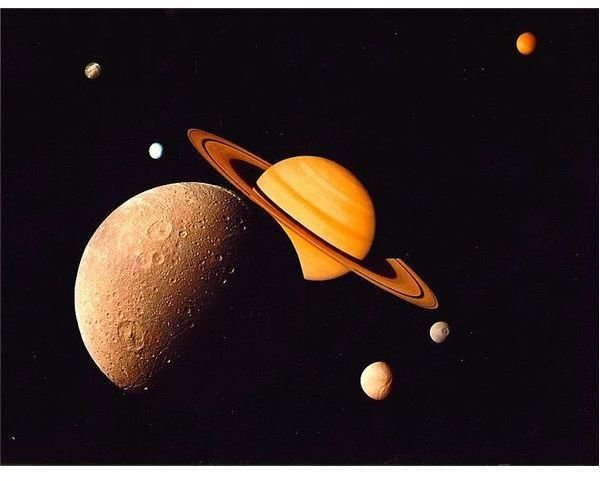
Above right: Saturn with five moons, notably Dione. (Supplied by NASA; Public Domain; https://upload.wikimedia.org/wikipedia/commons/a/a9/Saturn _family.jpg)
Discovering the Moons of Saturn
Observations from the Earth before the 20th century hailed the discovery of only nine moons. A telescope was first used by Christiaan Huygens to discover the largest moon in 1655. The next four, Tethys, Dione, Rhea and Iapetus, were discovered by Giovanni Domenico Cassini between 1671 to 1672. Nearly a hundred years passed before Mimas and Enceladus were discovered by William Herschel in 1789. 1848 saw the discovery of Hyperion by W.C. Bond. By using a photographic plate, W.H. Pickering located the final of these moons, Phoebe, in 1899.
As telescope technology and spacecraft designs advanced in the 20th century, the remainder of the moons of the planet Saturn were discovered. The most important event during this period was the flyby of the Voyager missions between 1980 and 1981.. Photographs sent back by the spacecrafts resulted in the discovery of four additional moons, one of which wasn’t discovered until further analysis of the images in 1990. Further discoveries have been made using the Cassini spacecraft currently in orbit around Saturn . Cassini reached orbit in 2004 and continues to send information back at a steady rate, including that of flybys of Phoebe, Enceladus and Titan.
How the Moons of the Planet Saturn Were Named
Beginning in 1847, John Herschel proposed naming the moons of the planet Saturn after the brothers and sisters of the Roman god of agriculture. This lasted until the 20th century, when the names of titans had been exhausted. At this time, the moons with regular orbits were named after other characters in Roman-Greek mythology. It was also decided at this time that moons with irregular orbits would be named from other mythological gods, specifically those of the Inuit, Gallic and Norse cultures.
Unique Facts About Saturn’s Moons
Some of Saturn’s moons have unique features unlike most other known planetary bodies. One such feature is the existence of shepherd satellites, small moons that follow the orbit of Saturn’s rings. As the planets move around the planet, they have the tendency to disrupt the edges of rings. Saturn also has a set of co-orbital moons, Janus and Epimetheus. They orbit only a couple miles apart from each other. In theory, they could collide, however, the effects of the bodies gravity results in slight movements that cause each to swap orbit every four years. Several of the moons of the planet Saturn also exhibit orbits that lead or trail Langrange points. These are known as trojan moons. Telesto and Calypso are trojan moons of Tethys, while Polydeuces and Helene are trojan moons of Dione.This is caused by the fact that gravitational forces of the two larger objects have the same ratio as the two smaller bodies, causing a concentration at the center of each objects mass.
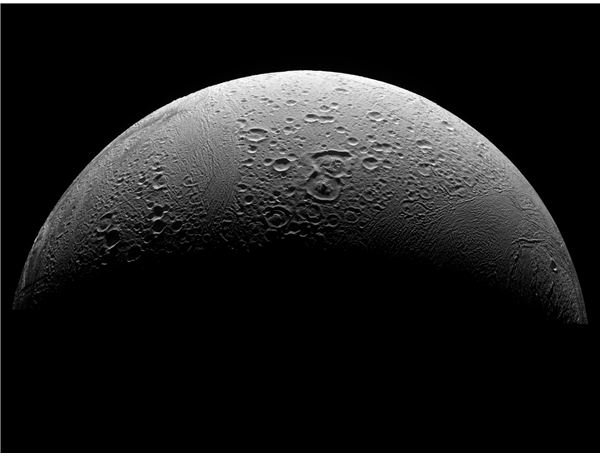
Above left: Enceladus. (Supplied by NASA; Public Domain; https://upload.wikimedia.org/wikipedia/commons/c/c5/PIA08409 _North_Polar_Region_of_Enceladus.jpg)
Resources
“Moons of Saturn” CSEP: https://csep10.phys.utk.edu/astr161/lect/saturn/moons.html
“Saturn” Enchanted Learning: https://www.enchantedlearning.com/subjects/astronomy/planets/saturn/saturnmoons.shtml