Since before the space program existed, speculation by science fiction writers and artists pointed to the possibility of life outside of Earth. The search for proof of life in outer space has been a primary focus of mankind’s exploration, prompting the launch of many space probes and telescopes.
Space Bacteria
In 2001, astronomers at Cardiff University in Wales determined that they had discovered clumps of Earth-like bacteria along the edge of the planet’s atmosphere. In a meeting of the International Society of Optical Engineers in San Diego, California, Professor Chandra Wickramasinghe stated that the bacteria were too far away from the planet to have come from Earth, therefore they must be from another location and may be proof of life in outer space. Additional evidence show that due to the distribution of the samples, they must be falling into orbit from space, with a third of a ton coming into the planet’s atmosphere each day. This also adds evidence to the theory that life on Earth came from spores or bacteria from another planet.
Antarctic Meteor
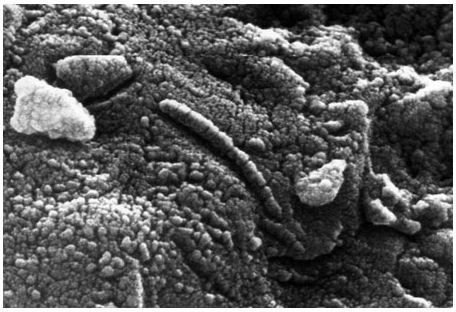
Known as meteor ALH84001, scientists discovered a meteor in 1996 in Allan Hills, Antarctica that may possibly be proof of life in outer space. This meteor fell to Earth 13,000 years ago and tested to be a 4.5 billion year old sample of Mars . Within the tiny cracks of the meteor, ancient bacteria appear to be present. Researchers have identified carbonate globules, polycyclic aromatic compounds and iron, which all signify the presence of biochemical reactions. Additionally, photographic evidence shows fossilized bacteria itself, leading to many debates within the scientific community regarding whether this sample actually represents proof of life in outer space or simply a contaminated piece of space rock.
Above left: ALH84001. (Supplied by NASA; Public Domain; https://upload.wikimedia.org/wikipedia/commons/a/a8/ALH84001 _structures.jpg)
Cloud Colonies of Venus
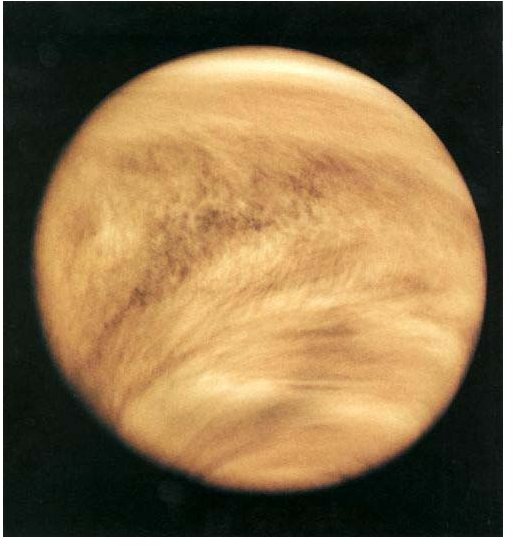
It is widely accepted that life as we know it cannot survive on the surface of Venus , where high temperatures and pressures of 90 atmospheres would make it less than hospitable. However, recently evidence has shown that it is possible for life to exist in the clouds roughly 30 miles (50 kilometers) from the surface. The temperature is this region is only 86 to 176 degrees Fahrenheit (30 to 80 Celsius) and the atmospheric pressure is equivalent to sea level on Earth. This conjecture, accompanied by research from David Grinspoon, the Principal Investigator for NASA ’s Exobiology Research Program, point to the likelihood that organisms most likely inhabit this area in hydrogen clouds.
Probes sent from both Russia and the U.S. seem to point to possible proof of life in outer space. Both hydrogen sulfide and sulfur dioxide were found together, an interesting fact considering they usually destroy each other in a short period of time. This means that some organism is most likely producing them. The additional presence of carbonyl sulfide also points to the potential for life as trees and microorganisms on Earth make this substance. Dirk Schulze-Makuch of the University of Texas at El Paso believes that the combination of these three gases, along with the lack of carbon dioxide, means that there is most likely a possible organism using the carbon dioxide to produce the gases.
Above right: Clouds on Venus. (Supplied by NASA; Public Domain; https://upload.wikimedia.org/wikipedia/commons/b/bc/Venuspioneeruv.jpg)
Water in the Solar System
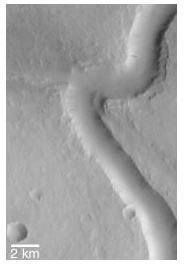
One of the greatest pieces of evidence that points to the likely proof of life in outer space is the fact that many celestial bodies throughout the solar system maintain certain forms of water either on (or below) the surface or in the atmosphere. The most notable of these is the possibility of water on Mars. The Phoenix lander showed in 2008 that frozen water did indeed exist in the soil. Other bodies also have water in different forms. The Messenger probe sent to Mercury identified large volumes of water in the exosphere and hydrocarbon lakes were identified on Titan by the Huygens probe . Speculation over the years also points to possible water on the two moons of Jupiter, Europa and Ganymede , as well as Saturn ’s moon Enceladus .
Above left: Potential water flow on Mars. (Supplied by NASA; Public Domain; https://upload.wikimedia.org/wikipedia/commons/e/eb/Scamander _Vallis_from_Mariner9.jpg)
The Quest Continues
What astronomers and researchers the world over have determined is that life may exist in a variety of forms throughout the solar system. The search for “little green men” in the past has given way to a more concrete scientific approach, as demonstrated by the fact that most research is geared towards microscopic life. The basic fact is that if we find life of any kind close to home, then one may surmise that intelligent life, such as ours, is most likely not alone in the universe. It must have developed somewhere else.
While proof of life in outer space has not been concretely determined, the quest to find it still continues. Scientists and researchers alike will always use whatever means they have at their disposal to find the answer to one of life’s persistent questions: “Are we alone in the universe?”
Resources
Space: https://www.space.com/searchforlife/bacteria _space_010731.html
Duke University: https://www.chem.duke.edu/~jds/cruise _chem/Exobiology/search.html
Astrobiology Magazine: https://www.astrobio.net/exclusive/311/venusian-cloud-colonies