Since ideas about bringing back extinct species were first presented to the public in the late 20th century, a number of researchers and geneticists have endeavored to map the genomes that could make this theory a possibility. One of these species is Neanderthal man.
Neanderthals were early human primates who occupied much of Europe during the last million years. Questions about how the species died out are hotly contested - were Neanderthals killed by modern humans? Or did they simply become naturally extinct? A number of geneticists have begun to research the possibilities of cloning the long dead species. According to some, the possibility is apparent, however, the ramifications are extensive.
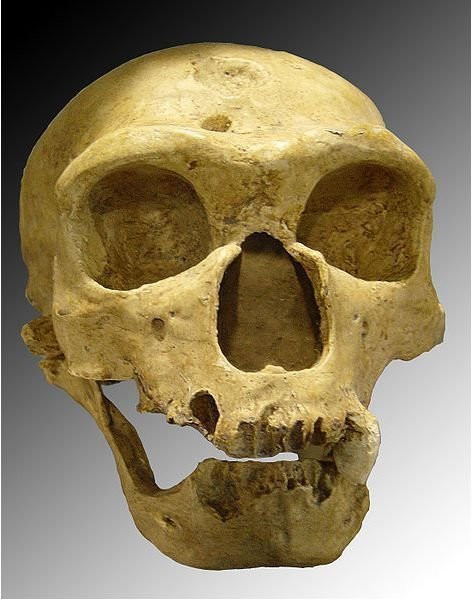
Above left: Neanderthal skull. (Supplied by Luna04 at Wikimedia Commons; GNU Free Documentation License; https://upload.wikimedia.org/wikipedia/commons/e/e0/Homo _sapiens_neanderthalensis.jpg)
Neanderthal Genome
In February of 2009, a team of German researchers from Max Planck Institute for Evolutionary Anthropology in Leipzig announced that the preliminary work of mapping the Neanderthal genome had been completed.
Approximately 800,000 years ago, Neanderthals and modern humans separated, and they became specifically genetically different about 300,000 years ago. The gene map has given scientists a deep look into the history and potential life cycle of this near-human primate. Using information about mitochondrial DNA mapped in 2008, the study required that 3.7 million distinct gene elements of DNA from the nucleus be mapped as well.
This information has shown that both humans and Neanderthals both share the gene for speech. It has also shown that interbreeding was possible, specifically linking European DNA to that of the extinct species. The gene map also shows that, like humans, Neanderthals stemmed from a very small population.
One of the major differences the genetic information has shown is that the gene that regulates brain size is missing in the Neanderthal.
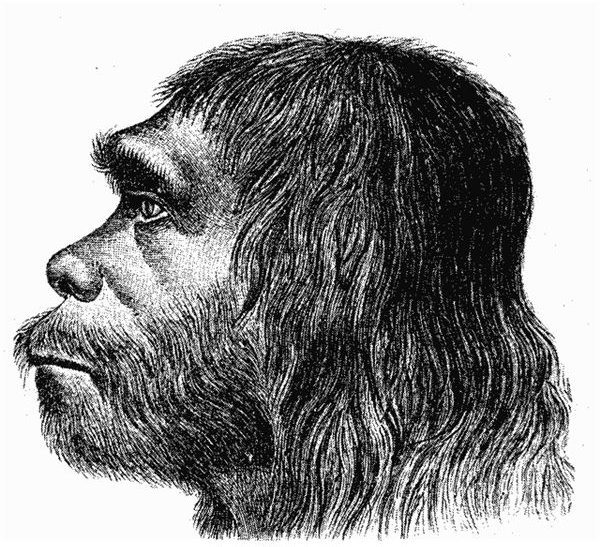
Above right: Neanderthal drawing. (Supplied by Wikimedia Commons; Public Domain; https://upload.wikimedia.org/wikipedia/commons/9/9b/Neanderthaler _Fund.png)
Process
Using information gathered from the genome mapping of woolly mammoths and cave bear, the techniques for gene sequencing of an extinct species have been established throughout the late 1990s and early part of the 21st century. Researchers gathered the information from a number of Neanderthal bones from across Europe and Asia as well as fossilized hair samples.
The concept for engineering a cloned Neanderthal is rather basic by the standards of general human genetic engineering. A number of scientists have stated the process would be as simple as modifying the DNA in a human egg. After a number of rounds of the process, it could be implanted into a human female’s womb and brought to full-term. According to some sources, this could be accomplished as soon as 2012.
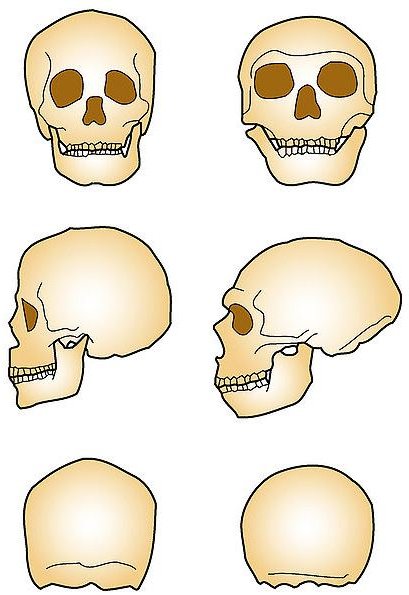
Above left: Comparison of Neanderthal and Sapiens crania. (Supplied by 120 at Wikimedia Commons; GNU Free Documentation License; https://upload.wikimedia.org/wikipedia/commons/0/07/Neandertal _vs_Sapiens.jpg)
Genome of a Neanderthal Ethics
The ethical implications of bringing back Neanderthal man are massive. Religious groups, spurred on by the news of the most recent advances have protested against modifying modern human DNA into that of another species. According to the U.S. Conference of Catholic Bishops, the organization is opposed to all types of human cloning including the concept of bringing back the extinct species .
In addition, civil rights attorneys also question the ramifications of cloning a Neanderthal. Would the species be considered human, thereby enjoying the rights of modern man? Or would the species merely end up being locked away for research or placed into zoos around the world?
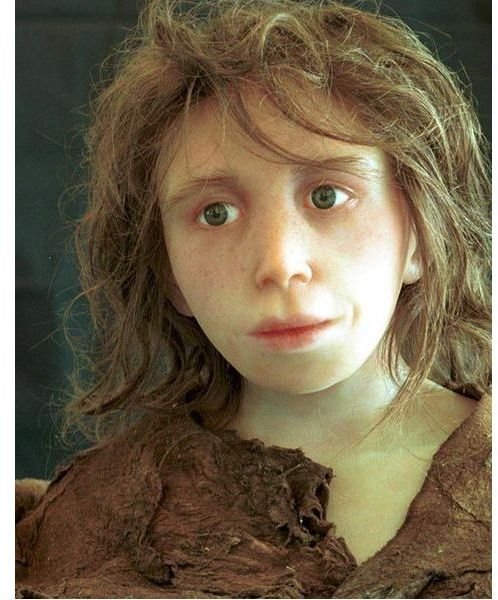
Above right: Model of Neanderthal child. (Supplied by Christoph P.E. Zollikofer at Wikimedia Commons; Public Domain; https://upload.wikimedia.org/wikipedia/commons/d/d9/Neanderthal _child.jpg)
Resources
Daily Galaxy: https://www.dailygalaxy.com/my _weblog/2007/06/neanderthal-man.html
CBS News: https://www.cbsnews.com/stories/2010/02/12/tech/main6201715.shtml
This post is part of the series: Genetic Origins of Man and Man’s Best Friend: Dogs
Mankind developed over millions of years to the state in which it finds itself today. Tied to the origins of humans is the decline of the Neanderthal and the rise of the dog.