According to the laws of genetic diversity, haplogroup types are passed from parent to child, giving scientists a map of human migration and evolution. Haplogroup distribution in Europe happened primarily through the immigration of various cultures over thousands of years.
Predominant Haplogroups
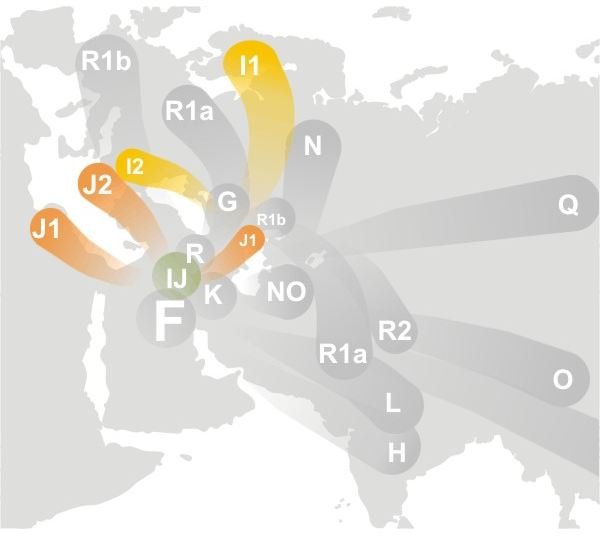
Haplogroup distribution in Europe began approximately 33,000 BC with the influx of haplogroup IJ from the Middle East. After around 10,000 years, mutations caused the creation of the distinctly European haplogroup I. Most scientists believe that the Cro-Magnon populations belonged to this genetic group. This division is still predominantly located in Northern Europe, particularly Scandinavia.
One of the most common population groups in Europe is haplogroup J. It descended from Mesopotamia into the areas of Greece, Italy, France and Spain sometime during the Bronze Age.
The last influx of genetic variations from Africa occurred sometime after 7,000 BC. Haplogroup E1b1b migrated from the Horn of Africa 25,000 years ago and ultimately made its way through the Middle East and into Europe, settling in Greece and the Balkans.
Haplogroup G descended into Europe from the Caucuses, primarily responsible for genetic variations found in the Russian and Eastern Europe regions. A mutation of the haplogroup, G2a, however, is found in Switzerland, Greece and Italy. A number of theories exist as to why this gene came to Europe, most notably the use of eastern populations as fighters for the Roman Empire. This is supported by the fact that haplogroup G is less prevalent the further away one gets from Rome.
Rare European Haplogroups
A rare European haplogroup, T, is found in less than one percent of the populations. Ironically, this haplogroup is found in random pockets throughout Europe: Sicily, Ibiza and Serbia. This most likely occurred due Phoenician colonization between 1200 and 800 BC.
From Southeast Asia, haplogroup N immigrated to Finland and Russia 10,000 years ago. Areas of Hungary and Slovakia are populated by haplogroup Q, descending from the Hun invasions of the 5th century. Haplogroups C3 and P came from the Mongol invasions and is sporadic throughout Europe. Trading with merchants from Persia and India brought L, while the Gypsy populations of Eastern Europe are descended from the Indian subcontinent, bringing H to the region.
Above Right: Haplogroup IJ (Supplied by Sasha I at Wikimedia Commons; GNU Free Documentation License; https://upload.wikimedia.org/wikipedia/en/6/63/Haplogroup _IJ_%28Y-DNA%29.jpg)
Reasons for Genetic Variations
There are a number of different reasons for the genetic variations of haplogroups within Europe. Invasions of cultures over the years, either through war or general immigration, is the primarily reason for the occurrence. Due to the status of men within early human society, concentrated populations of genetic variants developed within a few generations of an influx. Prominent men often practiced polygamy, spreading their genes to more children. Women were often used to unite tribes or as prizes in warfare, destroying the native populations of many haplogroups.
Mitochondrial DNA
Mitochondrial DNA (mtDNA) is transmitted through females. While the N group is believed to be the original mtDNA, it was mostly wiped out over the course of thousands of years. Today, most haplogroup distribution in Europe do not correspond to the Y-DNA haplogroups. This is most likely due to the tendency of women to reproduce outside of their original tribe, creating a deep mixture of subclades within the various ethnic groups.
Resources
“European Haplogroups” Eupedia
“What are Haplogroups?” DNA Heritage
Related Links
What is Deep SNP Testing in DNA?
This post is part of the series: Genetic Origins of Man and Man’s Best Friend: Dogs
Mankind developed over millions of years to the state in which it finds itself today. Tied to the origins of humans is the decline of the Neanderthal and the rise of the dog.