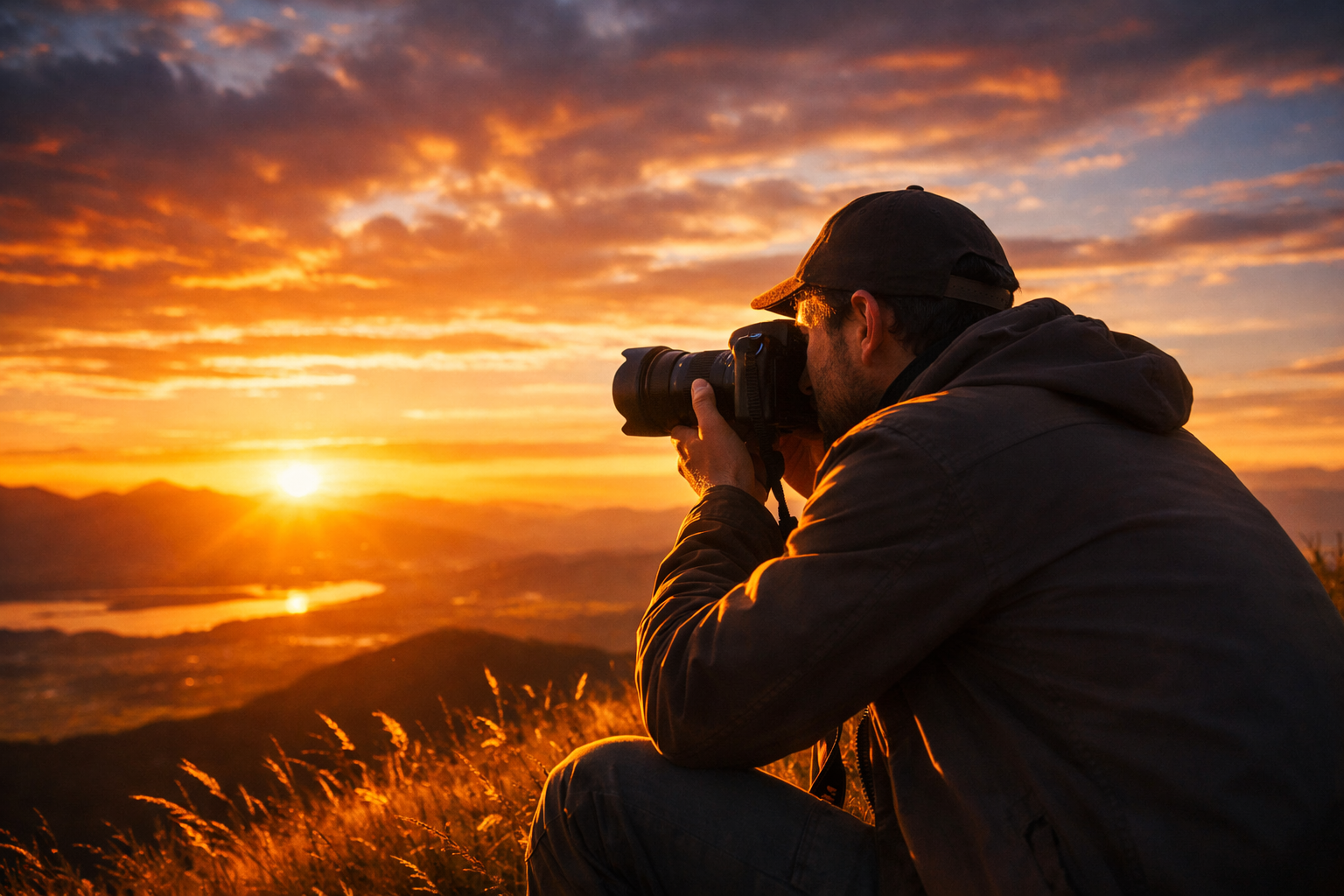
Anyone who has a camera can capture great scenery but only a photographer can connect emotionally with the environment in order to express something personal.
What this article is about
“Most tourists feel compelled to put the camera between themselves and whatever is remarkable that they encounter. Unsure of other responses they take a picture. This gives shape to experience: stop, take a photograph, and move on.” Susan Sontag - On Photography
The world is full beautiful places and it is through photography that we are able to experience the splendor of places we have never seen before. Calendars, brochures, postcards and books – these give us a glimpse of romantic and majestic locations we never thought existed.
This tutorial will tackle a number of things:
- The history and development of landscape as a subject of art
- How to express ideas and emotions through landscape images
- Understand the different techniques which can aid you in creating expressive landscape images
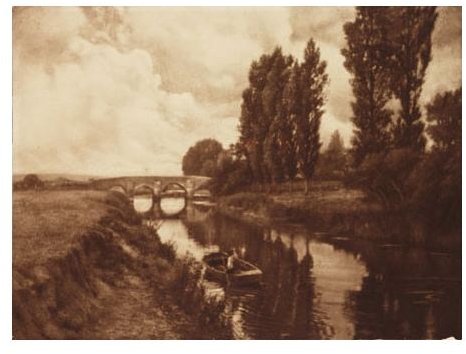
Sample Photos - pictorial photography style
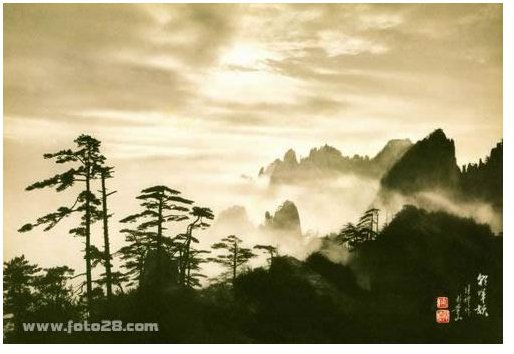
The history of landscape photography
Early landscape photography used the same principles used in painting in order to create works of art. Prior to the 18th century, landscape was painted only as a backdrop for a principal subject. In the latter part of the century however, artists such as John Constable and William Turner have started romanticizing the environment, using it as a principal subject in paintings.
Photography was invented at a time when western cultures were exploring new lands. It was used as a medium for documenting the grandeur of the natural environment and usually included small details.
The first photographic movement was born a couple of years after Constable and Turner and was known as the “pictorial photography”. Pictorial photographers believed that their field is more than just an objective, mechanical media. Photography was not just about the information contained by the images they produced, but rather, about the effect and the mood they translate.
At this time, technology for photography was still in its primitive stage and many photographers felt that their lens recorded too much detail. To address this, photographers started employing several techniques to soften their images. The main goal was to create an image which looked more like a painting or a drawing. Some of the most common techniques used included print manipulation as well and taking the images out of focus.
By 1889, Dr. Peter Henry Emerson started promoting “naturalism”. He believed that photographers should stop emulating the techniques in painting and start treating photography as an independent art form. He believed people should strive to communicate something personal through their work. They should look at the environment for inspiration. In 1902, Alfred Stieglitz helped promote photography as an aesthetic medium. Through his exhibit entitled “Photo Secessionists”, he featured nonconformist pictorial images of everyday objects taken with a hand held camera, hence the term “realism”. The break from pictorial photography was initiated by a group called the F64. Some of its members included prominent photographers such as Edward Weston and Ansel Adams who produced images using the smallest apertures on large format cameras for maximum sharpness and detail.
Continue on to page 2 where you will learn about photography as a personal expression.
Photography as a personal expression
With the different hues of nature, landscape images are more than just a simple record of landscapes at a particular point in time. It is an image which represents the photographer’s emotion, idea or concept. Landscape photography uses light , design and symbolic reference as a way to communicate. Today, photography is viewed as such and its power to convey self-expression and charge emotions cannot be underestimated.
Today, the camera is more than just a recording medium, but rather, seen as a tool for a photographer to record his personal vision. It is a tool which can transform the familiar to the exotic, the real to surreal.
Landscape photography is no longer just about the beauty of nature, but also, the depiction of natural landscape as seen from an urban dweller’s point of view. Landscape images now depict alternative realities. They can be used as a political tool showing the differing values of society. The traditional conduct of landscape photography was unified and harmonious, but it may now be portrayed as cluttered and confused – a change owed to the development of technology and the changes it has effected to our world.
Landscape photography is a way for photographers to explore their personal relationship with their environment, a way to interact and respond to the external stimuli. The camera is now used as a tool for discovery and revelation.
Sample of urban landscape photography
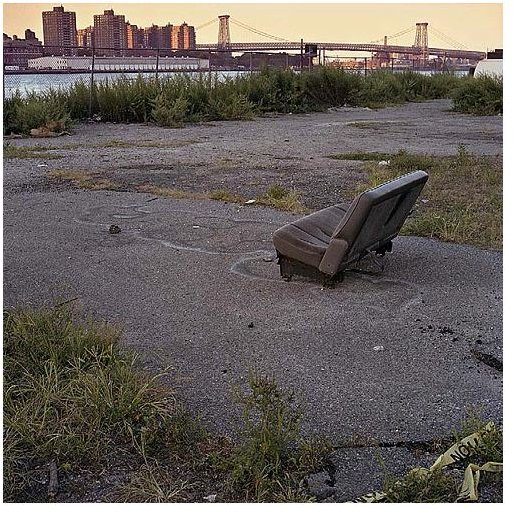
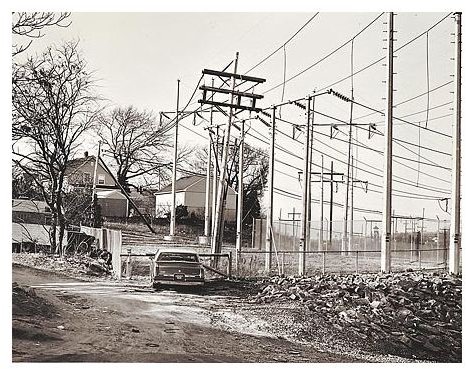
How to take expressive photographs
If you are using a standard lens, you will realize that taking panoramic images can be difficult. On the other hand, a wide angle lens can take too much detail giving you an empty sky and foreground which does very little for composition.
As a photographer, you will need to learn how to remove excessive detail without ruining the message and emotion you wish to convey. The only way for you to do this is to find a great vantage point to capture the details you need for your message to be completed. You can move in closer to reduce the information contained on the frame but take care not to move too close or the feeling of the broad landscape may be lost.
Through careful observation and knowledge of the basic elements in photography, you will be able to achieve the landscape image you want.
Using ambient light
The best landscape photos are taken on low light situations – during sunset or sunrise . During this time of the day, the different colors in the sky can help you in depicting the mood you want to express. Also, the changes in contrast will give you lots of possibilities to use to your advantage.
In many cases, you might want to take photos of landscape with the sun shining bright in the sky. In this case, the extreme brightness might overexpose the details in the sky and underexpose the land. To prevent this, you can use a filter on your lens. You should also consider shooting at a different time of the day. Aside from these, it is important that you use the camera’s RAW format so you can exploit the full dynamic range that your image sensor is capable. You can also play with the exposure or correct the images in post-production.
Also, it is best to learn exposure bracketing so you can take a series of photos and merge them through Photoshop’s HDR (High Dynamic Range) automated feature. It is best not to change shutter speed and aperture for maximum results.
Night photography
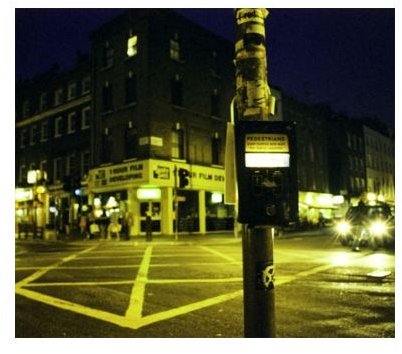
Although they call it “night” photography, the best time to take photographs is at dusk, not in the middle of the night. During this time, the remaining light of the day will cast colorful shadows on the landscape allowing the viewer to delineate the different features of the scenery.
Night photography is a technically demanding exercise and will need the use of several photographic elements as well as additional equipment.
Always use a tripod to hold your camera and if you can, purchase a cable release to trigger the shutter. Of course, if your camera has a self-timer, then you can also use that feature to your advantage. Bring a flashlight with you so you can easily see the controls of your camera. To minimize noise on your images, raise the ISO and use long exposure settings.
When shooting night lights, you should avoid pointing your camera directly to the light source. Also, you can use exposure bracketing to get different images which you can merge later on during post production.
Continue on the page 3 to learn the different techniques you can use in landscape photography.
Composing a shot
We all know how important composition is when it comes to delivering your message through images. Unlike people photography , however, the horizontal line is one of the most powerful elements you can use to compose your shot.
Most landscape shots are in horizontal format because this is usually how the eye sees landscapes. Using the vertical or portrait format with tall subjects (such as mountains) can ruin your shot. To avoid using portrait mode when shooting landscape, you will have to move to a different vantage point.
Putting the horizontal line in the middle of the frame is best avoided (remember the rule of thirds ?) and you should also consider what your foreground will be. Will it be the sky? Or perhaps there is another interesting element which you can use to construct the weight and balance of the image?
If you decide to remove the horizon on the image, then you are creating a closed landscape. Creating a sense of depth is more difficult with a closed image, but it isn’t impossible to achieve.
Adding depth and scale
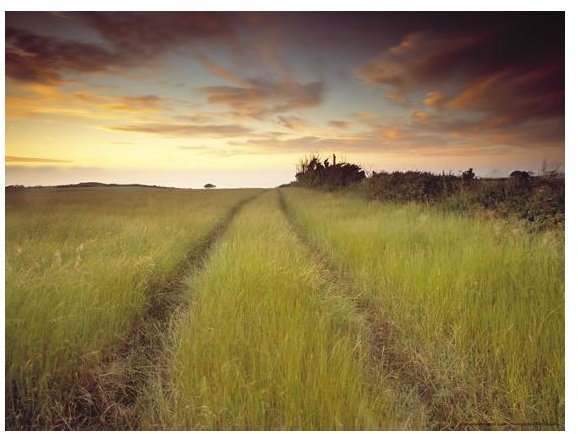
If you wish to add depth to your photos, you should learn how to exploit lines found in the foreground to lead the viewer’s eyes to your main image. Roads, rivers and fences can be used for this purpose. Create an illusion of depth by lowering your vantage point or angling the camera down.
The lines in the photo (left) will help the viewer establish a sense of place.
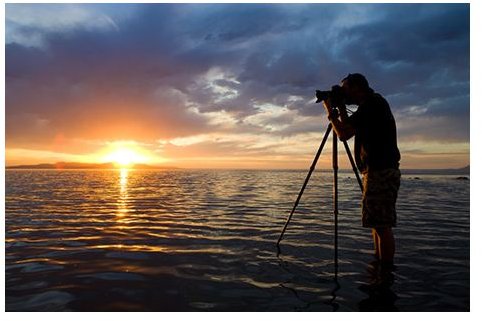
Sometimes, creating a sense of depth may be difficult due to the absence of lines and the lack of color in the foreground. In this case, you can add a subject which is of a known size which can serve as a focal point of interest.
In the photo below, the photographer tells us how vast the sky and the ocean are.
To combine scale and depth, you will need to learn how to manipulate your camera’s focal length.
Correcting distortion
The wide angle lens is preferred by many photographers because it is able to capture a lot of details on the frame. However, you should not underestimate the power of a telephoto lens, especially if you hate the distortionary effect that wide angle lens produces when photographing a subject at close range. To correct this distortion, you can shoot at a distance and use a longer lens so you can get more details. To prevent overexposure when working with a telephoto lens, you can use UV or Skylight filters.
Shooting photos with small details
If you wish particular features in a landscape, you can capture more detail using your camera’s macro mode or a macro lens. Take care not to use shallow depth of field and wide apertures. Also, macro mode will shoot at extended shutter speeds so you should use your tripod or monopod to prevent blurring.