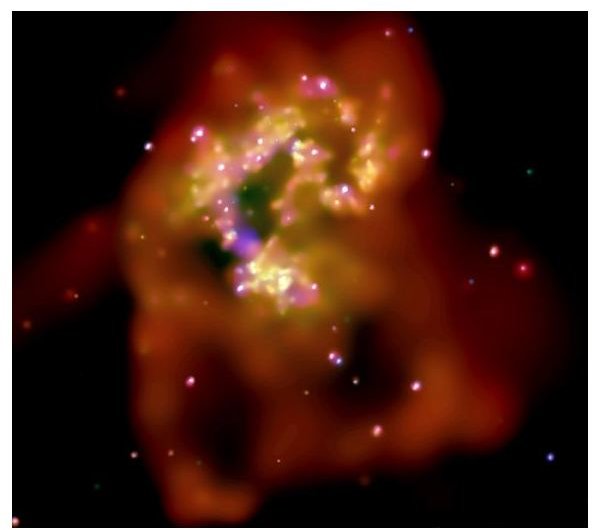
A quick peek into the world of neutron stars. Get to know some interesting facts about these extremely small and dense stars.
The Facts
The following are general facts about neutron stars:
1) Mass or Weight: about 2 solar masses (4 x 1030 Kg. OR 8.8 x 1030 Lbs)
2) Radius: 10 Km. (6.2 miles)
3) Temperature at the time of formation: 1011 - 1012 K
4) Escape Velocity: 150,000 Km/s OR 93,200 miles/s (approx. half the speed of light)
5) Mean density: about 4 x 10¹⁷ Kg/m3 (2.4 x 10¹⁶ pounds/ft3)
6) Magnetic Field: 1012 times the Earth’s magnetic field (5 x 10⁷ T OR 5 x 10¹¹ gauss)
7) Observed rotation periods: 1.4ms - 30s
8) Rotation rate: upto 38000 rpm
9) Surface Gravity: 1012 g (9.8 x 10¹² m/s2 OR 3.2 x 1013 ft/s2)
10) Estimated number in our galaxy: 109
11) Number of neutron stars observed: about 2000
Timeline of Discovery
1932: Discovery of the neutron by Sir James Chadwick.
1933: Existence of neutron stars proposed by Walter Baade and Fritz Zwicky.
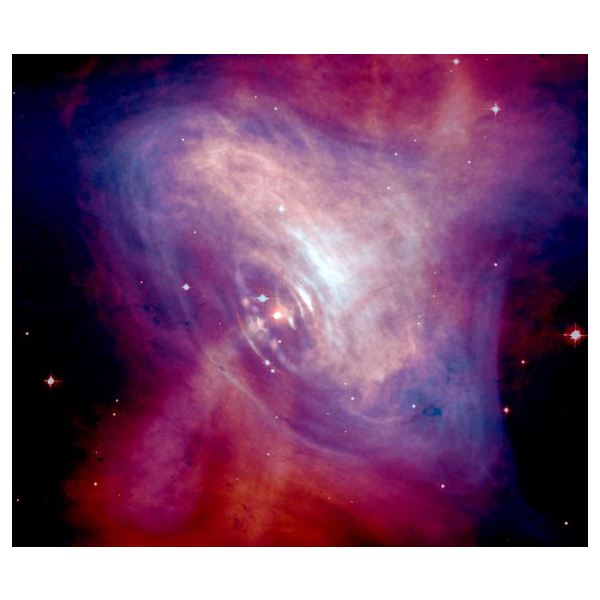
1965: Crab nebula neutron star discovered by Samuel Okoye and Antony Hewish.
1967: Antony Hewish and Jocelyn Bell discover the first pulsar.
1979: Discovery of magnetars .
Interesting Information About Neutron Stars
1. Neutron stars are so dense that a teaspoon full would weigh more than all the human beings on Earth.
2. Neutron stars share a few properties with atomic nuclei. They are almost entirely made up of nucleons and also have high densities of the same order.
3. The first extrasolar planet was found orbiting a neutron star (more specifically a pulsar) - PSR 1829-10.
4. As of 2008, the EOS (equation of state) for neutron stars is not known.
5. Neutron stars appeared in fiction for the first time in October 1966 when Larry Niven’s English language science fiction short story " Neutron Star" got published. Since then, a good number of stories have been written about them.
Images
References
1. https://en.wikipedia.org/wiki/Neutron_stars
2. imagine.gsfc.nasa.gov/docs/science/know_l1/neutron_stars.html
3. https://csep10.phys.utk.edu/astr162/lect/neutron/neutron.html
4. https://www.astro.umd.edu/~miller/nstar.html
https://antwrp.gsfc.nasa.gov/apod/image/0503/crab_xrayopt_c2.jpg