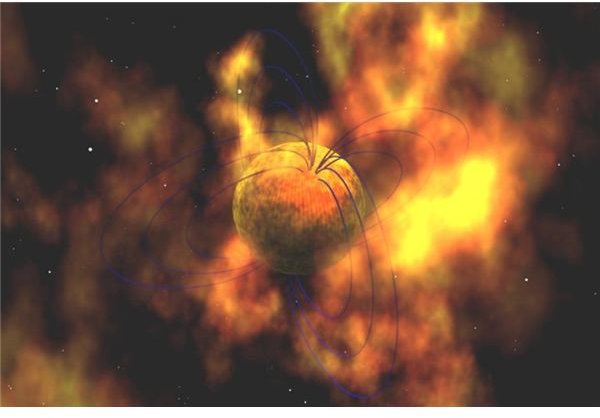
Imagine a magnet so powerful that any starship coming within a million miles of it would be pulled into it. Such magnets exist in our own galaxy. They are a unique kind of neutron star called magnetars.
A Stellar Discovery
In November of 1996, Dr. Chryssa Kouveliotou of Marshall Space Flight Center in Huntsville, AL was observing data from the Compton Gamma Ray Observatory satellite. She detected sudden bursts of gamma rays from a neutron star 40,000 light years (lys) from Earth.
The burst continued for hours in bunches, and the pulse period changed over time.
Now all neutron stars have intense magnetic fields which cause them to emit gamma ray bursts. But this star gave off bursts that were unique in number and duration. It indicated a magnetic field at least 1000 times stronger than the typical neutron star. That would be so strong that the star would not be heated by fusion—it would be heated by the force of the magnetic field, heating the surface to 18 million degrees F.
The field drifts through the crust of the star, and every so often causes a ‘starquake.’ When the starquake occurs, the gamma rays are emitted.
Mistaken Identity
Magnetars actually were first detected in 1979, but their mechanism was not comprehended then. In March of that year, gamma ray detectors around the world suddenly began to ring off the wall. A gamma ray burst of unprecedented intensity flooded Earth. It lasted just 2/10ths of a second, but was followed by a 100 second tailing off.
Interestingly, Dr. Chryssa Kouveliotou, working on her Doctorate in Astrophysics at the Max Planck Institute, was one of the researchers who detected this burst.
With so many detectors picking up the burst, it was easy to pinpoint its location. But scientists could scarcely believe their data. If the location was correct, the intensity of the bursts were even stronger than originally thought.
The triangulation data said unequivocally that the burst came from the Large Magellanic Cloud (LMC). That is a satellite galaxy of our Milky Way about 160,000 lys away. If the burst did indeed come from there, it had to be immensely strong.
The data was irrefutable. The burst came from a pulsar in the LMC.
A few years later, astrophysicists selected a name for these phenomenon—Soft Gamma Ray Repeaters or SGRs, because the gamma rays are ‘soft’ as opposed to ‘hard gamma rays’ such as given off by a nuclear bomb.
Enter the Magnetar
The theory stayed there until two researchers, Dr. Robert Duncan of the University of Texas in Austin and Dr. Chris Thompson of the University of North Carolina at Chapel Hill, developed a new idea in 1992. When a massive, rapidly rotating star explodes, it collapses to a tiny, 12 mile diameter core. If the core is spinning at 200 rotations/second or more, the hot neutron liquid rising and falling from the center to the crust sets up a dynamo effect, creating that incredible magnetic field.
They coined the term ‘magnetar’ to describe the phenomenon.
Since then, some 10 magnetars have been detected in the Milky Way. Several more have been found in the LMC.
A Slow Death
The magnetic field that makes magnetars so fascinating carries their fate. It has been discovered that the field is so strong it slows their rotation about one second every 300 years. Eventually, a magnetar will cease rotating fast enough to generate a magnetic field strong enough to keep it hot. It will cool, become dark, and disappear from view. It will then be a small, dead rock of incredible mass floating aimlessly in space.
Sources and Credits
Sources: NASA
https://science.nasa.gov/newhome/headlines/ast20may98 _1.htm
https://science.nasa.gov/newhome/headlines/ast05mar99 _1.htm
https://www.nasa.gov/missions/deepspace/f _magnetars.html
https://heasarc.gsfc.nasa.gov/docs/xte/learning _center/discover_0698.html
Artists Concept: NASA https://science.nasa.gov/newhome/headlines/mag _pix/TV-graphics/tv_sgr.jpg