Comets are chunks of rock and ice that usually have eccentric orbits, sending them out into the far reaches of the solar system as well as our own neighborhood around Earth. The Hartley 2 comet will soon be making a trip into the inner solar system, where we can observe it.
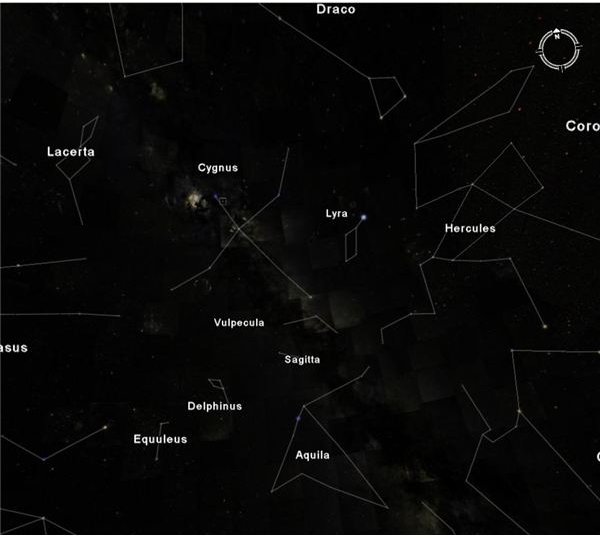
On October 20, 2010 a 1.6 kilometer piece of ice and rock will come within 18 million kilometers of the Earth. To you and me, this may seem like an impossibly huge distance, but in terms of the solar system it will be right next door. 103P, or more familiarly known as Comet Hartley 2, is a periodic comet that comes to the inner solar system every 6.46 years. When it does reach its position near the Earth, it will be visible to the naked eye with an apparent magnitude of 5, and will be found in the constellation Cygnus. You can find Cygnus, the swan, by facing east after dark and looking up from the horizon. The constellation has a cross shape in its center that appears to be knocked on its side. While the human eye can observe apparent magnitudes of up to 6, Hartley 2 might be difficult to see if you are in an area with light pollution , so bring binoculars.
On November 4, 2010 a NASA probe called Deep Impact will make a pass by Hartley 2, giving us an unprecedented view of this comet. The probe has already started taking pictures of Hartley 2, when it came into range of its telescopes on September 5 at a distance of 60 million kilometers. The NASA probe will take precise measurements of the rate at which the comet is losing mass. Hartley 2 does not have strong enough gravity to hold itself together. In its eccentric orbit around the Sun, it will come close enough that ice will turn into water. This ensures that Hartley 2 will have a steady loss of mass at each orbit. Current estimates say that the comet will only be able to survive another 100 orbits around the Sun.
Eventually Hartley 2 will become the victim of tidal forces and be torn apart. The force of gravity drops off as a function of the square of the distance, so that an object twice as far away will feel a fourth of the gravitational pull. An object three times the distance will feel 1/9 the effect of gravity. This means that the two sides of Hartley 2 pointing towards and away from the Sun are experiencing different gravitational forces. The near side will be ripped away from the far side, causing a catastrophic breakup of the comet.
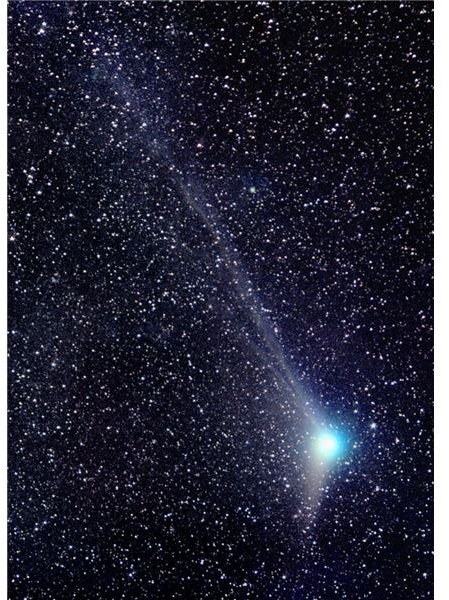
Facts about Hartley 2
Mass: 3x10¹¹ kg
Diameter: 1.6 km
Albedo: .028
Orbital Period: 6.46 years
Semi-major Access: 3.46 AU
Inclination: 13.6 degrees
Last Perihelion: May 17, 2004
Next Perihelion: October 28, 2010
Aphelion Distance: 5.87 AU
Perihelion Distance: 1.05 AU
References
https://ssd.jpl.nasa.gov/sbdb.cgi?sstr=103P
https://www.nasa.gov/topics/solarsystem/features/epoxy20100908.html
https://authors.library.caltech.edu/15882/
Credits:
Cygnus: https://www.cfa.harvard.edu/cygnusX/cygnus _const.jpg
Comet: https://science.nasa.gov/media/medialibrary/2005/01/05/05jan _machholz_resources/candy1.jpg