The designs for the Apollo space suit became the basis for all space suits constructed in subsequent years. Each of the space suit parts was necessary for the advanced missions, most notably the moon boots, helmet design, life support system and protective gloves for the Apollo space suit.
Why the Apollo Mission Needed a Special Space Suit
Before the mission to the moon could be achieved, scientists working for NASA in the 1960s had to design a space suit that would allow astronauts to perform the complex duties both aboard the spacecraft and the rocky surface. What the researchers at NASA came up with was the Apollo A7L and A7LB uniforms, each with a variety of space suit parts, each fitting into place to make a whole.
In addition to having to work in microgravity, the suits for Apollo needed to be able to allow the astronauts to bend at the waist and legs, unlike previous designs for the Mercury and Gemini missions . They also needed to be fully self-sustaining to avoid the necessity of a tether to the lunar lander. Among the most important parts were the helmet, moon boots, portable life support system and protective gloves for the Apollo space suit.
Above left: Apollo Space Suit. (Supplied by NASA; Public Domain; https://upload.wikimedia.org/wikipedia/commons/e/e6/Apollo _Moonwalk2.jpg)
Apollo Space Suit Gloves
Each of the protective gloves for the Apollo space suit were designed for the individual astronaut. They were custom-molded with silicone-rubber fingertips. This allowed the astronauts to feel some sort of sensitivity when touching equipment and picking up moon rock. The Apollo gloves were attached to the arms of the main suit body using pressure seals. There were two layers to the protective gloves for the Apollo space suit: the first layer were black rubber that fit the exact mold of a person’s hand, while the second was the extra-vehicle activity covers that added extra protection while on the mission.
Pressurized Lunar Boots
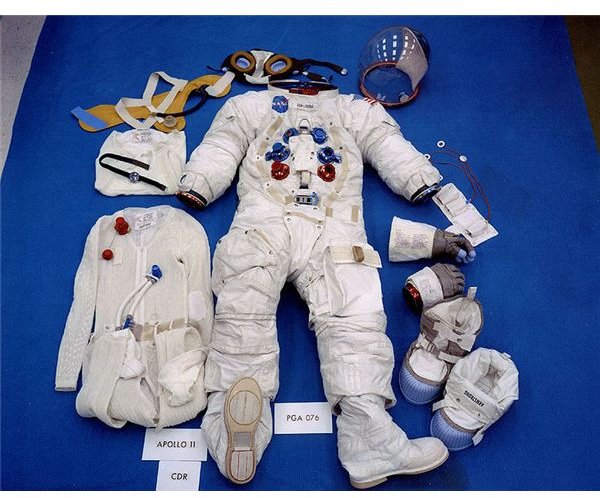
Each astronaut was fitted with pressure boots covered with lunar boots. The pressure boots were similar to the protective gloves in that they were designed from actual molds of each astronaut’s foot. The lunar boot slipped over the pressure boot to provide a more secure seal as well as offer a tangible way to walk around on the moon’s surface. Materials used in the boot were very strong to help prevent any possible problems that may arise on the moon. The main body of the lunar boot was made of metal woven into a fabric and attached to a ribbed silicone-rubber sole. The tongue and inner layers of the lunar boots were made from Teflon-coated glass-fiber cloth. Additional alternating layers of insulation made from Kapton film and glass-fiber cloth was also added to keep the astronauts’ feet warm.
Above left: Apollo 11 space suit. (Supplied by NASA; Public Domain; https://upload.wikimedia.org/wikipedia/commons/3/33/Apollo _11_space_suit.jpg)
Apollo Space Suit Helmet
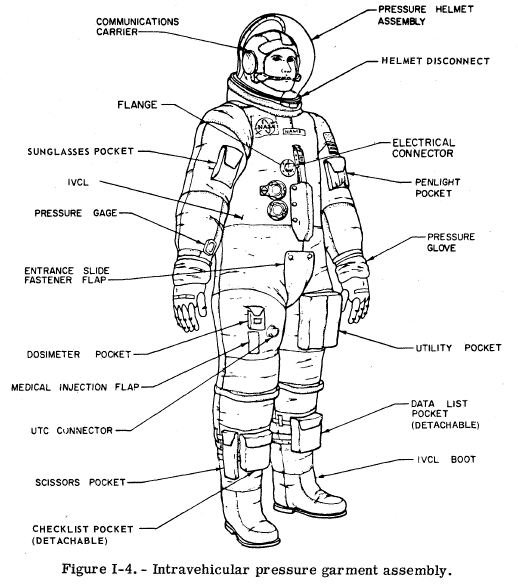
Helmets were one of the most important space suit parts necessary for a successful Apollo mission. During the initial launch, astronauts were fitted with the space helmet that looked notoriously like a fish bowl. However, for the actual lunar mission, astronauts needed an addition that would protect their eyes from the solar radiation of space. Unlike previous missions, the polycarbonate helmet allowed astronauts to move their heads freely, a necessity while walking around the moon’s surface, while still protecting the head from damage. The visor itself was designed with a gold plate, found to be one of the best solutions for eye protection.
Above right: Schematic of space suit. (Supplied by NASA; Public Domain; https://upload.wikimedia.org/wikipedia/en/8/88/CMP-A7L.png)
Portable Life Support System
In order to allow the astronauts on the moon to move around without constant connection to the lunar lander, some sort of portable life support system (PLSS) was needed. The solution NASA developed was to add additional space suit parts in the form of an advanced backpack. Included in the backpack were a pressurization system to maintain the overall suit, air for breathing, water to keep the astronauts cool and radio communication equipment. It also housed a small empty pack that was used to hold tools to conduct geological research. The PLSS was able to be recharged aboard the lunar module if necessary.
Impact on Future Space Suit Parts Design
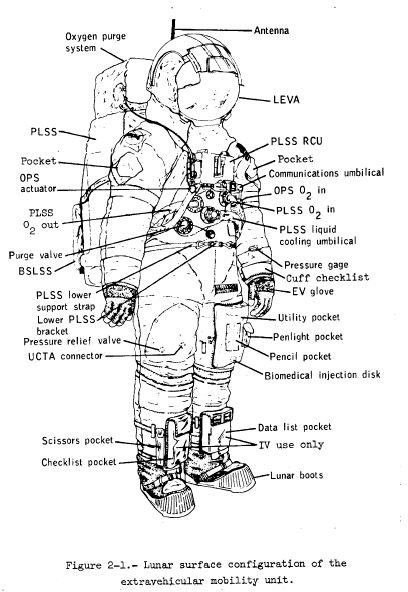
The Apollo space suit parts were the most advanced design of the era and had a strong influence on how future space suits were created. Due to the success of the program’s implements and challenges faced by the missions, NASA technicians knew how to make improvements that impact even modern designs. In addition, the different factors used in the space suit were adapted for civilian use . From this point on, each of the space suit parts from the lunar boots and helmet to the PLSS and protective gloves for the Apollo space suit, were improved and advanced with new concepts.
Above left: Schematic of EVA suit. (Supplied by NASA; Public Domain; https://upload.wikimedia.org/wikipedia/en/9/9d/EV-A7LB.png)
Resources
“Apollo Space Suit” The Sixth Squadron: https://www.sixthsquadron.com/index.html?articles/space/ApolloSpaceSuit.htm
“History of the Space Suit” MIT: https://web.mit.edu/16.00/www/aec/spacesuit.html
This post is part of the series: The Space Suit and Other Equipment for Astronauts
Since the dawn of the space program, the need for space suit design to protect astronauts and cosmonauts was a necessity. NASA focused its early attempts on the Apollo mission, but as new reasons for space travel were adopted the space suits changed with the times.