It is widely known that the Russians (actually the Soviets) were first in space. Sputnik-1 and Yuri Gagarin showed the way for future of space exploration. This article is the first in the series describing Soviet Space Program.
Overview
Contrary to US and later European programs, the USSR actually didn’t have one “Space Program”. There were numerous projects, each of them refereed to as “space programs”. Of course, each project had different name and objectives.
There were 5 manned space programs
- Vostok
- Voskhod
- Soyuz
- Salyut
- Buran
Also, several unmanned programs were defined:
- Sputnik
- Cosmos
- Luna
- Venera
- Mars
Early years
But even before the Soviet era, Konstantin Tsiolkovsky, regarded by many (especially Russians) as the father of space travel, had proposed the concept of multi-staged rocket to reach Earth orbit. The multi-staged rocket was the only way to overcome Earth’s gravity, by disposing of the “used” fuel tanks and using “secondary” rockets.
After the second World War, young and talented engineer, Sergey Korolev, was appointed as the Chief Designer of first Soviet Space program – the Vostok. Even prior to that, Korolev had supervised the first inter-continental ballistic missile, the R-7 and the first artificial satellite, Sputnik-1.
Vostok program
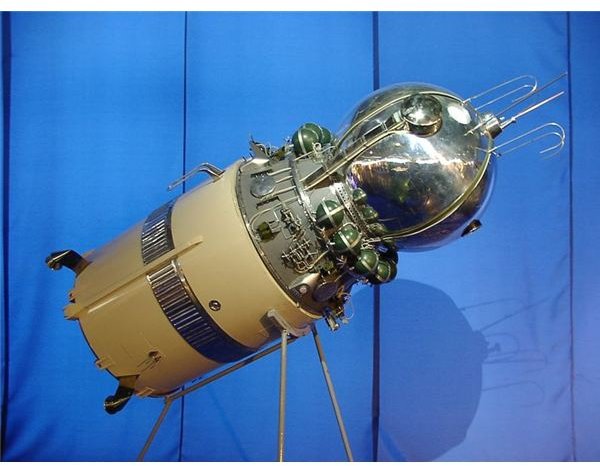
The space program “Vostok” (East) — was the Soviet program intended to create a series of single piloted spacecraft for flights on a circumterraneous orbit. Several spaceships of the name “Vostok” were created under direction of general designer, Sergey Pavlovich Korolyov from 1958 to 1963.
Work on creation of the piloted ship demanded deep study of such new areas as descent in an atmosphere, creation of reliable heat-shielding, hypersonic aerodynamics etc. In particular, it has been noted that ballistic descent from an orbit can result in a 10G load on the astronaut.
During the medical research conducted in April, 1958, several tests on pilots in a centrifuge had shown that at certain positions, the human body is capable of withstanding loads up to 10G without serious consequences for the health of the person. It had predetermined a choice of the spherical form for the first piloted ship, as it allowed the desired position and had the least problems when dealing with various “attack angles” in aspects of drag and lift-to-drag ratio. The most comprehensible way of returning of a cosmonaut was ejection at height of several kilometers and the further descent with a parachute.
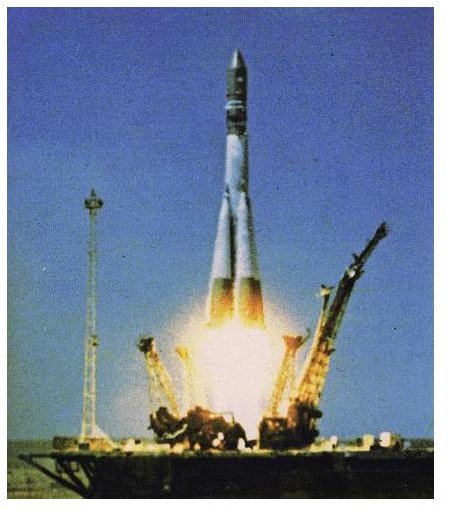
First piloted “Vostok” flight, which took place on April, 12th, 1961, became the first-ever space vehicle to carry a person into space. The day of April, 12th, is marked in the Soviet Union – now Russia - and in many other countries of the world, as the World Day of Aircraft and Astronautics.
The first “Vostok” that was piloted by Yury Gagarin made only 1 revolution around the Earth, having flown about our planet for 108 minutes. Flight of the ship, Vostok-5, with cosmonaut Valery Bykovsky lasted about 5 days. During this voyage the ship and cosmonaut orbited the Earth 81 times. At the same time, Vostok-6, the last spacecraft of the series, was piloted by Valentina Tereshkova, first woman in space. It was also the first time that 2 ships were in orbit simultaneously.
Vostok Spacecraft
Credits
Vostok Model: photo taken and edited by de:Benutzer:HPH on “Russia in Space” exhibition (Airport of Frankfurt, Germany, 2002)
This post is part of the series: Soviet/Russian Space Program - a Review
This series reviews the development and advances of space technology and programs by the former Soviet Union and Russia.