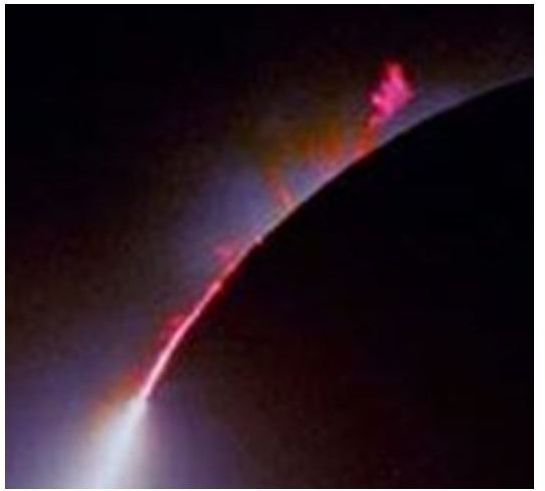
The Sun’s chromosphere is actually the invisible upper layer of its atmosphere. Yet, it produces some of the Sun’s most spectacular phenomena.
An Invisible Sun
The Sun’s chromosphere is a tenuous layer of primarily hydrogen, an estimated 2000 to 5000 miles thick above the photosphere, the only part of the Sun we actually see without special instruments. We can’t see the chromosphere because the photosphere is so bright it drowns out the relatively “dim” light of the upper layer.
The Sun is made up of several layers.
-
The Core—50 percent of the Sun’s mass but only 1.5 percent of its volume. Its temperature is 15 million degrees K.
-
The Radiative Zone—photons from the core travel through this zone over millions of years..
Advertisement -
The Convection Layer—here the temperature is about one million degrees K or less. The gases move up and down through this layer like a conveyor belt. It is here that the Solar Wind is produced.
-
The Photosphere —the visible part of the Sun. Sunspots occur here.
Advertisement -
The Chromosphere—see below
-
The Corona—the very upper part of the Sun’s atmosphere and the strangest. It reaches millions of miles into space.
Advertisement
Because this unique layer is primarily hydrogen, it produces “hydrogen alpha” light with a deep red color. Nineteenth century astronomers became aware of this part of the Sun only during total eclipses when a sliver of the Chromosphere peeked over the limb of the otherwise darkened disk. Today, special instruments, and the Japanese Hinode (Sunrise) spacecraft, equipped with special filters to see this invisible layer, have revealed its hidden secrets.
A Seething Cauldron of Plasma
And it does hold secrets. Seen by Hinode, this tenuous layer of hydrogen is a place of biblical fire and brimstone. There are ‘spicules’—short lived but energetic bubbles of hot gasses that jet high into this layer. These bubbles last about 15 minutes, but are produced continuously. They move so fast they often are ejected into the Sun’s Corona.
But the spicules are chumps compared to the other phenomena created in this strange plasma. It is here that solar flares, prominences and coronal mass ejections (CME) are initiated. These explosions of plasma are sometimes larger than Earth. They can have an impact on our planet too. Many times solar flares and CMEs have disrupted communication and even caused power outages.

A Magnetic Personality
These eruptions are caused by the Sun’s intense magnetic field, which is much stronger than the Earth’s. In the lower layers that we mentioned above, the plasma is sufficiently dense to cause the magnetic lines of force to loop back to the layer’s surface, so the magnetic field stays within that layer.
This layer, however, is so tenuous, its plasma cannot contain the magnetic fields that course through it. Consequently, these fields just stretch upwards into the thin plasma and twist it around and about and create these massive eruptions and explosions.
The magnetic fields create another unique feature. Normally, the heat from the photosphere should dissipate as it moves upwards through the upper layer, so this upper layer should get cooler as you go higher. But it gets hotter. The temperature rises from an estimated 4500 degrees kelvin at the bottom to 10,000 degrees kelvin at the upper levels.
Astronomers believe this is caused by magnetohydrodynamic waves. If a magnetic field gets displaced, say, when it produces a prominence, when it tries to go back to its original shape it starts to oscillate. That oscillation creates waves in the plasma that generate heat.
Sources and Credits
Hinode chromosphere image: NASA https://genesismission.jpl.nasa.gov/educate/scimodule/SunandSolar/Final%20Linked%20SSW/6AppendicesCari/c.pdf
19th centruy view of chromspher: University of Michigan https://solar-heliospheric.engin.umich.edu/hjenning/Chromosphere.html
Hinode: NASA https://science.nasa.gov/science-news/science-at-nasa/2007/21mar _chromosphere/


