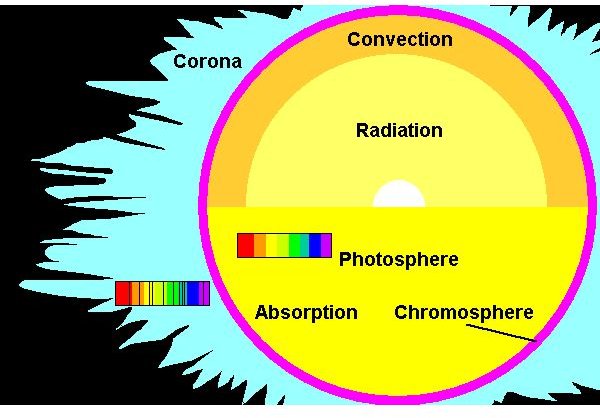
When we look at the Sun through a properly protected telescope, what we see is not really the ‘surface’ of our star. The Sun really has no surface. We see a rather tenuous part of its atmosphere called the photosphere. But a great deal goes on in this tenuous cauldron of hot gas.
A Veil Hiding the Sun
Our Sun, like all stars, consists of many layers, as shown in the diagram below. But because of the nature of the makeup of stars, we do not see the inner layers. We see only an outer layer of tenuous atmosphere called the photosphere—literally light sphere. All the light we see from the Sun comes from this layer.
The reason we see only this layer is because the photosphere of the Sun is opaque. This is because there is an extra electron loosely attached to the hydrogen atoms that make up most of the gas. This causes the gas to readily absorb light. Thus it becomes opaque.
The photosphere is cooler than the other layers as well, with a temperature of 4500 to 6000 degrees K, depending on the depth.
We’ve noted that this opaque layer is tenuous. In fact, its pressure is only a few hundredths Earth’s atmospheric pressure, and its density about one ten-thousandth that of our atmosphere.
A Seething Cauldron
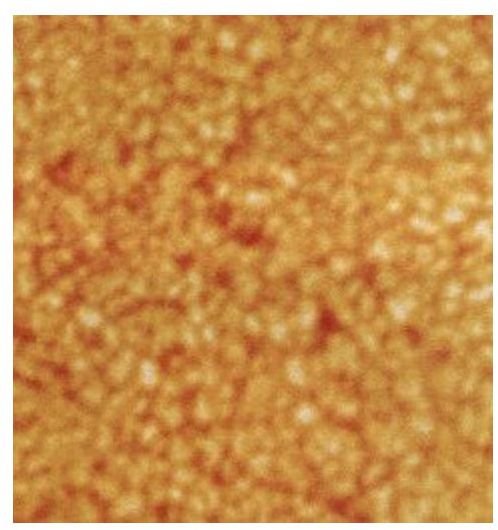
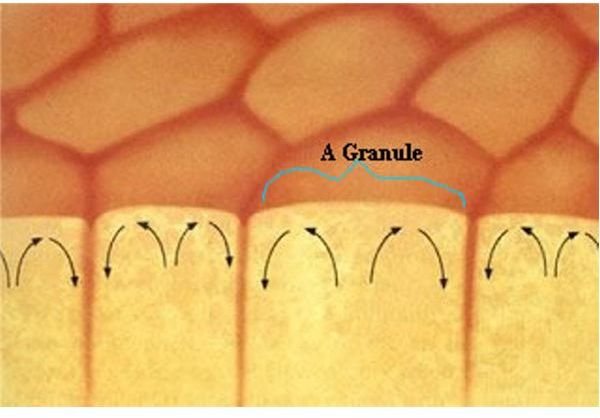
Despite its unsubstantial nature, the photosphere of the sun is a violent place. The first thing you might notice if you observe it are millions of ‘bubbles’ across its face. These are called granules, because they look a bit like sand granules, but they are in constant motion. Note in the picture to the right the granular look is created by light areas surrounded by dark areas. The light areas are hot gases welling up from lower parts of the photosphere. The dark areas are cooler gases higher in the photosphere that are sinking back down, as shown below.
Something else goes on in the photosphere—sunspots . These ‘holes’ in the photosphere are areas of extreme magnetic flux. They are dark because hotter gases from the lower regions are prevented from rising to the top of the photosphere by the intense magnetic fields. The spots are cooler than the surrounding gases.
Interestingly, sunspots always occur in pairs. Just as a bar magnet has a north and south pole, so do sunspots.
More Violent Tantrums
Because sunspots are caused by intense magnetic fields, they give rise to even more violent activity in the photosphere of the Sun. One of these is the solar prominence. This is the spectacular display of hot plasma looping out into space and back to the photosphere.
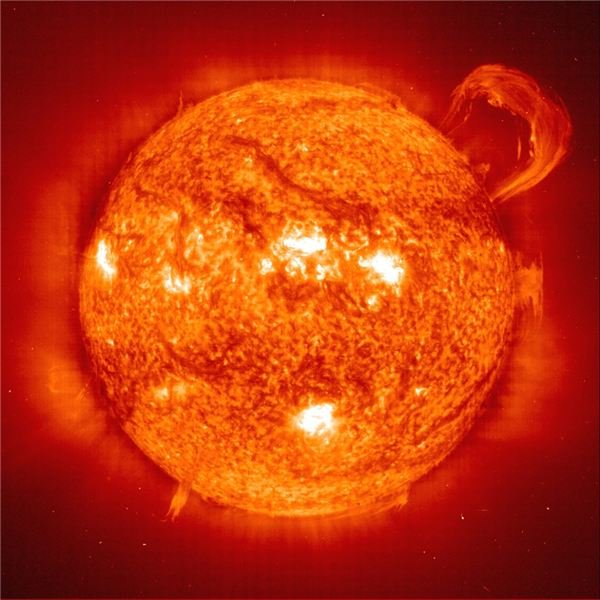
Prominences are explosions of plasma shot into space by magnetic disruptions around sunspots. The ends of the prominence will be near two sunspots of opposite polarity. What happens is the magnetic fields interfere with each other. They get twisted and plasma between the two breaks free and rockets into space at velocities as high as 1300 km/sec. The plasma is still bound to the sun by the fields however, and cannot escape.
Another, sometimes unseen except by x-ray, infra red and other specialized cameras, is a solar flare. These expulsions of plasma into space can and often do disrupt communications on Earth, and even knock out our power grids.
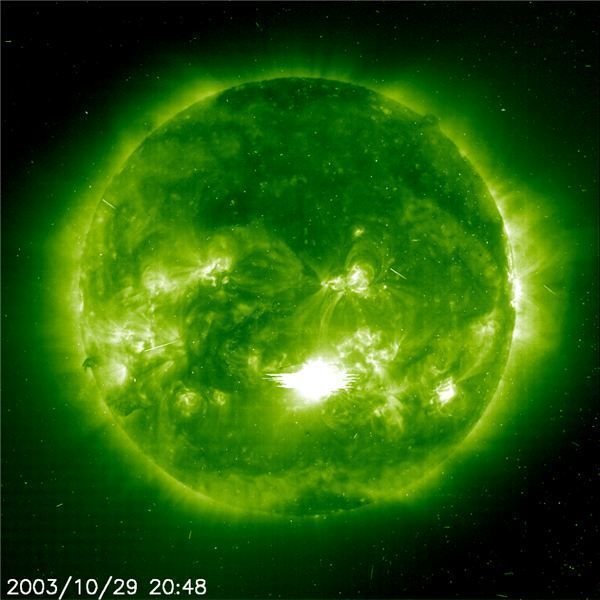
The difference between a prominence and a flare is distinct. A prominence is an eruption of plasma generated by the magnetic field of two sunspots–their north and south poles. Both ends of the prominence remain connected to these sunspots.
A solar flare, on the other hand, results when magnetic fields become disconnected and shear. A field is left without a companion and collapses with a tremendous release of energy. This expels huge amounts of plasma from the photosphere into space. If Earth is in the way, all manner of disruptions occur.
Sources and Credits
Sources:
National University of Singapore: https://www.math.nus.edu.sg/~mathelmr/gem-projects/hm/0203-1-02-sunspots/photosph.html
NASA: https://imagine.gsfc.nasa.gov/docs/science/know _l1/sun.html
Credits:
Sun layers: University of Wisconsin at Green Bay https://www.uwgb.edu/dutchs/planets/sun.htm
Granules: National University of Singapore: https://www.math.nus.edu.sg/~mathelmr/gem-projects/hm/0203-1-02-sunspots/photosph.html
Prominence: NASA SOHO Image: https://antwrp.gsfc.nasa.gov/apod/ap060416.html
Solar flare: NASA SOHO site https://www.nasa.gov/images/content/52840main _10.29eit.gif