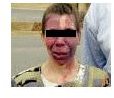
Find out more about the symptoms and cause of Sturge-Weber syndrome, a disfiguring disease that is characterized by neurological problems such as seizures and headaches,
What is Sturge-Weber Syndrome?
Sturge-Weber syndrome (SWS), also known as encephalotrigeminal angiomatosis, is a congenital neurological disorder accompanied by a distinctive birthmark called a port wine stain. The underlying cause is the overgrowth of capillary blood vessels, resulting in blood-vessel tumors called angiomas, around the fifth cranial nerve, also called the trigeminal nerve. Both the port wine stain birthmark and the neurological problems result from these overgrown capillaries. The angiomas may affect one or both sides of the head and face.
Sturge-Weber Symptoms
Sturge-Weber syndrome is present at birth and affects half of the head and face. Though an overgrowth of blood vessels is the underlying cause, symptoms fall into two categories: neurological and dermatological. Glaucoma can also be present.
At right: A woman with Sturge-Weber syndrome, with a port wine stain covering most of her face. Photograph from the U.S. Equal Employment Opportunity Commission (EEOC), public domain.
The neurological symptoms of Sturge-Weber syndrome include seizures and headache. Seizures are present in 70% to 80% of patients with one brain hemisphere involved, and 93% of those with both hemispheres involved. Seizure onset is during the first year of life in 75% of cases and in the first five years in 95% of cases. Seizures are treated with neuroleptic (anti-seizure) medications. In the most severe cases, part of the affected brain hemisphere may be removed, a dangerous and extreme procedure called a hemispherectomy. Hemispherectomy is performed almost exclusively in children because their brains are plastic enough to recover well.
In Sturge-Weber, headache is a common symptom, usually migraine headaches. Headaches may occur after seizures and, in some patients, are related to glaucoma.
The dermatological symptoms are dominated by the large birthmark covering one or both sides of the face. Called a port wine stain, the birthmark may range from light pink to deep purple in color. As the child grows into an adult, the port wine stain may grow as well, sometimes resulting in a large, disfiguring tumor. Fortunately, laser treatment is effective against the birthmark, and the prognosis is especially good if treatment starts early in life.
Genetic Cause of Sturge-Weber Syndrome
The cause of Sturge-Weber syndrome is poorly understood, and it shows no clear genetic pattern. It does not run in families, and males and females are affected equally. According to one hypothesis, it may result from a local somatic mutation , possibly in the gene for the protein fibronectin (Zhou et al. 2009).
Port wine stains are present in about 3 out of every 1000 births. A child born with a port wine stain on the face has an 8% to 15% chance of having SWS, but these odds are higher with very large birthmarks.
References
- The Sturge-Weber Foundation (SWF) website.
- Q. Zhou et al. “Fibronectin: characterization of a somatic mutation in Sturge-Weber syndrome (SWS) .” Medical Hypotheses 2009 Aug;73(2):199-200.