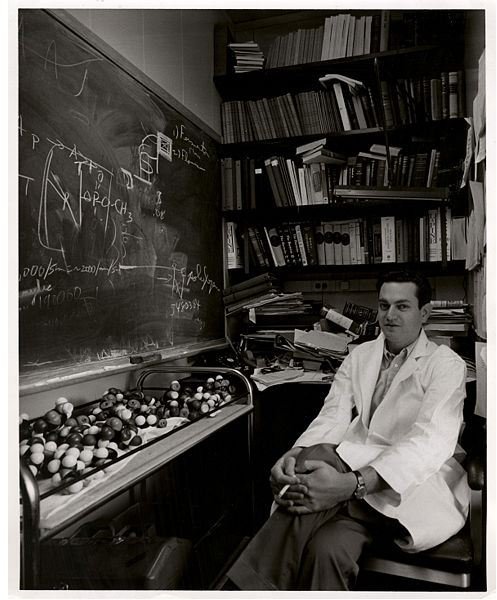
Marshall Warren Nirenberg is one of the most famous scientists in genetics. During his work for the National Institutes of Health in the late 1950s and early 1960s he studied the relationship between DNA, RNA, and protein, and helped identify the basis of the genetic code.
Marshall Warren Nirenberg was born in New York City in 1927. As a child, he developed rheumatic fever, prompting his family to relocate to Orlando, Florida for the warmer climate. Here he developed an interest in biology, which he chose to pursue professionally. After receiving his science degree from the University of Florida in 1948, he continued for his masters in Zoology.
Nirenberg discovered he was interested in biochemistry and moved to the University of Michigan to attain his doctorate under the teachings of Dr. James Hogg. In 1957, he began a stint at the National Institutes of Health as a fellow of the American Cancer Society where he became one of the most famous scientists in genetics.
Above left: Marshall Warren Nirenberg. (Supplied by the National Institutes of Health at Wikimedia Commons; Public Domain; https://upload.wikimedia.org/wikipedia/commons/f/f6/MNirenberg.jpg)
Genetic Coding Breakthrough
A variety of experiments throughout the 1940s and 1950s showed that DNA was the molecule of basic genetic information. However, there were no breakthroughs in understanding how DNA controlled the formulation of proteins. There were also big questions as to the role RNA played in the process. While working for the National Institute of Health, Nirenberg teamed with Heinrich J. Matthaei to discover the relationship between these processes in 1959.
After creating an RNA sample comprised solely of the nucleotide uracil, they added it to an extract of Escherichia coli. This extract contained the cellular machinery needed for protein synthesis such as DNA, RNA and ribosomes. Utilizing DNase to ensure that no extra proteins would be produced, they added a radioactive sample of phenylalanine. After analyzing the extract they had determined that they had identified the genetic code for the amino acid: UUU. Nirenberg had established that three units of genetic material (DNA or RNA and known as codons) form an amino acid. Over the next few years, Nirenberg’s team repeated the steps to decipher the three-base codons for many other amino acids.
Using this research, one of Nirenberg’s colleagues, Phillip Leder, passed various combinations of messenger RNA through a filter, stimulating the binding of transfer RNA to ribosomes. The transfer RNA could then be associated to various amino acids, identifying the messenger RNA sequence.
Awards and Recognition
In 1966, he was bestowed the National Medal of Science. In 1968, Nirenberg was awarded the Nobel Prize in Physiology or Medicine, which he shared with Har Gobind Khorana and Robert W. Holley. He was also awarded the Louisa Gros Horwitz Prize and the National Medal of Honor that same year.
Nirenberg is also a member of the American Academy of Arts and Sciences, the National Academy of Sciences, and the American Philosophical Society.
Resources
“Marshall Warren Nirenberg Biography” Nobel Prize (https://nobelprize.org/nobel _prizes/medicine/laureates/1968/nirenberg-bio.html)
“Marshall Warren Nirenberg” FAQS (https://www.faqs.org/health/bios/75/Marshall-Warren-Nirenberg.html )
This post is part of the series: Scientists that Changed Genomic Research
Throughout history, a number of scientists have changed the way we study genetics. These prominent individuals take a place amongst the greatest researchers of all time.


