Physical sports, like martial arts and boxing, take on a life of their own and can present some of the biggest challenges for producing professional still images. Here are a few tips for how to correctly take images of these events with a clear look on specifics and safety.
Middle of the Action
Some sports take place in large stadiums with lots of players and are perfectly designed for photo documentation, while some work very differently. Today, boxing and mixed martial arts are seeing a resurgence of popularity and getting clean images of them is going to have an even more lasting impression on fans than with most types of sports photography. Though it is not easy for any competitive event, it is especially difficult and dangerous for these physical matches. Here is a look at how to take these kinds of images in a way that will capture them clearly and keep you safe.
Motion
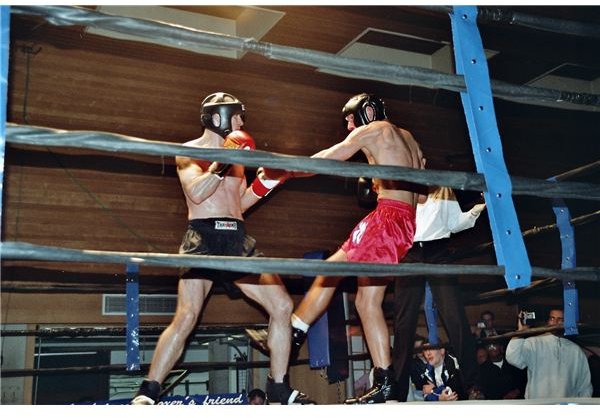
The primary issue to deal with martial arts photography, and boxing photography specifically, is the speed at which things often take place. When close up, the punches and kicks between opponents can go so fast that it can be next than impossible to capture them so that they appear almost still, which is much of the issue when actually filming the events. To deal with this the first place you should go is to bring up the shutter speed fairly high to deal with the fast motion, possibly even upwards of 1/500 or beyond. This is going to first give you the freedom to go without any kind of support system and will also allow you to capture the hits mid motion, as well as small details like the sweat bouncing off of the fighters.
This is going to darken your image, so you want to make sure that you zoom in closer to the subjects so as to block out the background. Since they will be in a ring there will likely be a series of bright lights right on them, which will take care of the lighting issues for the subjects. Bringing up the shutter speed will allow you to keep the ISO down and the aperture open, but will darken up the background significantly. This could appear unnatural, so instead you can just go much closer and isolate the subjects in a way that will make the background invisible.
Safety
An additional issue for martial arts photography is going to be the need for distance from the action. The chance for accident is much
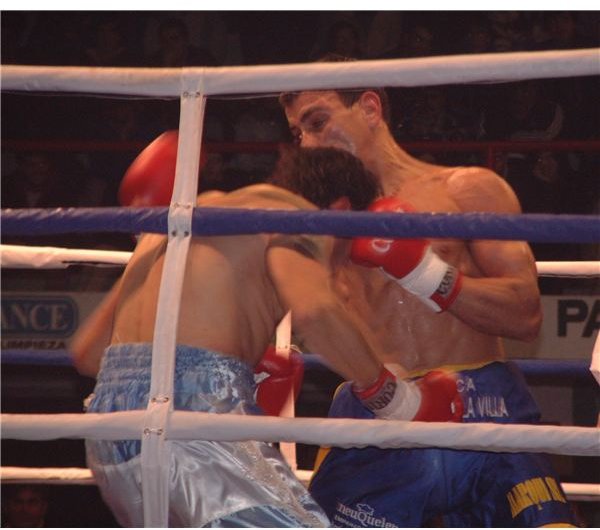
higher in that the sport is based around violence explicitly, which is different than accidentally being hit at a soccer game. The issue here is that you will need to be ring side to capture the images, yet the ring itself is surrounded by audience members and so you have to stay fairly close to the action.
It is then best to position yourself behind one of the four corners of the ring for boxing photography, and the same should work for martial arts as long as they are not in a cage. This will usually allow for more standing room, and will have a full metal barrier that will provide a foot or two of movement room between the combatants and the photographer. The sides of the ring where the “ropes,” or sport bungee chords are, is not going to provide much protection at all.
Avoid Telephoto
Though you are providing some amount of distance between you and the subjects, you should not allow it to be so dramatic that you have to switch to something like a telephoto lens . If you did this you would have to deal with overall light loss and you may want to maintain the wide angle perspective if you want to see close up hits. A telephoto lens will be appropriate if you are photographing the event from a great distance, such as a prepared press box away from the ring, but this is not going to capture the energy that you want from martial arts photography.
Constructing Photos
Prepared photos are an important part of this set up as they are with all sports photography, especially since the fighters will need images to promote themselves. There is a certain aesthetic that has permeated martial arts and boxing photography, mainly because it is a one on one sport that requires a certain intensity and perceived conflict. This is usually done by creating a brighter subject against a black, or blanketing, background. This can be easily achieved by changing the lighting on the set along with the camera settings. Begin by using a three point studio lighting set up with a key light, fill white card, and backlight hitting the back of the subject’s head head rather sharply. Bring the key light a foot or two closer to the subject than normal. From here you will close up the aperture so that your subject remains brighter while the unlit background stays dark.
References
Photos
Source: Author’s own experience.