The benthic zone, or sea floor, extends from the water’s edge to the deepest ocean trenches. Learn about this varied habitat and the organisms that live there.
The Benthic Zone
The benthic zone begins at the edge of the sea at the intertidal zone , extends out along the continental shelf, and continues down the continental slope to the abyssal plain , thousands of meters below sea level. It includes the entire seabed, rising along the mid-ocean ridges where new sea floor is continually being made, and dives down into the deep ocean trenches.
The habitats of the benthic zone vary widely depending on how far below the surface the bottom lies. Just beyond the intertidal zone, the shallow water receives ample sunlight and oxygen. Continuing down along the continental slope, the environment becomes increasingly dark and cold, and the pressure increases. A remarkable variety of organisms live in these different habitats, each with specialized adaptations reflecting the conditions of their environment.
Benthos: Inhabitants of the Benthic Zone
The organisms that live in the benthic zone are collectively called “benthos.” They include crustaceans, mollusks, worms, fish, and any other type of organism that makes its home on or in the seabed.
The majority of benthos are scavengers or detritus feeders that eat decomposing organic matter. Much of the food supply in the benthic zone is in the form of “marine snow,” small particles of decaying organic matter that slowly descend through the water column and accumulate on the ocean floor.
Benthos in the intertidal zone include sea stars, barnacles, mussels, sea anemones, sea urchins, snails, and other creatures that attach themselves to the rocky substrate or burrow in the sand. Benthos in deeper zones include fish, crustaceans and tube worms.
Benthic Fish
Benthic fish, also known as groundfish, are those that stay on or very near the sea bottom, whether in shallow or deep water. Unlike fish that spend their time swimming, benthic fish are very dense and have negative buoyancy, allowing them to effortlessly lie on the bottom or bury themselves. Other adaptations commonly seen in benthic fish include the lack of a swim bladder and a flattened body shape. They are predominantly bottom feeders that eat detritus, or ambush predators that lie in wait for their prey to come within striking distance.
There are many different types of benthic fish. Flatfish, including flounder, halibut, plaice, sole and turbot, lie on the the sea floor or bury themselves in the sand. Asymmetrical physical adaptations include having both eyes on one side of their head, and different pigmentation on each side of their bodies; the side facing down is usually pale, while the side facing up is camouflaged. Some species of flatfish are predators, feeding on smaller fish, while others eat mainly invertebrates.
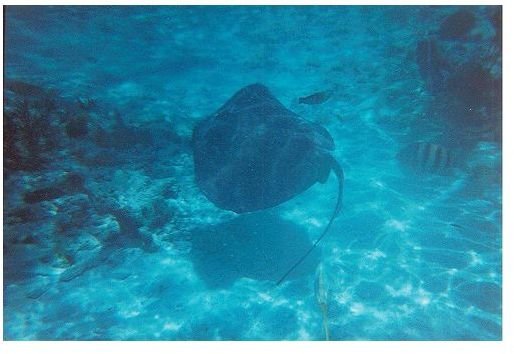
Rays and skates are also flat, but are bilaterally symmetrical, with their eyes on top of their head. These cartilaginous fish are predators that bury themselves and wait for prey, feeding largely on crustaceans, clams, oysters and snails.
Rattails are benthic fish that have a large head and mouth, and a body that rapidly tapers down to a long, narrow tail. They live in the deep sea, and are scavengers, feeding chiefly on invertebrates. Some species of rattails are brotulas, chimaeras and grenadiers.
Resources:
https://people.whitman.edu/~yancey/deepsea.html#epipelagic
https://en.wikipedia.org/wiki/Benthic _zone
https://en.wikipedia.org/wiki/Benthos
https://en.wikipedia.org/wiki/Benthic _fish#Benthic_fish
Photo credit:
https://www.flickr.com/photos/ctsnow/516817700/in/photostream/