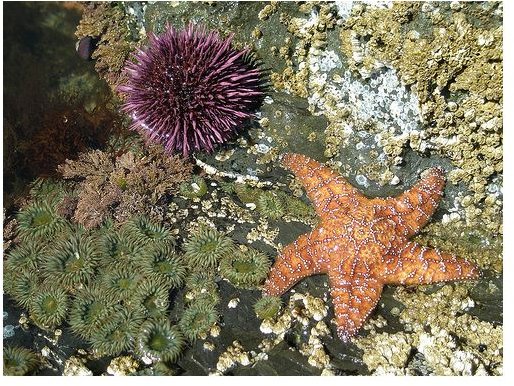
The intertidal zone is a unique ocean habitat because it is underwater only part of the time. Learn about the different regions of the intertidal zone and the creatures that make their home in a place where the conditions constantly change.
Overview of the Intertidal Zone
The intertidal zone is the region where the sea meets the shore, extending between the low and high tide marks. As the tides rise and fall twice each day, the intertidal zone alternates between being underwater and being exposed to air. Due to these extremely changeable conditions of temperature, salinity and moisture, the rich variety of animal and plant species that lives in the intertidal zone must adapt to an environment that is often harsh, with rough waves, blistering hot sun and fierce winds.
The terrain of the intertidal zone may be a rocky coastline studded with tide pools, a sandy beach, or a wide stretch of mud flats. Each of these habitats is occupied by diverse communities of organisms that have adapted to life in an unstable environment.
High Tide Zone
The intertidal zone is divided into subregions based on distance from the water. The high tide zone is farthest from the water. It is exposed to the air much of the time, and is only completely submerged during the highest tides. When not underwater, however, it is frequently subjected to the crashing of the waves. Many of the creatures that occupy the high tide zone attach themselves firmly to the rocks to avoid being swept away.
Barnacles are found in abundance in the high tide zone, often completely encrusting the surface of the rocks. They attach themselves with a glue-like substance, and once mature, they are unable to move. Barnacles mainly eat plankton, which they capture from the water with their feathery legs.
Limpets and snails are also common in the high tide zone, but unlike barnacles, they are able to move about to search for food when the tide is in. They primarily feed on algae during high tide, and clamp their shells down tightly against the rocky surface to avoid becoming desiccated when the tide is out.
Crabs are the most mobile of the occupants of the high tide zone, scuttling over the rocks and sand scavenging for food, and hiding in cracks and crevices. Their tough shells serve to protect them from predators and from the pounding waves.
Middle Tide Zone
The middle tide zone sees the most activity of the three zones. Mobile animals from the adjoining zones often move into this zone to feed with the changing of the tides.
Mussels thrive in the middle tide zone, thickly coating the rocks. These bivalves are filter feeders, and subsist on plankton that they remove from the water while they are submerged.
Sea stars are fascinating denizens of the middle tide zone. While they appear to move slowly, these carnivores are aggressive predators. The preferred prey of sea stars are mussels, which the sea stars devour by prying open the shell, everting (turning inside out) their stomach, and inserting their stomach into the mussel’s shell to digest the contents.
Anemones are another species often seen in the middle tide zone. Related to both jellyfish and coral, anemones have a single foot with which they attach themselves to a surface, and a cylindrical neck ending in a circle of tentacles. Anemones are carnivores, and they have a sharp spine that injects a poison into their prey, paralyzing it so they can draw it in with their tentacles.
Low Tide Zone
The low tide zone is mainly submerged, and only exposed during the lowest tides. The organisms that live in this zone need to be underwater most of the time, and are less able to withstand being exposed to air for extended periods. Here is found an abundance of seaweed, as well as an extensive array of different species.
Colorful spiny sea urchins are echinoderms like sea stars, and similarly move about and attach themselves to a surface by the suction of their tube feet. But unlike the carnivorous sea stars, sea urchins are herbivores and feed mostly on algae.
Abalone are large gastropod mollusks, a variety of sea snail. They feed on algae, and generally remain in the same place unless food becomes scarce. The main predators of abalone are sea otters, and they are also eaten by some fish and bat rays, which dislodge them from the rocks and swallow them, shell and all.
Nudibranchs, sometimes known as sea slugs, are mollusks without shells. Some species are incredibly beautiful, with brilliant colors and delicate, feathery gills. They defend themselves by secreting a toxin, and they are carnivorous, feeding on various animals including anemones, barnacles, sponges, corals, or even other nudibranchs.
Resources
https://oceanlink.island.net/biodiversity/intertidal/intertidal.html
https://en.wikipedia.org/wiki/Intertidal_zone
https://www.sfgate.com/getoutside/1996/jun/lzone.html
Photo credit: https://www.flickr.com/photos/mountainamoeba/696520153/