Differences between a Meteoroid, Meteor, Meteorite, and a Comet
A Plethora of Astronomical Objects
One moonless night—cloudless and haze free—you are away from the city lights, standing still and gazing up into the heavens. What do you see? You see thousands of bright ‘points’ in the night sky. No one needs to tell you that almost all of them are stars. But, there are some other bright spots; unmoving and not quite small enough to be considered just points. You recognize those as planets. Yet, there are a variety of other objects as well. In fact, there is an occasional streak of light. Very rarely, the streak is not moving; most of them move quite rapidly and then disappear. What are these?
Stationary Streaks
The streaks that seem not to move, appear immobile, are comets. Most streaks on the other hand, are fleeting, though occasionally one may last many seconds. You have probably heard three different words relating to these rapidly-moving objects: meteoroid—meteor—and meteorite. What is the difference in their meaning?
Definitions and Descriptions
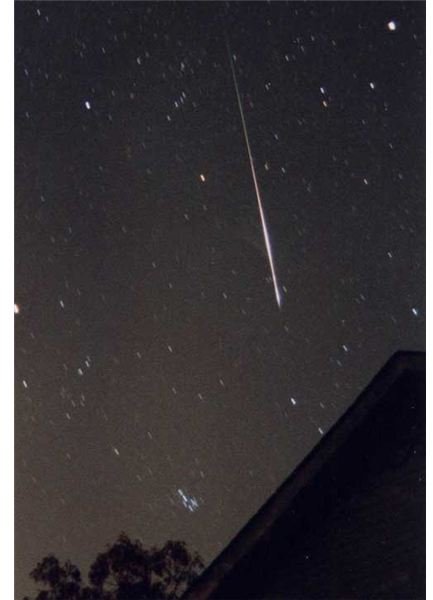
Meteoroids are stone or metal chunks moving through space ranging in size from a particle the size of a grain of sand to the size of a boulder (smaller than an asteroid). By definition, they are located within our solar system. As long as they are free in space, they continue to be called meteoroids.
If a meteoroid enters into the gravitational field of a planet or moon, however, and is headed toward that object’s surface, it then becomes, and is called, a meteor. The popular misnomer for a meteor is ‘shooting star,’ although clearly a meteor is not a star. A star getting even remotely close to Earth would bring about the planet’s demise. The Earth could not survive either the gravitational force of a star, nor its heat or its light.
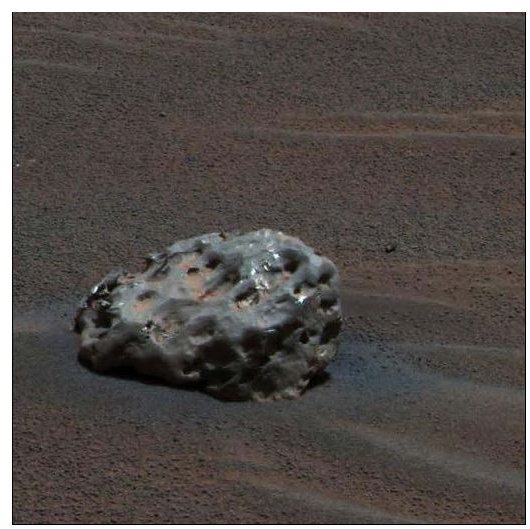
Meteors not only produce a light trail, they produce a smoke trail. A meteorite is simply a meteor that strikes the Earth’s or any other planetary surface. Meteors far outnumber meteorites, as most meteors are quite small and burn up in Earth’s atmosphere without ever reaching its surface. Most fascinatingly, meteors produce not only light and smoke trails, but a hissing sound as well.
More Comet Information
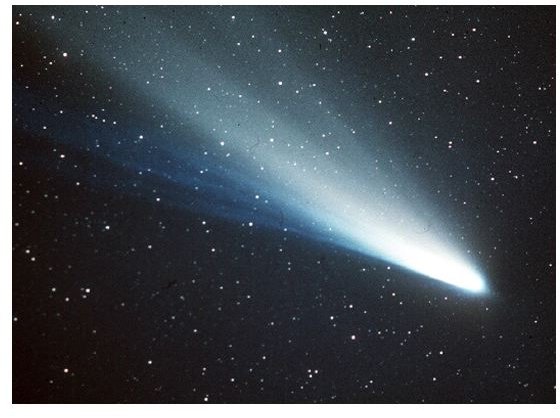
A comet is really a different beast altogether; their origin is still a matter of debate. A comet is a small mass of frozen gases interspersed with non-volatile grains, i.e., dust, sand, and small rocks. Comets travel in highly elliptical orbits about our Sun.
As the comet approaches the Sun, some of the comet’s nucleus volatilizes; hence, the tail increases in length. In fact, a comet may have more than one tail, each with a different physical nature. One tail contains particles—another tail contains ions or plasma**,** which are deflected by the magnetic field of the Sun–hence, the separation.
For the Enthusiast
These fascinating objects provide some of the greatest opportunities, both of discovery and of pleasure for the amateur astronomer and extraterrestrial scientist. Meteorites are not only collectible, but can be illuminating. There is even a field of study for meteoroids, meteors and meteorites called meteoritics. Comets can be identified and photographed. Such studies are well within the reach of many budding enthusiasts.