In the first part of this two-part series on the genetic support for the theory of evolution, we’ll be examining what DNA sequences and genes can tell us about the history of common descent.
DNA Sequences
One of the most compelling pieces of genetic evidence for evolution is also one of the most basic. All living organisms use nucleic acids to encode genetic information; either DNA , or in the case of some viruses, RNA . The genetic code that specifies which DNA sequences translate into which amino acids is extremely similar in living things, with the only major differences being found in “simple” organisms like bacteria.
Many of the actual DNA sequences of complex genes are very similar among animals and the differences that do exist quite nicely reflect the degree of relatedness among species. For example, one gene that has been highly studied by scientists is the gene that makes the cytochrome c protein, which functions in the electron transport chain (the last stage of cellular respiration that takes place in mitochondria ). The sequence of this gene in humans and chimps , our closest relatives, is virtually identical (with amino acid sequences being completely identical), while humans have varying degrees of differences in nucleotide sequences with other, less related organisms. The less related an organism is to humans, the more the nucleotide differences in the cytochrome gene. Scientists have found that there are:
-
13 nucleotide differences between humans and pigs
-
17 nucleotide differences between humans and ducks
Advertisement -
20 nucleotide differences between humans and snakes
-
31 nucleotide differences between humans and tuna
Advertisement -
36 nucleotide differences between humans and moths
-
66 nucleotide differences between humans and yeast
Advertisement
Genes and Relatedness
Though many genes are extremely similar and the degree of similarity also reflects the degree of relatedness among organisms, genes will often not be identical. This is to be expected given the idea that genetic mutations arise in DNA sequences, causing variation in a population (a basic tenet of modern evolutionary synthesis). Many scientists believe that there is a “basal” rate of mutation and the amount of variation within sequences can be used as a “molecular clock”; while this idea has some problems (rates of evolution can change depending on the gene being analyzed and the group being analyzed), the difference in the amount of mutation found when comparing species gives a good indication of when those species last shared a common ancestor.
The idea that gene sequences reflect relatedness is supported by such a large amount of evidence that it is even used in courts of law; this is the concept behind DNA profiling (like DNA fingerprinting ) and paternity testing.
Evolutionary scientists can take the information observed in DNA sequences and construct what are called “phylogenetic trees”, which are essentially like family trees. By analyzing the differences and similarities in sequences among organisms, scientists can visually plot out the degree of relatedness among those species. These results are corroborated by other pieces of evidence as well, such as fossils and overall anatomical morphology.
Genes and Evolution
Moving on to a larger scale, we can look at the genes themselves and see that there are quite a number of genes that are shared by a wide variety of living things. These genes perform the same or similar functions in the genomes in which they are found, from the human genome to the fly genome. There would be no reason for organisms as different as humans and flies to have the same genes to perform similar functions, if not for the fact that they were descended from a common ancestor that possessed those genes. We’ve already looked at the cytochrome c gene; evolutionary scientists also invoke the opsin family of genes, which are used in light-sensing structures, more commonly known to us as “eyes”.
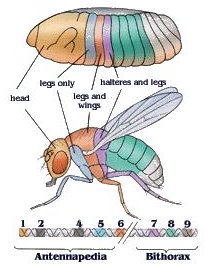
Perhaps the most famous of cases of stunning gene similarity among living things are the Hox genes . Essentially, Hox genes are genes responsible for laying down the basic body plan of an organism very early in its development; Hox genes, first found
in the fruit fly, establish what will be the front and back of an organism, and where structures such as limbs and eyes will develop; interestingly, the order of these genes on the chromosome perfectly correlates with the parts of the body that are influenced by particular genes. Not only are these genes found in virtually all organisms tested to date (including jellyfish), and not only are their sequences virtually identical in all organisms, but they are also found in the same order on the chromosomes of organisms studied. These genes are so identical that scientists have been able to take Hox genes from
one species and express them in another species; the genes function perfectly. For example, the gene governing limb development in chicks, called Sonic hedgehog, can be expressed in a shark and govern the perfect development of a shark fin.
One last piece of gene-scale evolution evidence can be found in what some scientists call vestigial genes. Just as vestigial structures are structures that at one time had a function for an organism but now essentially serve no purpose, vestigial genes are genes that were once expressed in an organism to make a protein product, but now are silent. Two classic examples are the gene responsible for Vitamin C synthesis (found but completely nonfunctional in the human genome and in higher primates) and odorant receptor genes, used in olfaction. The human genome contains around 100 odorant receptor genes, of which roughly 70% are completely nonfunctional; indeed, humans, and primates in general, are less dependent on their sense of smell than many other organisms. Dolphins contain numerous odorant receptor genes, with not even one being functional; dolphins, in other words, have given up their sense of smell. Again, there would be no reason to have genes without any function whatsoever unless they were passed along through common descent.
References
The Shape of Life: Genes, Development, and the Evolution of Animal Form (Raff, 1996)
Evolution (Mark Ridley, Ed., 1997)
From DNA to Diversity: Molecular Genetics and the Evolution of Animal Design (Carroll et al., 2001)
Asking About Life (Tobin and Dushek, 2005)
Biology: A Guide to the Natural World (Krogh, 2005)
The Chimpanzee Sequencing and Analysis Consortium. “Initial sequence of the chimpanzee genome and comparison with the human genome.” Nature, 2005.
Your Inner Fish (Shubin, 2009)
https://www.talkorigins.org/faqs/comdesc/section1.html
Images courtesy of Wikipedia
This post is part of the series: The Genetic Evidence for Evolution
In this two-part series we’ll be looking at how molecular biology, from DNA sequences to population genetics, supports the theory of evolution.