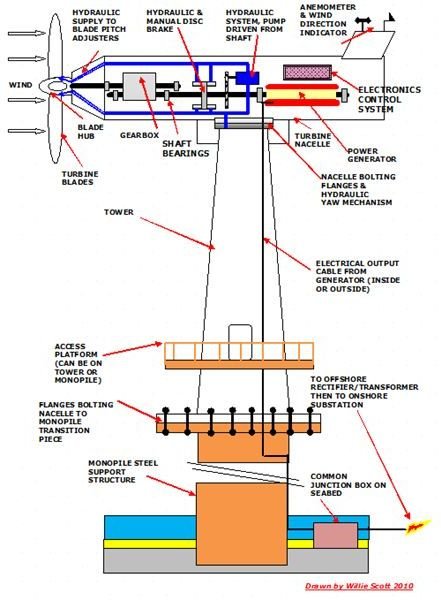
The wind turbine blades are fixed to the hub from where a shaft drives the generator through a gearbox. These are housed in the nacelle along with a control panel fed by instruments on the tail fin. The blade pitch and yaw are hydraulically operated and automatically controlled by the control panel
Introduction to Offshore Wind Turbines
Offshore wind turbines can be of a much larger output and overall size (so large in fact that some have a helicopter landing area on the top of the nacelle) than their onshore counterparts; this is because of the strong winds which are prevalent offshore. These enable the large turbines to operate at optimum efficiency exporting the power ashore through subsea cables. The wind turbine consists of a set of three blades which are attached to the blade hub on the nose cone. The hub is attached to a high tensile shaft which drives a gearbox and generator located in a weatherproof nacelle.
The nacelle contains the other components, namely the hydraulic system and the electronic automatic control unit. The control unit manages the pitch and yaw facilities. The control unit is supplied with data from instruments mounted on the tail fin attached to the rear of the nacelle.
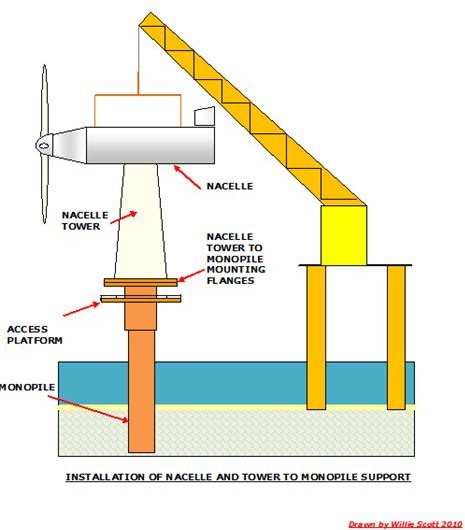
Once the project has been approved, the subsea cables are laid on the seabed to transmit the electricity ashore. The support structure is then installed and the turbine nacelle, including the hub and blades are then fitted to the support and the turbine commissioned.
Offshore wind farms are becoming more popular as the output of the turbine increases, the largest in UK waters being 5MW.
This is another article in the series of wind turbines in the renewable energy section, and should be read in conjunction with my previous article on the installation of offshore wind turbine supports to give the fuller outline of the offshore wind farms.
We shall begin with a description of the wind turbine components and their function…..
Offshore Wind Turbine Components
The Turbine Rotor Blades
There are normally three fiberglass reinforced polyester rotor blades, (sometimes having lightening conductors incorporated) up to 70m long that are connected to the central hub, extracting the kinetic energy from the wind.
The hub contains the electro-hydraulic motors used to change the angle of the blade to the wind, known as the pitch which can alter the blade rotation. The blades rotate slowly, usually between 8 and 15 revs/min in wind speeds of between 4 and 27 m/s.
The Nacelle
This contains all the components essential to the efficient operation of the turbine. It is fitted at the top of the tower and maintains the blades facing the wind by an electric/hydraulic yaw unit above its connection to the tower, operated by the electronic controller.
On the nacelle tail is fixed the wind speed anemometer and a wind vane to give the direction of the wind and sometimes a lightning conductor. The speed and direction of the wind data is fed to the electronic controller which adjusts the blade pitch and yaw accordingly.
The nacelle has a maintenance and inspection access hatch from vertical ladders or a lift inside the tower.
A helipad can also be fitted to the top surface of the nacelle.
.
Turbine Drive Shafts and Disc Brake
These are hollow or solid steel hardened shafts which are under very high stresses and considerable torque. There are normally two shafts: the gearbox input drive shaft from the blade hub and the gearbox output shaft which drives the power generator.
The gearbox output shaft also drives the hydraulic system and incorporates a hydraulic and manual disc brake system which is used during turbine maintenance.
Turbine Gearbox
The gearbox is used to increase the revolutions from the main drive shaft to the power generator drive shaft. Depending on the type of generator and the number of poles used, an input speed of 15 revs/min can be increased to 1500 revs/min.
Wind turbine drive mechanisms can also have a direct drive system which uses variable blade pitch, thus avoiding the use of the gearbox and giving a quieter and more efficient operating system.
The Turbine Power Generator
Nominal generator output for offshore wind–farm turbines is continuously increasing as it is more economical to use a high output generator. Usual generator capacity nowadays ranges between 3 and 5 MW. A recent installation to the Beatrice oil field in the North Sea has two 5MW capacity turbines providing power to the field offshore installations making these turbines the largest in UK waters.
The length of the turbine blades along with the cube of the wind speed determines the output of the power generator. Most of these are producing AC power instead of the previous DC. This DC power was suitable for battery charging systems, but had to be rectified to AC before supplying the grid.
Wind electrical power generators are of the doubly-fed induction asynchronous type which are usually employed in turbines of over 1MW capacity and improve the efficiency of the system.
The power produced by the offshore wind farms is fed ashore by subsea cables.
Wind power is not a constant supply therefore it is used as back-up to the existing fossil fuelled, hydro and nuclear power stations outputs.
The next section deals with the subsea power cables, offshore transformers and the Environmental Impact Statement as well as sketches showing the turbine components and installation of the turbine to the offshore sub-sea support.
Transformers and Output Cabling
The transformer is installed offshore on a concrete base fixed to the seabed. Once the transformer is installed the subsea cables, which are armor plated and about 100 mm diameter, are connected. These run from the generator down the tower and monopile into the wind farm junction box on to the transformer and from there to the landfall and into a substation on the coast. The cables are buried about a meter deep in the seabed sediment using a water-jetting Remotely Operated Vehicle (ROV).
UK Offshore Wind Farms Output
With the announcement last month (January 2010) by the UK government that the round 3 offshore wind farm area allocations have all been taken up means that there will be in excess of 32GW of renewable energy generated by offshore wind turbines hopefully by the end of 2012.
Wind turbines for offshore use range between 1.5 MW and 5 MW with the largest UK offshore one being 5 MW operating in the North Sea and the world’s largest being 6 MW operating at Elhoft, Germany.
Safety and Emergency Systems on the Turbines
The wind strength on most of the offshore locations sites can reach gale force so to prevent damage to the wind turbine components a centrifugal speed governor is installed, usually in the hub. This alters the pitch of the blades hydraulically and controls the rotor speed by feathering the blades which in turn slows or stops the blades rotation.
This method of stopping the blade rotation in conjunction with the operation of the hydraulic disc brake on the turbine driveshaft is used when maintenance or inspection is being carried out. A permit to work system is also raised, this being similar to the oil and gas offshore maintenance permit system.
Long-life food supplies are stored in the tower for use if personnel are stranded due to adverse weather conditions and recently a helipad has been fixed to the top of the nacelle for emergency evacuation.
Access to the wind farm area is restricted to all public yachts and pleasure craft.
Environmental Impact Statement
This will contain the following information,
- Impact of the windfarm - on birds, marine fauna, fishing industry, ships navigation, and overflying aircraft
- An estimate of the windfarm power output - including the number of turbines and their overall dimensions
- The area taken up by the windfarm - must be within the government allocated areas
- subsea cabling - size and number of subsea cables, location of transformers and landfall location
- An installation method statement - type of support tower used, method of installation
- Duration of installation and commissioning – projected start and finish dates
- Full list of subcontractors - all subcontracting companies with number and trades of employees.
Sketches of wind turbine and installation method
This post is part of the series: Installation and Operation of Offshore Wind Turbines
The wind turbines used in offshore windfarms can be of a much greater capacity (3 – 5 MW) than their onshore counterparts. This is due to the supply of a more regular, higher wind speeds which are prevalent offshore, remember the power output of the turbine is the cube of the wind speed.