The Mir space station was the first successful orbiting space station after NASA’s Skylab. For its 15 years in orbit it served as a research platform for Russia and many other countries that sent astronauts and cosmonauts to stay on board. Get some facts and history on the Mir space station.
Mir Space Station
The International Space Station , which is a joint venture of USA, Russia, ESA (European Space Agency), Japan, Canada, Brazil and Italy, is expected to be fully operational by the end of 2011. It will be the most sophisticated orbiting space laboratory. But the contributions which its predecessor, the Russian space station Mir made for its success is immense. Mir was not the first; it was Salyut 1, launched on April 19, 1971 which laid the foundation for the later space stations.
Nothing But Facts on the Mir Space Station
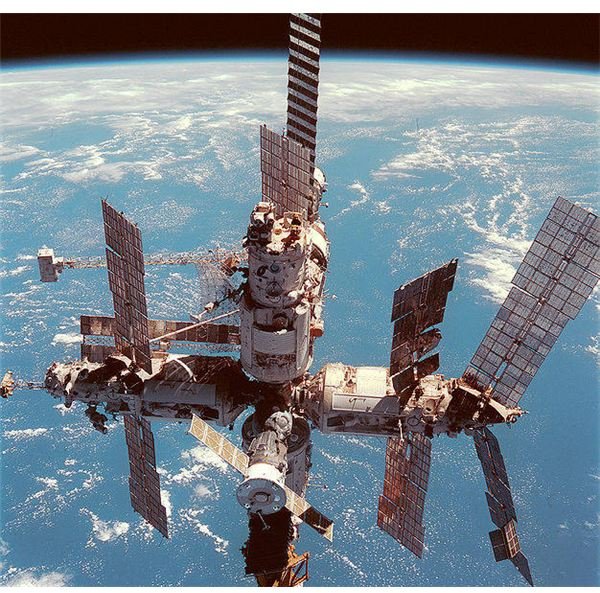
Launch date: February 20, 1986
Date of completion: April 26, 1996
Mass of Mir: 130,000-140,000 kg
Orbit: 362 km or 225 miles above Earth
Velocity: 28,163 km/hr or 17,499 miles / hr
Modules of Mir: Mir core, Kvant, Kvant 2, Kristall, Spektr, Priroda and Docking modules
Last scientific module added: Priroda
Re-entry: March 23, 2001
First crew: Leonid Kizim and Vladimir Solovyov
The person who spent the longest time the station: Dr. Valeri Polyakov (from January 1994 to March 21, 1995)
Total number of cosmonauts/astronauts who stayed in Mir: 105
Cargo vehicles (man and materials): Soyuz TM and Progress M
Structure of Mir
Mir core:
-
Launch date: February 20, 1986
Advertisement -
Size: 13 m long and 4 m in diameter (42.65 ft x 13.12 ft)
-
Weight: 20.9 tonnes (46,076 pounds)
Advertisement -
Launching vehicle: Proton
 Advertisement
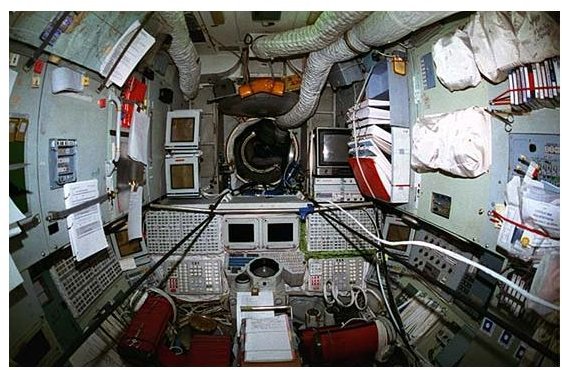
Function: It was the first module launched and acted as the living quarters for the astronauts. It contained a control unit which monitored and commanded the operation of the station. It had six ports; one port each in the front and back for docking and four radial ports in the front for berthing large modules
Kvant 1:
-
Launched on: 31 March, 1987
-
Docked on: 9 April, 1987 (rear docking port)
Advertisement -
Size: 5.8 m long and 4.15 m in diameter (19.02 ft x 13.61 ft)
-
Weight: 11 tonnes (24,250 pounds)**_
Advertisement
_**
Function: It was used to study astronomical structures like active galaxies, neutron stars, other cosmic bodies and also for Bio-technological research.
Kvant 2:
-
Launched on: 26 November,1989
-
Docked on: 2 December,1989
-
Size: 12.2 m long and 4.35 m in diameter (40.02 ft x 14.27 ft)
-
Weight: 18.5 tonnes (40,785 pounds)_**
**_
Function: It was home for the Extra Vehicular Activity (EVA) airlock, solar arrays and was also used for biological research.
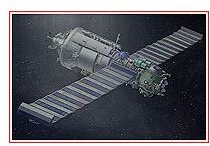
Kristall
-
Launched on: 31 May,1990
-
Docked on: 10 June, 1990
-
Size: 11.9 m long and 4.35 m in diameter ( 39.04 ft x 14.27 ft)
-
Weight: 19.6 tonnes (43,210 pounds)**_
_**
Function: Contained solar panels and acted as a Buran docking port.
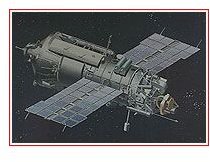
Spektr
-
Launched on: 20 May, 1995
-
Docked on: 1 June, 1995
-
Size: 9.1m long and 4.35 m in diameter( 29.85 ft x 14.27 ft)
-
Weight: 19.6 tonnes (43,210 pounds)**_
_**
Function: It was used for observing the Earth, mainly the natural resources and atmosphere.
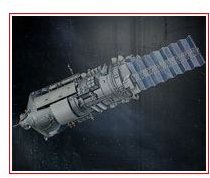
Priroda
-
Launched on: 23 April, 1996
-
Docked on: 26 April, 1996
-
Weight: 19.7 tonnes (43,431 pounds)**_
_**
Function: Its main function was Earth remote sensing. It studied ecological problems, ozone concentration and temperature of seas and clouds.
Conclusion
Mir provided the scientific community with invaluable service before it crashed into the Pacific Ocean. Thus an era of Russian space orbiting laboratories, which began with the launching of Salyut 1, came to an end.
Sources:
https://www.esa.int/esaCP/ESA28WTM5JC _Life_0.html
https://spaceflight.nasa.gov/spacenews/factsheets/pdfs/russian.pdf
https://www.russianspaceweb.com/mir.html
Images:
https://history.nasa.gov/SP-4225/sts86/photo/sts-86-photo-65.htm
https://www.russianspaceweb.com/mir _priroda.html
https://www.russianspaceweb.com/mir _spektr.html
https://www.russianspaceweb.com/mir _kristall.html
https://www.russianspaceweb.com/mir _kvant-2.html
https://www.russianspaceweb.com/mir _kvant.html