The rarefied field of the classification of astronomical bodies made international headlines in 2006, when Pluto was demoted from its position as one of the planets. Less well publicized was the simultaneous creation of an entirely new group of objects, the “small Solar System bodies” (SSSBs).
Redefining a Planet
By the early 2000s, the classification of Solar System bodies was becoming ever more complicated, as new probes and more powerful telescopes discovered increasing numbers of objects that did not fit neatly into the old categories. It was the discovery of Eris, an object beyond the orbit of Neptune that is larger than Pluto, that finally prompted the International Astronomical Union (IAU) to convene a meeting to resolve the confusion. The resulting redefinition of the term “planet” removed Pluto from the ranks of the “big boys” of the Solar System, and gave a new name to the multitude of small bodies that orbit the Sun.
Smaller Members of Our Solar System
When asking the question “What are small bodies in space?”, it might be easier to ask “What are they not?” According to the 2006 IAU definition, an SSSB is any object orbiting the Sun that is too small to be a planet or a dwarf planet.
The IAU defined a planet as an object that:
- orbits the Sun
- is massive enough that its internal pressure is balanced by the strength of its gravitational field (causing it to be approximately spherical)
- has no large bodies in its orbit other than its own satellites.
A dwarf planet such as Pluto satisfies only the first two criteria, while SSSBs meet only the first. This definition of an SSSB embraces:
- asteroids
- comets
- trans-Neptunian objects
- meteoroids .
Trans-Neptunian objects are bodies lying beyond the orbit of Neptune, with the exception of Eris, Pluto, Makemake and Haumea, which are now designated dwarf planets. Although an asteroid, Ceres is also a dwarf planet and so is not an SSSB. Meteoroids are objects between the size of a grain of sand and a large boulder; those that enter the Earth’s atmosphere become meteorites if they reach the surface, or meteors if they do not. So-called micrometeoroids are components of the interplanetary dust. It is currently unclear whether a lower size limit for SSSBs will be set in the future.
Peanuts, Croissants and Piles of Rubble – Images of SSSBs
By definition, SSSBs are too small to be spherical. As a consequence, the group includes some of the oddest-looking objects in the Solar System.
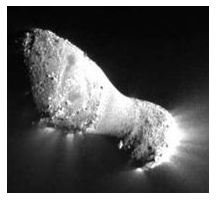
Comet Hartley 2 was famously photographed by NASA’s Deep Impact probe in November 2010, revealing a peanut-shaped object that has been described as “a cross between a bowling pin and a pickle.”
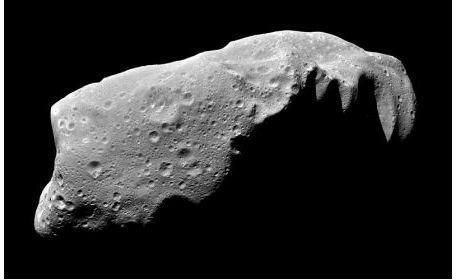
The Galileo probe imaged the asteroid 243 Ida in 1993, during its journey to Jupiter – the first time a flyby of an asteroid had been attempted. Resembling a croissant, 243 Ida is thought to comprise two solid bodies joined by a bridge of loose material. Due to this unusual shape, Ida’s gravity is lower in the middle than at either end. If an astronaut were able to walk from one end of the asteroid to the other, he or she would first lose weight, then gain it again.
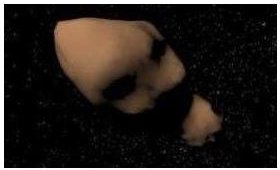
Another strangely shaped asteroid is 4179 Toutatis, which caused a stir in 2004 when a close pass by Earth raised concerns that it might one day collide with our planet. Toutatis has been described as a “rubble pile” due to its appearance, which suggests that, like 243 Ida, it was formed by the coalescence of smaller bodies.
Small But Not Insignificant
The SSSBs are diverse in both nature and size, with members ranging from little more than specks of dust to the giant asteroids Vesta and Pallas, which were thought to be planets when they were discovered in the 19th century. Despite the IAU definition, the SSSBs are far from merely a repository for objects that do not belong elsewhere. And as the 4179 Toutatis scare shows, these small bodies are worth paying attention to, for they include the near-Earth objects – those asteroids, comets and meteoroids that might one day pose a threat to all life on our planet.
Image Credits
Comet Hartley 2: NASA/JPL-Caltech/UMD, https://commons.wikimedia.org/wiki/File:495296main _epoxi-1-full_full.jpg
243 Ida: NASA/JPL, https://commons.wikimedia.org/wiki/File:243 _Ida_large.jpg
4179 Toutatis. NASA, https://commons.wikimedia.org/wiki/File:4179 _Toutatis.jpg
References
“Pluto and the Developing Landscape of Our Solar System” https://www.iau.org/public/pluto/ (Accessed 07-09-11)
“Small Bodies of the Solar System” https://science.nasa.gov/planetary-science/focus-areas/small-bodies-of-the-solar-system/ (Accessed 07-09-11)
“Small Bodies: Profile” https://pds.jpl.nasa.gov/planets/special/smbod.htm (Accessed 07-09-11)
“Small Solar-System Bodies” https://nineplanets.org/smallbodies.html (Accessed 07-09-11)
“Space Radar Provides a Taste of Comet Hartley 2” https://www.nasa.gov/mission _pages/epoxi/epoxi20101028.html (Accessed 07-09-11)


