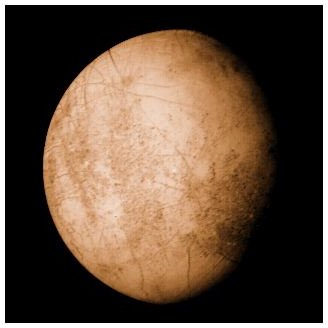
Just what you wanted to know about one of the most intriguing and shy places of our solar system: Europa, one of Jupiter’s largest moons, but the smallest of the Galileans (Europa, Io, Callisto, and Ganymede).
Europa
The Facts
-
Year discovered: 1610
-
Discovered by: Galileo Galilei
Advertisement -
Position among Jupiter’s moons: 6th satellite from the planet
-
Size among Galilean moons: Smallest
Advertisement -
Average distance to Jupiter: 670,900 km, 416,877 miles
-
Rotation: synchronous with Jupiter (9hr 50m 30s)
Advertisement -
Orbital period: 3days 13hr 13m 26.4s (3.551181 Earth days)
-
Orbital Inclination to Jupiter’s equator: 0.470 degrees
Advertisement -
Eccentricity: 0.009
-
Diameter (equatorial): 3,138 km, 1,950 miles
Advertisement
-
Mass: 4.80×10²² kg, 10.5821x10²² lbs
-
Mean Density: 3,010 kg/m3, 187.908 lbs/ft3
Advertisement -
Gravity: 0.134g
-
Escape Velocity: 2.025 km/s, 1.258 miles/s
Advertisement -
Surface temperature (average): -171C, -276F, 102K
-
Surface pressure: 1 μPa, 10-11 bars, 9.8x10⁻¹² atm
Advertisement -
Atmospheric composition: Almost entirely molecular oxygen (O2)
-
Albedo: 0.67 +/- 0.03
Advertisement
What is really cool
-
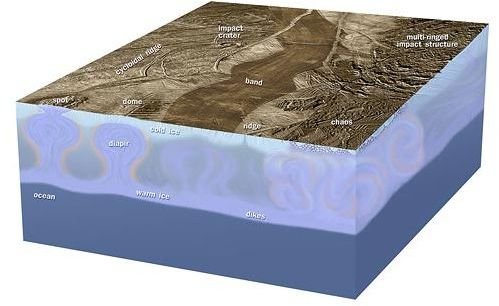
An ocean trapped under ice. Europa is covered by a water sheet estimated to be a hundred kilometers (62 miles) thick, the surface layer being frozen ice, the rest probably in liquid form.
Advertisement -
Smooth as baby skin. Europa’s most prominent surface features, its lineae (lines), are a result of brightness contrast in images, between adjacent surface areas. There are no large mountains or deep ridges, and only small craters since the surface of Europa is relatively new: Between 20 and 200 million years old.
-
Lots of oxygen, but no air to breathe. Europa’s atmosphere practically consists of nothing but oxygen. This means two things: it’s not breathable by human standards since Earth’s atmosphere is mainly nitrogen and only 22% oxygen, and it’s extremely thin. The oxygen is continuously produced from the ice surface, by way of radiolysis (radiation splits the water molecules into hydrogen and oxygen), but most of it escapes into space.
Advertisement -
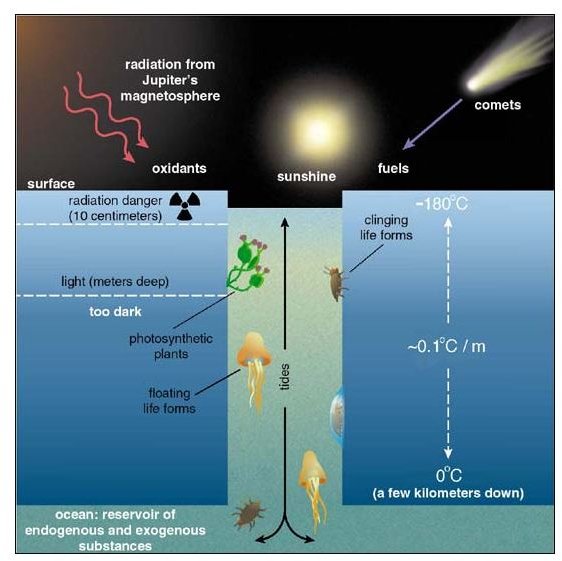
A possible harbor of life. If the hypothesis of the largest part of the water sheet being in liquid form is confirmed, then the volume of water will be twice as much as Earth’s oceans, and there could exist microbial life, in conditions similar to certain deep ocean areas where energy from hydrothermal vents provides organisms with energy, instead of the sun. As far we know, this is the most realistic probability for life in our solar system. A must read on the subject is Richard Greenberg’s, Unmasking Europa - The Search For Life On Jupiter’s Ocean Moon.
Credits
https://en.wikipedia.org/wiki/Europa _(moon)
Unmasking Europa - The Search For Life On Jupiter’s Ocean Moon, by Richard Greenberg (ISBN 978-0387479361)
This post is part of the series: Jupiter’s Moon, Europa, One of the Galilean Moons
Read the facts about the fourth largest Galilean moon of Jupiter, Europa. Mythological, physical, orbital and theoretical facts about Europa are available in this series.