Tick, tock, tick, tock…what in the world is an astronomical timepiece? Find out where these clocks originated, how they work, and where they can be found today.
First A Definition!
What is an astronomical clock? According to the Free Dictionary, this type of clock is a “complex clock showing astronomical phenomena, such as phases of the Moon.” (1) Let’s discuss some facts about these clocks including how they differ from conventional timepieces to understand their purpose and function better.
How do I Tell Time With This Clock?
These clocks provided more data than just the time of day; in fact, their key purpose was to provide scientific information about astronomy rather than the time. For instance, they measured solar time, sidereal time, or 24-hour analog time. They taught about eclipses, seasons, equinoxes, and lunar phases. If it was important to know the leap year cycles, or sunrise and sunset data, it was readily available from astronomical timepieces. However, did they tell time? These clocks did measure time, but in a different manner than other clocks; time was measured according to the position and movement of stars and planets.
What Type of Information Can I Get With This Clock?
In general, most of these clocks track some or all of the following:
- Time
- Position of the Sun
- Zodiac constellations
- Planting aspects
- Moon phases
- Hour lines
- Eclipse predictions
However, as with any timepiece, each individual clock may furnish other specialized data, depending on its intended purpose.
What’s Inside That Clock?
Most of these astronomical timepieces were mechanical clocks and included escapement mechanisms (a gear wheel and an anchor, typically a pendulum or pallet). Here is a list of the various clockwork components used:
- Oscillator – A pendulum repeating the same motion continuously with a timed interval between swings or “beats” was the most common oscillator.
- Controller device - Typically, this was gear wheels that kept the pendulum swinging.
- Counter chain – Wheel trains counted the pendulum swings, translated them in measurements of time, and provided power to the oscillator.
- Indicator display – In most early astronomical timepieces, this would have been bells, or audible sounds, versus a visual display.
- Power source – This was commonly a weight at the end of a pulley driven by gravity or a mainspring.
Most of these clocks contained an orrery, which is a “mechanical model of the solar system” (2) that displays planetary location and motion. An astrolabe for measuring altitude was another key component of these clocks.
Where Can I Find the Best Example of This Clock
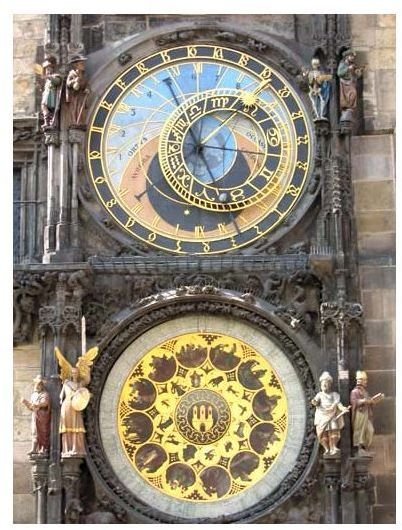
The most famous, and one of the oldest known examples of such a clock, is the Prague astronomical clock. Mikulas of Kadan and Jan Ondrejuv called Sindel built this clock, which dates to 1410. Amazingly, the clock’s mechanism functions as well today as it did in 1410.
An interesting fact to note, however, is that telling time with this clock is harder than interpreting some of its astronomical data. The reason for that, as mentioned earlier, is these clocks’ designs were crafted for providing scientific information rather than tracking the passage of time. The Prague clock’s internal clockwork is an escapement mechanism; the original clockwork has been functioning continuously for at least 600 years(3).
What are Some Other Famous Astrological Timepieces?
What are some other well-known astronomical timepieces? Let us take a trip through time and see.
- 1092 – Su Sung’s Cosmic Engine: As commissioned by Emperor Shen Tsung, Su Sung’s task was to build the “most perfect clock the world had ever seen.” (3)
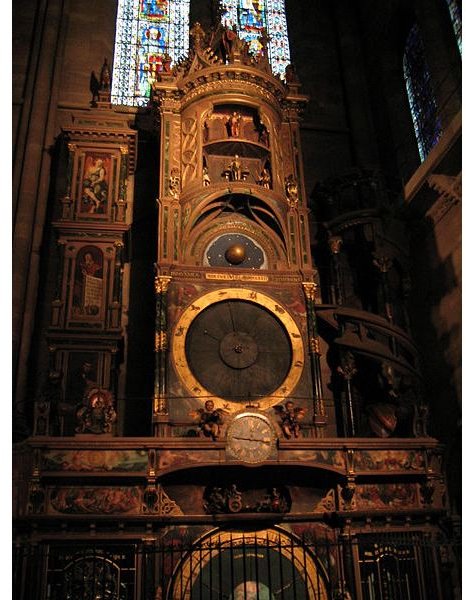
- 1352 – 1354: The first of three Strasbourg clocks was built in 1352-1354. A second clock was started in 1547, but not finished until 1571, and was in service until the 18th century. The current clock dates to approximately 1838 - 1842. The Strasbourg clock is one of the largest astronomical timepieces in the world.
Astronomical clocks date back centuries but still exist today as monuments to man’s ingenuity, mechanical engineering skills, and clock makers’ artisanship. By learning more about the history of these clocks, one is better able to appreciate their historical significance and purpose.
Reference Sources
1. Free Dictionary, https://www.thefreedictionary.com/astronomical+clock
2. Leitch, Alexander, “The Rittenhouse Orrery , The” Princeton University, https://etcweb.princeton.edu/CampusWWW/Companion/rittenhouse _orrery.html
3. J. Podolsky, “Prague Astronomical Clock ,” https://utf.mff.cuni.cz/Relativity/orloj.htm
Image Credits
Prague Astronomical Clock by Kallema under Public Domain
Strasbourg Astronomical Clock by wyzik under CCA 2.0