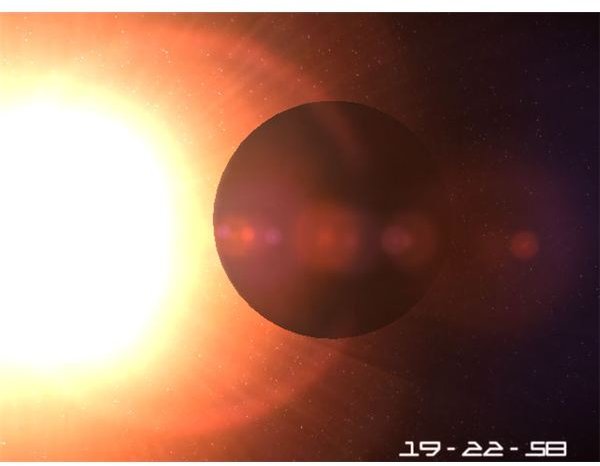
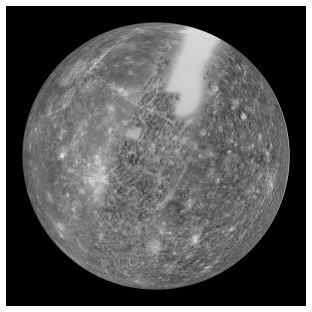
Many people wonder, “Why is the planet Mercury orange?” It’s temperature, magnetic field, and composition all point to a rocky gray planet. The reason for this has to do with its orbit around the Sun and how that orbit appears from Earth. It has to do with the composition of Earth’s atmosphere.
Introduction - Space in Colors
If you’re an amateur sky watcher, you may have asked yourself, “Why is the planet Mercury orange?” For that matter, you may have asked why the Sun appears yellow. The main reason the Sun appears yellow from Earth is due to atmospheric scattering. In other words, particles in the atmosphere are of such a size that they scatter light of shorter wavelengths, such as indigo, blue, and green. The yellow light radiated by the Sun, however, isn’t scattered as much, and so the yellow light makes it to surface while the shorter wavelengths are scattered. This is most apparent when the sun is high overhead.
The Sun and Mercury
But sunrise and sunset appear orange much of the time. Why is this the case, and how is it relevant to the main question: “Why is the planet Mercury orange?”
When the sun is low on the horizon, its rays must penetrate much more of Earth’s atmosphere to make it to our eyes. The more atmospheric particles the Sun’s radiation has to pass through, the more that shorter wavelengths are scattered. At sunset, indigo, blue, green, and yellow light is scattered by all the atmospheric particulates that they pass through on their way to our vantage point on Earth. However, the longer wavelengths, including orange and red, are not scattered much, and so they show through more strongly at sunrise and sunset, making the rising or setting sun appear orange.
Sunrise and Sunset
From a vantage point on Earth, the planet Mercury never appears to be very far from the Sun due to its orbit. Because of this, Mercury is only visible to the human eye when it is very low on the horizon: just before sunrise and just after sunset. It isn’t seen in fully dark skies. When Mercury is visible to the human eye, which only happens a few times in a year, it will be seen very low on the horizon, near the direction of the sunset or sunrise, depending on which time of day it is visible.
Merucry is not only Orange…
Because of its low altitude above the horizon, Mercury takes on a color that is interpreted variously as being reddish, pinkish, or orange. It appears so for the same reason that sunsets appear orange at sunrise and sunset: the sunlight it is reflecting must pass through a long section of the earth’s atmosphere before it reaches the eye, and the shorter wavelengths are scattered.
Summary
So, to sum up, why is the planet Mercury orange? It is because the Sun’s light reflected off Mercury must transverse quite a bit of atmosphere before reaching our eyes, and in that long slice of atmosphere that it must traverse, atmospheric particulates scatter the shorter wavelengths of indigo, blue, green, and yellow. Therefore Mercury appears orange or orange-red, depending on individual interpretations of where orange ends and red begins. Wavelengths longer than red (infrared rays) are not visible to the unaided human eye.
References
https://homepage.ntlworld.com/mjpowell/Astro/Naked-Eye-Planets/Naked-Eye-Planets.htm#Mercury
https://ww2010.atmos.uiuc.edu/(Gh)/guides/mtr/opt/air/sun.rxml
https://ww2010.atmos.uiuc.edu/(Gh)/guides/mtr/opt/air/sun.rxml
https://science.nasa.gov/science-news/science-at-nasa/2010/nasa-sunset-planet-alert /
https://www.planetary.org/news/2008/0703_MESSENGER_Scientists_Astonished_to.html