In the far reaches of the solar system, the dwarf planet Pluto is spinning in a mutual orbit around its biggest Moon. Charon is an interesting case in our solar system, and has characteristics that cannot be found anywhere else.
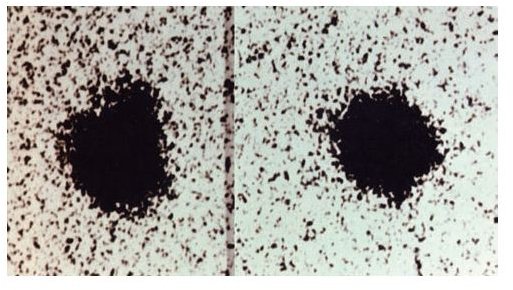
Charon is the biggest of Pluto’s three moons. It is about half the size of Pluto, meaning that they have a mutually synchronous orbit. It was discovered in 1978 at the US Naval Observatory by James Christy. In Greek mythology Charon is the ferryman that carries souls across the rivers Styx and Acheron, delivering them from the living world into Hades.
Just the Facts
Diameter: 1,186 km
Distance from Pluto: 19,600 km
Mass: 1.62x10²¹ kg
Volume: 902,700,000 km3
Surface Area: 4.58x10⁶ km2
Mean Density: 1.65 g/cm3
Surface Gravity: .278 m/s2
Temperature: -220 degrees C
Absolute Magnitude: 1
Rotation Period: 6.4 Earth days
Orbital Inclination: 96.16 degrees
Interesting Facts
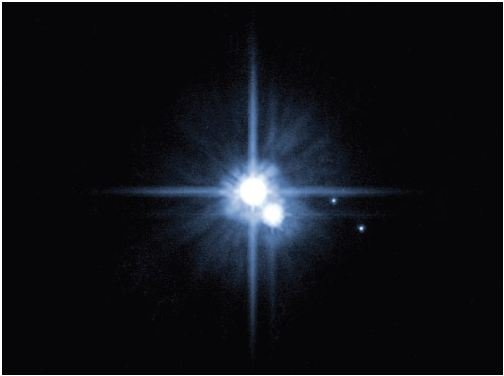
Charon itself appears to be covered in frozen water, differing from Pluto’s surface which is composed of frozen nitrogen, methane, and carbon dioxide. The most common theory is that Charon was formed from material that was blasted off of Pluto from a collision. This theory is similar to how scientists believe the Earth’s moon was formed. Much like the Earth’s moon, Charon keeps the same face pointed towards Pluto at all times, which is called “tidal locking”. However, Pluto is the only planet that always presents the same face to its moon. Charon neither rises or sets, but appears to hover over the same spot on Pluto’s surface. When it was initially discovered, Charon appeared as a slight bulge that would periodically show up on Pluto.
Luckily, a few decades after Charon was discovered, its existence was proven beyond a doubt when Pluto reached a new part of its orbit. There are only two parts of Pluto’s 248 year orbit where Charon can easily be observed with telescopes. In the late 1980s Pluto and Charon passed in front of each other repeatedly for several years, allowing astronomers to make maps of each body. Unfortunately, Charon is so far from the earth that detailed images of it are impossible with current technology.
Charon is one of three moons of Pluto, the other two being Nix and Hydra. In January 2006, Nasa launched its New Horizons

spacecraft to observe the Pluto and Charon system. It should arrive in 2015, becoming the first spacecraft to visit them. It is part of a NASA search to find additional moons of Pluto, and will incorporate ground-based telescopes and possibly even the Hubble Space Telescope.
Related Articles
Major Discoveries of the Space Age
Nothing But the Facts About Pluto
The Myth About the Tenth Planet
Sources
https://www.nasa.gov/pdf/62223main _Pluto.Lithograph.pdf
https://solarsystem.nasa.gov/planets/profile.cfm?Object=Plu _Charon
https://solarsystem.nasa.gov/planets/compchart.cfm?Object1=Plu _Charon&Object2=Pluto
https://felc.gdufs.edu.cn/jth/myth/Greek%20Online/new%20picture/charon.jpg