The same awful force that killed the dinosaurs might actually return to the Earth every few million years. A rogue star orbiting our Sun might be responsible for enormous amounts of death and destruction, and could be looming its ugly head once again.
Peculiar Paleontology
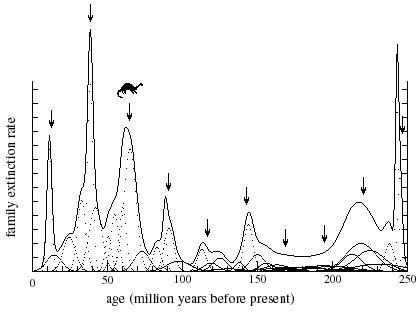
Sixty-five million years ago, at what is now the Yucatan Peninsula in Mexico, some Tyranosaurus might have looked up to see a flash of light across the sky. Seconds later it would be hit by a shockwave, knocking it over before it was vaporized by a wall of heat. The rock that smashed into the Earth left behind a crater 180 kilometers in diameter, and triggered drastic worldwide changes in weather that killed the dinosaurs. We’ve all heard about the mass extinction that wiped out the dinosaurs, but what might surprise most people is that extinction events are actually common. Examining the past 250 million years, paleontologists have found at least 8 periods where a large number of species has been wiped out.
Even more surprising is the fact that those extinctions occurred very regularly. Two paleontologists named David Raup and Jack Sepkoski wrote a paper in 1984 in the journal Nature showing that over a 250 million year period, extinction events were separated by roughly 26 million years. Almost as if there was some countdown every 26 million years before some catastrophic event devastated all life on Earth. Needless to say, our two scientists were puzzled. Luckily, astronomers also read Nature.
Astronomers to the Rescue!
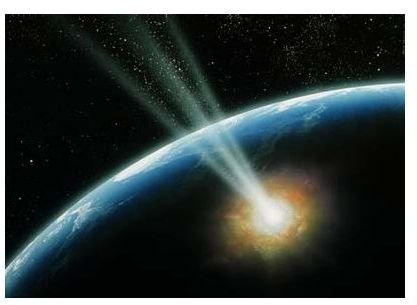
In the same journal, three astronomers wrote an article to hypothetically explain the remarkable regularity of extinction events on Earth. Our solar system might actually have two stars! Normally the inner solar system does not have very many asteroids or comets. Even when an object does hit the Earth, our thick atmosphere usually burns it up. Only very rarely do objects large enough to cause much damage make their way through the atmosphere.
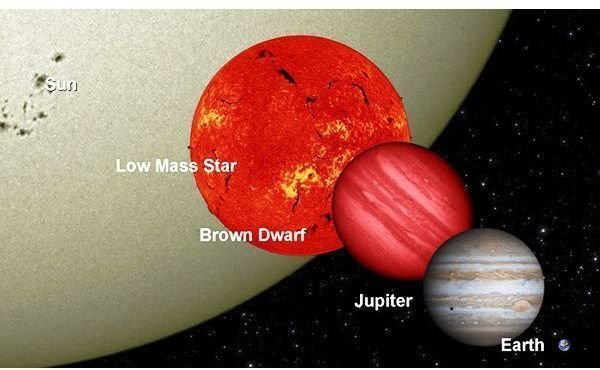
It is possible that a red dwarf star or a large brown dwarf could be orbiting the Sun in a highly eccentric orbit with a semi major axis of 1.5 light years. The fact that this star would be both extremely faint and very far away would make it indistinguishable from other stars in the sky. Out in the extreme reaches of the solar
system, this dwarf star would come close every 26 million years to the Oort Cloud. There is a roughly spherical shell of comets that orbits the Sun at about a light year’s distance. The gravitational effects of this star on the Oort Cloud would send comets careening off their normal orbits, sending a few into the inner solar system. If these comets can sneak their way past Jupiter’s guard, they could find themselves smashing into the Earth, killing whatever life that happens to be there.
One of the coolest parts of astronomy is, of course, the names. The astronomers who hypothesized this star live up to the standard. Keeping with the mythology theme, they named it for the Greek god Nemesis. She is the spirit of divine retribution against those who succumb to hubris, and personifies vengeful fate. She strikes down those who have become too confident in themselves, ruining people with too much good fortune. The data shows that we’ve had 2 extinctions in the past 50 million years, so we’re probably safe for now. But we won’t be able to hold off Nemesis’ wrath forever.
Sources
https://muller.lbl.gov/pages/lbl-nem.htm
https://static.howstuffworks.com/gif/extinction-2.jpg
https://disinfo.s3.amazonaws.com/wp-content/uploads/2010/03/StarSizes.jpg