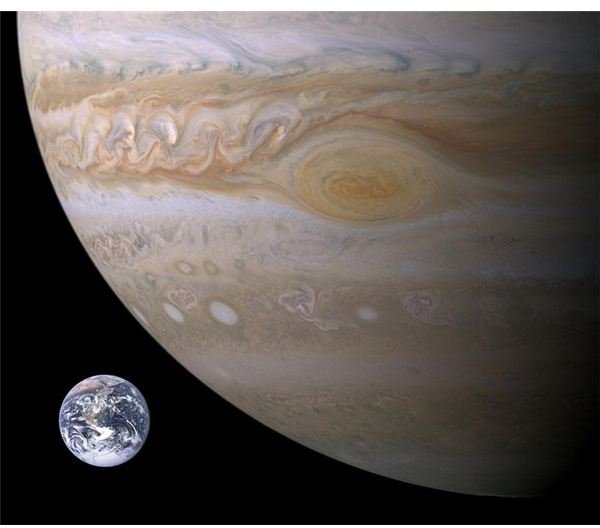
Among the many amazing features of the planet Jupiter is its rate of rotation and the effects it produces. One of those effects is the hurricane-like storm we call the Great Red Spot.
Jupiter - Great and Massive
Jupiter, by virtue of its huge size is one of the Jovian Planets, having a mass 318 times that of Earth, while possessing a volume more than 1320 times as great. Jupiter has an abundance of hydrogen and helium (86 percent and 14 percent of its atmosphere, respectively). Interestingly, despite its large size, Jupiter is the fastest-rotating planet in our solar system, a complete rotation requiring just less than ten hours. This surprising rate of rotation produces some interesting phenomena.
Forces and Rate of Rotation
Gravity pulls matter toward its center. Rotation counters that force, most notably at a planet’s equator. Because of its high rate of rotation, Jupiter is notably an “oblate spheroid” - a flattened sphere.
Not all regions of Jupiter rotate at the same rate. It rotates slightly faster at its equator than it does at the poles. At its equator, Jupiter rotates in 9 hours and 50 minutes, whereas as the poles it rotates once in 9 hours and 56 minutes. One could conclude that the day is longer at the poles than at the equator.
Measurements of Jupiter’s Rotation
How are these rotation rates measured? They are derived from radio waves picked up by radio telescopes. These radio waves are under the influence of Jupiter’s magnetic field, which originates at its core. Hence, measurement is not dependent on an artificial external probing, but on a property inherent to Jupiter itself.
Deductions
A question arises concerning energy effects of Jupiter’s rapid rotation. Since it does rotate so rapidly, and different parts at different rates, friction should generate considerable heat. Friction should also slow rotation over time, and the heat generated should add to atmospheric turbulence. In fact, the turbulence of Jupiter’s atmosphere may be at least partly responsible for some of the most interesting visible features of the massive planet.
Heat should produce convection cells. The Great Red Spot may be the most outstanding demonstration of this. In fact, the Great Red Spot appears to be a storm, resulting from constant atmospheric winds of almost 300 miles per hour, due to the planet’s rapid rotation. In fact, lightning bolts have been seen in Jupiter’s atmosphere.
Why hasn’t the Great Red Spot disappeared? One cited reference suggests that, even as a notable topographical feature on Earth may effect the outcome of an earthly storm, a similar feature Jovian topographical feature may prevent the Great Red Spot from disappearing.
Jupiter’s small angle of inclination (about 3 degrees) imparts seasonal stability to Jupiter. This stabilization limits some of the changes that might otherwise be experienced by Jupiter’s atmosphere.
References and Resources
1. World Book at NASA - Jupiter https://www.nasa.gov/worldbook/jupiter _worldbook.html
2. Rotation of Jupiter, Saturn, and the Earth https://mb-soft.com/public/planetro.html
3. YouTube - Jupiter: the Largest (Planet) https://www.youtube.com/user/SpaceRip#p/search/10/s56pxa9lpvo
4. National Geographic - Lightning Strikes, Changing Climate Revealed on Jupiter https://news.nationalgeographic.com/news/2007/10/071009-jupiter-lightning.html


