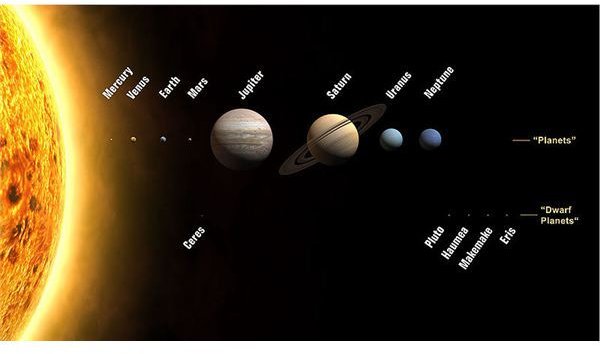
The celestial bodies in our Solar System are divided into different sections: the inner planets of Mercury, Venus, Earth and Mars separated by the asteroid belt from the outer planets of Jupiter, Saturn, Uranus and Neptune. Each celestial body is made of a different type of material: rock, gas or ice.
The celestial bodies in our Solar System are divided into two regions, based on the structure and size of the planets. The first region of the Solar System is commonly referred to as the inner planetary area, containing the first four planets, which are rocky worlds. This is set apart from the outer planets by the asteroid belt . The outer planets are the four gas giants. Surrounding the entire system is the Kuiper belt , a collection of icy bodies beyond Neptune.
Above right: Planets. (Supplied by NASA; Public Domain; https://upload.wikimedia.org/wikipedia/commons/c/c4/Planets2008.jpg)
Types of Celestial Bodies
According to the accepted modern theory, the objects in the Solar System are segmented into three distinct classifications: planets, dwarf planets and other small bodies. Each of these are defined by the International Astronomical Union.
In order for a body to be classified as a planet, it must maintain three specific criteria. First, it must be in orbit around the Sun. Second, it must contain enough mass to have formed into a spherical shape. A planet must also have cleared its orbital neighborhood of all other objects, with the exception of moons and orbital rings. By this definition, the Solar System only possesses eight known planets: Mercury, Venus, Earth, Mars, Jupiter, Saturn, Uranus and Neptune.
When Pluto was redacted from the planetary list due to its small size and highly eccentric orbit , it created an uproar within the scientific community. Now designated a dwarf planet or plutoid, Pluto is joined by other objects that fit the criteria of maintaining orbit around the Sun and being large enough to be spherical. The major ones include Ceres, Haumea, Makemake, Eris, Sedna, Orcus and Quaoar. Even so, the California Institute of Technology estimates there are thousands more.
Any other object in orbit around the Sun is simply a small celestial body. These include asteroids, meteors and satellites.
Composition of Celestial Bodies
Celestial bodies in our Solar System are composed of three classes of material: ice, gas and rock. The inner part of the Solar System is principally rock material, usually remaining solid no matter the environmental conditions caused by the Sun. Still, there are limited instances of both ice and gas within this region. The giant planets of the outer solar system are mostly gas, made primarily of hydrogen, helium and neon. Jupiter and Saturn are the most extensive examples of gas bodies. The outer edge of the Solar System is mostly composed of ice. Uranus and Neptune are generally considered ice planets, although there is believed to be occasional gas activity. The Kuiper belt is believed to be pretty much completely ice.
There are numerous features for the celestial bodies in our Solar System which define the way we look at their structure and formation. According to astronomers and space scientists, it is likely that any other planetary system capable of supporting life will have a relatively similar structure. This gives us a platform for which to standardize our search for life outside our planet.
Resources
“Solar System Exploration” NASA: https://solarsystem.jpl.nasa.gov/planets/index.cfm
Extreme Science: https://www.extremescience.com/zoom/index.php/space/35-space-science/113-solar-system